










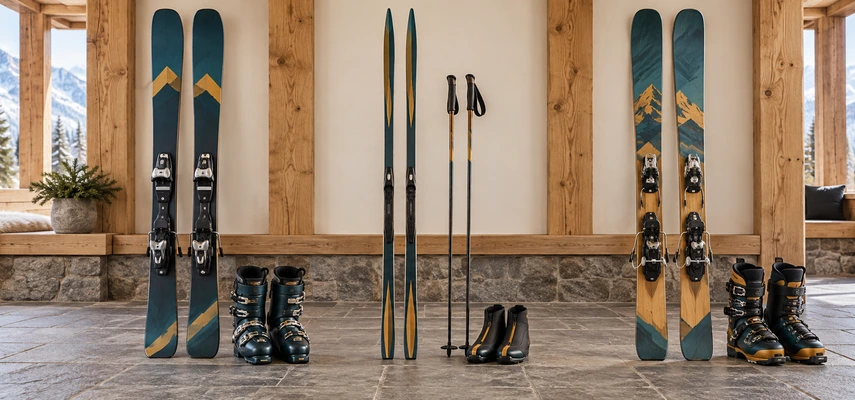

Ask three people about their skiing weekend and you might hear about riding a chairlift, gliding through quiet woodland, or climbing a mountain before descending it. All three went skiing. They may have shared remarkably little equipment, terrain, or ambition.
The names can make this confusing. Some describe how the skier moves. Others describe the landscape, the equipment, or a competition. A person can be skiing alpine-style equipment, outside a resort, in fresh powder, without competing in anything at all. Those labels can coexist.
The easiest way through is to ask a few practical questions. Is the heel held down or free to lift? Where does the uphill movement come from? Is the aim a descent, a journey, a performance, or a race? Once you know those answers, the vocabulary becomes much friendlier.
Alpine skiing: the familiar downhill picture
Alpine skiing is the version most people imagine when someone mentions a ski vacation. The skier descends a slope with boots secured at both the toe and heel. At a resort, lifts usually provide the uphill transportation.
That equipment gives the skier a direct connection to the skis for steering, edging, and managing pressure. Recreational alpine skiing ranges from gentle learning slopes to demanding terrain. It doesn’t mean racing, and it doesn’t require a particular taste for speed.
An alpine race uses that descending skill within a defined competition. Slalom emphasizes closely spaced turns; downhill uses a different course and speed emphasis. Those are disciplines within competitive alpine skiing, rather than separate answers to what someone should learn on their first morning.
A beginner seeking a conventional lift-served lesson will generally be booking an alpine lesson. Check that explicitly if a destination also offers Nordic skiing: the rental gear and meeting place may be completely different.
Cross-country: you provide the travel
Cross-country skiing puts forward movement at the center of the experience. Instead of repeatedly taking a lift uphill and descending, you propel yourself along trails that can include level ground, climbs, and descents.
The heel lifts, and the equipment is designed for the chosen technique and setting. That freedom helps the skier stride or skate. It also means a cross-country boot and binding behave differently from the rigid alpine setup a resort skier may expect.
U.S. Ski & Snowboard distinguishes classic and skate techniques. In classic skiing, a striding action often follows prepared parallel tracks. Skate skiing uses outward pushes from angled skis and generally needs a broad, firm prepared lane. Both involve timing, balance, and efficient use of the poles.
The Cross Country Ski Areas Association treats choosing between them as a useful first decision. Classic can offer a familiar walking-like introduction, but competent skiing still takes instruction. Skate isn’t simply classic skiing performed faster, and the equipment isn’t automatically interchangeable.
Nordic is a family name, with context
In everyday resort conversation, Nordic skiing often means cross-country skiing. In sport, the term can encompass a wider family that includes ski jumping and Nordic combined. Context matters more than insisting that every use means exactly the same thing.
Nordic combined brings ski jumping and cross-country racing together in one discipline. Biathlon combines cross-country skiing and rifle shooting, governed internationally by its own federation. You can enjoy an ordinary Nordic trail without encountering either a jump tower or a shooting range.
This is a useful example of why competition names shouldn’t dictate a beginner’s mental picture. Cross-country skiing can be a quiet recreational outing. The existence of demanding elite events doesn’t make the local learning loop an elite sporting venue.
When booking, ask whether the offered lesson is classic, skate, or another specific activity. “Nordic experience” may sound attractively broad, but the boots still need to fit an actual binding.
Telemark: a free heel and a distinctive turn
Telemark skiing is associated with a free-heel binding and a turn in which one ski leads the other as the skier lowers into a staggered stance. The trailing heel can rise, and the skier coordinates support through both legs. PSIA-AASI describes the discipline as alpine free-heel skiing.
It can look like a moving lunge, although the comparison captures the outline better than the entire technique. The movement involves edging, steering, balance, and pressure, not merely bending one knee dramatically.
Telemark doesn’t automatically mean wilderness travel. Skiers can use lifts and ski resort runs on telemark equipment. Conversely, having a free heel doesn’t turn every cross-country stride into telemark skiing. The equipment and movement patterns serve different purposes.
For a newcomer attracted by that flowing turn, seek a telemark-specific instructor and suitable rentals. An ordinary alpine rental package and a generic downhill lesson won’t necessarily deliver the equipment or instruction you’re expecting.
Touring: earning the climb as well as the descent
Ski touring describes travel in which the skier moves uphill under their own power and then descends. Alpine touring equipment allows heel movement for climbing and secures the heel for the descent. Telemark equipment can also be used for touring.
Removable climbing skins attach beneath the skis to provide traction during the ascent. They’re a specialized tool, not a coating that makes any ski suitable for every uphill route. Equipment compatibility, transitions, clothing management, and route selection all become part of the task.
Some resorts permit uphill travel on designated routes and at specified times. Others restrict it. An open ski area isn’t blanket permission to walk up a descending trail. Check the operator’s current rules before making plans.
Touring can also take place in backcountry terrain, where the challenges extend well beyond ascending efficiently. Parks Canada’s touring guidance emphasizes mountain hazards and preparation. Fitness and good downhill turns don’t replace avalanche education, navigation, rescue skills, and appropriate partners.
Backcountry and off-piste describe where you are
Backcountry skiing concerns the setting and its management, rather than a single turn or binding type. A skier may reach it by climbing, by other transport, or through a resort access point. Proximity to a lift doesn’t make the terrain patrolled or avalanche-controlled.
Off-piste literally points away from the prepared piste, but its practical meaning varies by place. It should never be read as a guarantee about control work, patrol coverage, or rescue. Check the local boundaries and rules, and ask qualified staff what a designation actually means.
Closed terrain is different again. A gate, rope, or closure isn’t an invitation to apply your preferred definition of adventurous skiing. Respect closures and stay out.
The distinction can prevent a serious misunderstanding: a skier can have the technical skill for a particular slope while lacking the knowledge to judge its snowpack or consequences. The Avalanche.org education pathway explains the need for forecasts, equipment, and training. A vocabulary article is only an introduction to that responsibility.
Freestyle and freeski: features, tricks, and specialized skills
Freestyle skiing includes events such as moguls and aerials, while modern freeski competition includes disciplines such as halfpipe, slopestyle, and big air. Naming and administrative groupings can vary, so consider the actual activity rather than treating every label as a perfectly sealed box.
Mogul competition combines turns through bumps with jumps and judged performance. Halfpipe uses a shaped channel; slopestyle uses a course of features; big air focuses on a major jump. Each demands its own progression and facilities.
Recreational park skiing draws on some of those skills without being a competition. A twin-tip ski can make skiing backward more practical, but owning one doesn’t supply landing technique or awareness of feature traffic.
The International Ski and Snowboard Federation’s organization overview shows how broad organized snow sport has become. For a beginner, none of this needs to become the first goal. Learn basic control and seek specialist coaching before entering features beyond your experience.
Ski jumping isn’t a large version of a normal jump
Ski jumping uses purpose-built hills, specialized skis, and a technique developed for the takeoff, flight, and landing. It belongs in a supervised training environment. A recreational skier shouldn’t interpret a competition broadcast as a guide to finding something steep enough to launch from.
The same distinction applies to other specialized branches, from speed skiing to ski mountaineering competition. They extend what people do on skis, but they don’t define a sensible beginner’s progression.
Watching those sports can still be useful. Notice how equipment changes with the problem being solved. A cross-country skier wants efficient propulsion; a jumper needs flight-specific equipment; a recreational alpine skier wants controllable descents. The differences are functional, not merely stylistic.
Adaptive skiing changes the equipment to fit the skier
Adaptive skiing includes techniques, instruction, and equipment matched to a person’s abilities and needs. Options may include seated equipment, outriggers that provide additional support, or guiding for a skier with a vision impairment.
It isn’t a separate snow surface or a single technique. Adaptive instruction can support different ways of participating in alpine and Nordic skiing. Competitive para sport has formal classifications, but a recreational lesson begins with the individual rather than a category on a broadcast graphic.
Ask a specialist program about available equipment, instructors, access, and advance booking. Describing your needs helps the program plan appropriately. Don’t assume a standard rental counter can provide every adaptation without notice.
The broader lesson is encouraging: skiing isn’t one standardized body performing one standardized movement. Thoughtful instruction and equipment can create different routes into the experience.
Choosing a first experience
Start with the day you want, rather than the most impressive label. If you want lift-served descents with friends, look for a beginner alpine package. If a self-propelled journey through winter woodland appeals, investigate a prepared cross-country center and a first lesson in the offered technique.
If telemark interests you, ask for it by name. If climbing toward remote snow sounds appealing, begin with qualified guidance and the training appropriate to the terrain. Backcountry is a change in responsibility, not a reward automatically unlocked by finishing intermediate resort runs.
Explain honestly that you’re new, confirm what rentals and access are included, and choose a setting where the instructor can match the task to your current control. There is no obligation to sample every branch.
Skiing offers a collection of ways to move through winter. The right beginning is the one that gives you a manageable skill to learn and a reason to look forward to the next outing. The label helps you find that doorway; it doesn’t need to become a lifelong contract.












