History of MasTec
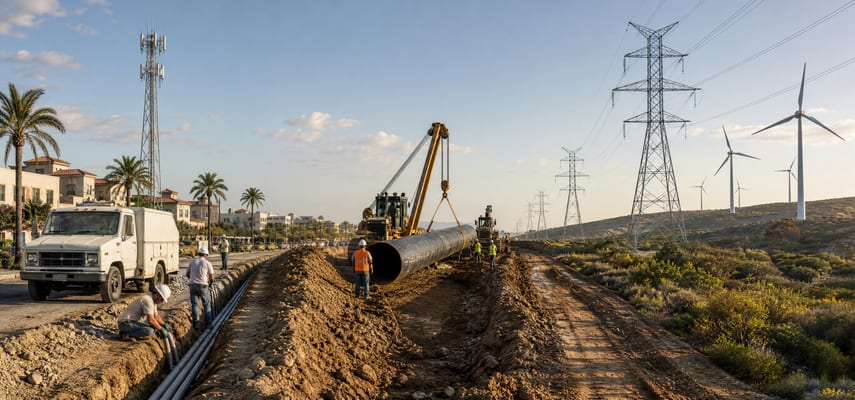
When a neighborhood gets new broadband, a wind farm rises on a scrubby ridge, or a high‑voltage line snakes across a valley, much of the visible work belongs to a class of contractors whose names rarely make headlines. MasTec is one of those companies: a Coral Gables, Florida–based infrastructure engineering and construction group whose footprint stretches across telecommunications, energy, pipelines and renewables.
Its story is a case study in how a regional construction business rode telecom booms, energy cycles and federal infrastructure spending to become a diversified national contractor.
Roots in South Florida and the company’s corporate emergence
MasTec traces its operating roots to Church & Tower, a South Florida telecommunications contractor dating to 1969. Jorge Mas Canosa served as president and chief executive officer of Church & Tower of Florida from 1969, and the company identifies his entrepreneurial outlook as an important origin of MasTec’s culture. His sons later became involved in the business: Jorge Mas joined in 1984, José R. Mas joined in 1992, and Jorge Mas and Juan Carlos Mas were among Church & Tower’s principal shareholders when the modern public company was formed.
The modern MasTec emerged on March 11, 1994, when publicly traded Burnup & Sims acquired Church & Tower, Inc. and Church & Tower of Florida in a stock exchange. The former Church & Tower shareholders received approximately 65% of the combined company, Church & Tower management assumed control, and Burnup & Sims was renamed MasTec, Inc. Burnup & Sims brought an even older corporate lineage, having served infrastructure markets since 1929.
Headquartered in Coral Gables, MasTec adopted the holding‑company approach common among construction conglomerates: create or acquire specialized operating units, keep regional autonomy for field crews, and consolidate finance and risk management centrally. That structure made it easier to chase the rapid, capital‑intensive opportunities of the telecom boom without losing oversight of safety and cash flow at dozens of remote job sites.
The telecom boom: building the nation’s wireless and fiber backbone
MasTec’s telecom roots
In the 1990s and into the early 2000s, demand for wireless capacity and fiber connectivity accelerated. Nationwide carriers were erecting cell towers and stringing fiber to densify networks; cable companies were expanding their footprints; and businesses sought dedicated data circuits.
MasTec expanded crews capable of installing towers, placing antennas, splicing fiber and pulling underground conduit. Representative awards included more than $450 million in communications and infrastructure contracts announced in March 2000, a five‑year Comcast fiber-network contract whose first phase was valued at more than $100 million, and a multi‑year assignment to engineer and install a 2,200‑mile fiber network along Florida highways.
At the same time, the work required investment in specialty crews and equipment—directional boring machines, fiber splicing tools and tower crews—which raised the stakes for project management and safety oversight. Success in telecom demanded both nimble field execution and a corporate nervous system capable of scheduling crews, tracking materials and managing margins across hundreds of small projects.
Diversification into energy, pipelines and utility services
MasTec expands into energy and utilities
Beginning in the late 2000s, MasTec pursued a stated diversification strategy beyond its legacy communications business. It acquired Pumpco, a midstream oil and gas pipeline contractor, in 2008; Wanzek Construction, with substantial wind-energy and industrial capabilities, later that year; and Precision Pipeline in 2009. In 2011, it completed its acquisition of EC Source, adding an engineering and construction platform focused on extra-high-voltage transmission systems.
Contracting for energy systems presented different technical and commercial demands than telecom. Transmission projects involved substantial engineering, right‑of‑way acquisition, heavy equipment and coordination with utilities and regulators. Pipeline work required regulatory compliance, environmental management and pipeline integrity expertise. By building capabilities in earthworks, welding, directional drilling and heavy lift operations, MasTec could move into larger projects and compete for bids that rewarded scale and breadth of service.
Growth by acquisition and the challenge of integration
Acquisitions became a central part of MasTec’s expansion. Pumpco, acquired in June 2008, increased its midstream pipeline capabilities. Wanzek, whose acquisition was completed in December 2008, expanded MasTec into wind-farm construction and related industrial work. Precision Pipeline, acquired in November 2009, extended the company into large-diameter interstate pipeline construction, while EC Source, fully acquired in May 2011, expanded its extra-high-voltage transmission and substation capabilities.
Later transactions increased MasTec’s scale in utility and clean-energy markets. The company acquired electrical-distribution contractor INTREN in May 2021, completed its approximately $600 million acquisition of Henkels & McCoy on December 30, 2021, and acquired Infrastructure and Energy Alternatives on October 7, 2022. MasTec said the IEA transaction significantly expanded its clean-energy and infrastructure segment, including utility-scale wind and solar capabilities.
Each acquisition brought customers, trained crews and equipment, but also integration challenges—harmonizing safety procedures, payroll systems, insurance, and cultural expectations. Acquisition‑driven growth helped MasTec enter new markets quickly, but it required disciplined governance and a replicable playbook for onboarding acquired companies and aligning them to corporate standards.
Public listing and corporate maturation
MasTec did not enter the public markets through a conventional MasTec-branded initial public offering. Instead, the Church & Tower companies entered a public-company structure through the March 11, 1994 reverse acquisition involving Burnup & Sims, an existing public company. MasTec subsequently traded on Nasdaq as MASX before moving to the New York Stock Exchange on February 14, 1997 under the ticker MTZ, which remains its trading symbol.
The current Florida corporation was originally incorporated on April 8, 1998 as MasTec Reincorporation, Inc. MasTec completed its reincorporation from Delaware to Florida on May 29, 1998. Public ownership gave the business access to capital markets while imposing quarterly reporting, formal corporate-governance and disclosure requirements.
For contractors operating under public scrutiny, transparency matters. Investors demand predictable accounting, clear backlog disclosure and visible safety metrics. That pressure tends to push construction firms toward greater operational rigor—in areas such as standard cost estimating, risk provisioning on large contracts, and centralized project controls. For MasTec, maturing into a public company meant balancing the long horizons of infrastructure work with short‑term market expectations.
Large projects, disaster response and reputation risk
By the 2000s and 2010s, MasTec and its peers were bidding on increasingly complex, multi‑year projects: long‑distance pipeline segments, grid‑strengthening transmission builds, and utility modernization programs. These projects carry more regulatory oversight, higher environmental scrutiny and larger financial exposure than small telecom jobs.
Contractors of MasTec’s scale also play visible roles after disasters. Hurricanes, wildfires and major storms create immediate demand for crews to restore power lines and telecommunications. Such work can be commercially significant and reputationally fraught: speed is essential, but so are safety and fairness in contracting. How companies respond to natural disasters informs their relationships with utilities, government agencies and local communities—relationships that matter when long‑term infrastructure contracts are at stake.
The pivot to renewables and grid modernization
MasTec and the energy transition
MasTec’s major expansion into renewable-energy construction began in the late 2000s rather than solely in the 2010s. Its December 2008 acquisition of Wanzek added extensive wind-farm construction capabilities, and its 2011 acquisition of EC Source strengthened extra-high-voltage transmission and substation work. In 2012, an EC Source subsidiary received a segment of the Susquehanna–Roseland 500-kilovolt transmission project. MasTec continued expanding these markets in the 2010s and 2020s, most notably through its 2022 acquisition of Infrastructure and Energy Alternatives.
The move into renewables also altered the company’s technical mix. Installing a utility‑scale solar array requires civil grading, electrical balance‑of‑system work, and foundation and racking installation; wind projects demand crane‑intensive logistics and specialized turbine crews. Transmission interconnections, meanwhile, involve complex engineering and long lead times for permitting and rights‑of‑way. For MasTec, acquiring or growing teams with these skills was essential to compete in an energy landscape increasingly defined by decarbonization goals.
Federal infrastructure spending and broadband initiatives
The Infrastructure Investment and Jobs Act, commonly called the Bipartisan Infrastructure Law, was enacted on November 15, 2021. Among its programs, the law established the $42.45 billion Broadband Equity, Access, and Deployment program and provided $10.5 billion for the Department of Energy’s Grid Resilience and Innovation Partnerships program. These programs fund states, territories, utilities and other eligible recipients, which can in turn procure infrastructure services from contractors.
MasTec has publicly identified BEAD funding as a market tailwind for rural communications expansion as deployment ramps. That disclosure establishes an expected source of downstream demand, but it does not identify MasTec itself as a named BEAD or federal grid-grant recipient. The federal programs are therefore best understood as expanding the addressable market for MasTec and its customers rather than as documented direct grant awards to the company.
Operational discipline: safety, margins and workforce management
Construction is a people business. For MasTec, success has depended on its ability to recruit, train and retain skilled tradespeople—linemen, welders, electricians, heavy‑equipment operators and fiber splicers. Workforce dynamics influence not only capacity to fulfill contracts but also safety outcomes and profitability. Skilled crews command higher wages, and shortages can drive up subcontracting costs or delay projects.
Safety and health programs are central to preserving workforce productivity and limiting insurance and litigation exposure. Contractors that can demonstrate consistent safety records are more competitive for large, long‑term contracts with utilities or government agencies. Similarly, tight management of margins—accurate estimating, prompt change order capture, and efficient materials logistics—separates firms that reliably convert backlog into cash from those that suffer erosion on thin bids.
Technology adoption and changing labor practices
Like many infrastructure builders, MasTec has grappled with how technology changes the job of building. Drones, GPS surveying, BIM tools, and remote monitoring allow better planning, quicker site assessments, and safer work planning. At the same time, much of the actual labor—pulling cable, welding pipeline joints, setting poles—remains manual and labor‑intensive. Successful contractors have used technology to reduce rework, improve estimating precision, and monitor safety in the field.
Labor relations and talent pipelines also shape contractors’ futures. Apprenticeship partnerships, training centers, and collaboration with community colleges help build steady crews. For companies expanding into new geographies or specialty trades, the capacity to train in‑house and to transfer know‑how across business units can be a decisive competitive advantage.
Recent years: adapting to market cycles and policy shifts
In the most recent half‑decade, MasTec has operated in an environment shaped by several overlapping forces: renewable energy growth, public infrastructure funding, supply‑chain volatility, and shifting labor markets. Those forces created both demand and friction. Materials price swings and extended lead times for specialty equipment made forecasting and contract procurement more difficult.
Federal broadband and grid programs expanded the potential market for contractors able to mobilize quickly and comply with public-funding rules. MasTec has specifically cited BEAD as a communications-market tailwind, although its disclosures reviewed for this history do not identify a direct federal grant to the company. Across the industry, contractors also leaned into recurring-service businesses—maintenance, emergency response and network upgrades—that can provide steadier revenue when new-build activity fluctuates.
Key milestones
- 1969: Church & Tower, MasTec’s operating predecessor, begins its documented South Florida lineage under Jorge Mas Canosa’s leadership
- March 11, 1994: Church & Tower combines with publicly traded Burnup & Sims, which is renamed MasTec
- February 14, 1997: MasTec moves its shares to the New York Stock Exchange under the ticker MTZ
- April–May 1998: the present Florida corporation is incorporated and MasTec completes its reincorporation from Delaware to Florida
- 2000: major broadband and fiber awards illustrate MasTec’s telecom expansion
- 2008–2011: Pumpco, Wanzek, Precision Pipeline and EC Source acquisitions accelerate diversification into pipelines, renewables and transmission
- 2021: MasTec acquires INTREN and Henkels & McCoy, substantially expanding its power-delivery operations
- October 7, 2022: MasTec completes its acquisition of Infrastructure and Energy Alternatives, expanding clean-energy and infrastructure capabilities
- 2020s: federal broadband and grid programs enlarge the potential market for MasTec’s communications and power-delivery customers
Corporate identity: a family legacy within a public contractor
MasTec carries the Mas family’s South Florida business legacy into a national profile. Jorge Mas Canosa led Church & Tower from 1969, and the family remained closely involved after the 1994 combination that created the modern MasTec. Jorge Mas now serves as chairman, while his brother José R. Mas, who joined the business in 1992, has served as chief executive officer since 2007.
Family involvement does not insulate a construction firm from the practicalities of the market. Public‑company disclosure, bondable performance, and competition from larger global engineering firms all require corporate discipline. Family leadership and public-company governance have remained parallel features of MasTec as it has decided where to expand, what capabilities to buy, and which markets to prioritize.
Why MasTec’s history matters to infrastructure policy and markets
The story of MasTec is, in microcosm, the story of American infrastructure contracting in the late 20th and early 21st centuries. It shows how firms respond to technology shifts (wireless and fiber), policy shifts (renewable incentives and federal infrastructure bills), and cyclical demand (energy booms and telecom cycles). It also highlights the structural realities of the industry: growth often comes through acquisition; project risk is concentrated in large, capital‑intensive works; and operational excellence—safety, skilled labor and supply‑chain control—determines long‑term competitiveness.
For policymakers and utility planners, firms like MasTec matter because they are the builders who translate plans and funds into physical systems. The capacity of the industry to deliver broadband to rural areas, to connect solar and wind farms to the grid, or to replace aging pipeline and transmission infrastructure shapes the pace and cost of national infrastructure goals.
Conclusion
MasTec’s evolution from a regional contractor in South Florida to a national infrastructure builder reflects broader economic currents: the rise of wireless networks, the expansion of energy and pipeline work, and the turn toward renewables and grid resilience. Its history underscores a simple truth about heavy construction: scale opens opportunity, but only if paired with disciplined operations, a stable skilled workforce and the ability to pivot when markets change. As public investment and changes in energy and communications markets reshape demand for roads, wires, pipes and fiber, companies like MasTec will remain central to whether those investments yield durable, on‑the‑ground change.