










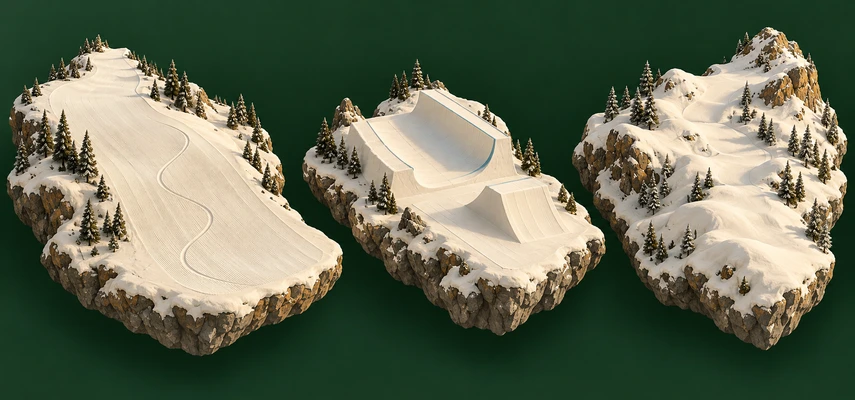

Put three snowboarders beside the same mountain and they may see three different playgrounds. One notices a beautifully groomed trail. Another studies a halfpipe. The third is interested in the snow beyond the grooming machine’s reach. They’ve brought the same broad idea—two feet on one board—but not the same afternoon.
Snowboarding’s categories describe a mixture of terrain, intentions, equipment and competition formats. That’s why the names sometimes overlap. Powder is a snow condition, freestyle is an approach to movement, and splitboarding describes a way of traveling uphill. They aren’t rival species that must occupy separate habitats.
Understanding the terms helps you choose lessons, interpret a mountain map and describe what interests you. It doesn’t oblige you to choose a permanent identity. A rider can enjoy a quiet groomed run, a playful movement and fresh snow on the same day, provided the terrain and skills are appropriate.
All-mountain riding: variety without a costume change
All-mountain is a broad description for riding a range of terrain and conditions. In ordinary recreational conversation, it often means a little of whatever the resort and the day provide: groomed trails, uneven snow and perhaps suitable ungroomed sections.
The appeal is flexibility. Instead of organizing the day around one feature or one kind of snow, you work with what’s available. A firm morning trail might soften later; a familiar route might develop bumps. Learning to adapt becomes part of the pleasure.
The label also appears on equipment. REI’s snowboard guide distinguishes several design categories, including all-mountain, freestyle and powder boards. A versatile board can be useful, but the words on its product page don’t confer the ability to ride every slope.
For a beginner, all-mountain ambitions can begin very simply: controlled turns on appropriate open resort trails. You don’t need to sample every terrain type before lunch. A broad interest in the mountain is entirely compatible with staying in a dedicated learning area while the basic movements settle in.
Freestyle: what can you do with the terrain?
Freestyle emphasizes creative movement. The rider might jump, rotate, grab the board, slide a feature or press one end of the board into the snow. The common thread is exploring movement rather than merely reaching the bottom by the most direct route.
A terrain park concentrates constructed features into a designated area. Boxes and rails offer sliding surfaces, while jumps and other snow features create opportunities for aerial or transitional movement. A park isn’t a single difficulty level. Its entrance doesn’t guarantee that the first feature you encounter suits you.
Freestyle can also happen away from big park structures, where local rules and traffic allow. Suitable small snow contours or flat-ground movements can offer progression without a competition-sized jump. The scale matters: learning a movement doesn’t require imitating the largest version visible in a video.
The NSAA’s freestyle terrain safety resources direct riders toward Park SMART principles. Inspect features, understand the intended direction and landing, respect other users and progress within your ability. A written guide can explain a feature’s purpose; it can’t assess your readiness to use it.
Halfpipe, slopestyle and big air aren’t interchangeable
A halfpipe has two opposing curved walls. Riders travel between them, using the transitions to rise above the walls and perform maneuvers. The shape helps redirect motion, but using it effectively demands timing and specialized skills.
Slopestyle combines a sequence of features into a run. A rider’s choices and execution across the course matter, rather than one isolated maneuver. Big air focuses on tricks from a large jump, with details determined by the event’s rules. Neither name is a sensible description of a beginner’s first lesson goal.
These are competitive disciplines as well as recognizable kinds of terrain. The International University Sports Federation’s snowboard overview identifies the range of events represented in its competition program. Everyday freestyle riding can borrow the creative spirit without involving a start list or a judging panel.
Freeriding: choosing a line through natural terrain
Freeriding usually emphasizes natural terrain and the route, or line, a rider selects through it. That can involve bowls, ridges, varied snow and terrain features that weren’t built as a park course. The exact use of the word varies between riders, media and equipment makers.
The important distinction is that the terrain presents the problem. You read its shape and conditions, then choose movements and a route. Where freestyle might ask what trick fits a feature, freeriding often asks what line fits the landscape and the rider’s capabilities.
The two can overlap. A skilled rider might use a natural snow feature creatively during a freeride descent. Labels describe emphasis; they don’t prevent a board from doing more than one thing. Equipment names are similarly approximate rather than strict licenses for particular terrain.
Freeride doesn’t mean backcountry, and backcountry doesn’t mean extreme freestyle. Natural terrain may be inside an open, managed resort boundary or beyond it. Management, access and hazards need checking separately from the name someone gives the ride.
Powder riding: a condition that changes the conversation
Powder refers to fresh, relatively unconsolidated snow. Instead of riding only on a firm surface, the board interacts with deeper snow that moves around it. Shape, surface area, speed, snow characteristics and technique affect how it rides and how much support it finds.
That difference helps explain powder’s appeal. The sensation can be softer and more buoyant than a groomed trail. It also changes the demands: starting, stopping and recovering after a fall may be harder than a highlight reel suggests. A scenic field of fresh snow is not automatically a forgiving learning area.
Powder boards are designed with this environment in mind, but not every powder outing requires buying a highly specialized shape. More fundamentally, equipment doesn’t remove deep-snow immersion hazards, hidden obstacles or avalanche concerns where those apply. The snow’s attractive appearance isn’t a hazard assessment.
Powder can occur in resort terrain or the backcountry. Those settings may have very different management and rescue implications. Ask where you’re going and what preparation it requires rather than using the word powder as a substitute for a plan.
Alpine racing and snowboard cross: time becomes the question
Alpine snowboard racing emphasizes turning through a prescribed gate course. In parallel formats, riders compete on neighboring courses. Precision matters because the route is constrained: an elegant turn in the wrong place doesn’t help you clear the next gate.
Equipment for some alpine disciplines looks different from the soft-boot setups familiar on recreational slopes. Narrower, directional boards and specialized boot-and-binding combinations can suit racing demands. The equipment is an adaptation to a job, not proof that other boards are less serious.
Snowboard cross introduces a different problem. Riders negotiate a course with banks and terrain features while competing directly with other riders. Line choice, timing and managing traffic become part of the contest. The result is racing, even though the course may contain features that look playful from the sidelines.
Banked slalom emphasizes a course of banked turns, typically with timed runs under the event’s format. It offers another reminder that categories connect: terrain reading, board control and speed can be tested without duplicating an alpine gate course. Specific rules belong to the actual competition, not a generic label.
Splitboarding: how you get uphill
A splitboard separates lengthwise into two touring pieces. With appropriate bindings and climbing skins, those pieces allow uphill travel. At the top, the rider reassembles the board for the descent. The defining feature is the travel system, not a separate style of turning.
That makes splitboarding a little like describing a hike by the transportation used to reach its beginning. It tells you something important, but not everything about the terrain ahead. A tour may involve varied terrain, navigation and changing conditions long before the descent begins.
Backcountry travel requires preparation beyond resort riding skills. Avalanche.org’s education resources emphasize forecasts, training and equipment. Appropriate partners and practiced rescue skills matter too. Carrying a transceiver without understanding decision-making and companion rescue is not the completed task.
A splitboard makes uphill travel possible; it doesn’t make the destination suitable. Beginner riders should establish controlled resort skills and seek appropriate education before considering unmanaged terrain. Snow immediately outside a boundary can present serious hazards even when the lift is still visible.
Choose the question that interests you
The categories become easier to remember when you connect them to questions. All-mountain asks what the day offers. Freestyle asks what movements the terrain invites. Freeriding asks which line makes sense. Racing asks how effectively you can negotiate a course. Splitboarding asks how you’ll travel to the descent.
You can be interested in several questions at once. What matters is matching the next experience to your actual skills and preparation. Tell an instructor what attracts you, whether that’s smooth cruising, playful movement or eventually exploring different snow. They’ll have a more useful starting point than a label alone.
Snowboarding doesn’t demand that you declare a specialty at the rental desk. Learn to control the board, notice which experiences hold your attention and let your interests develop. The mountain offers enough variety that you don’t need to decide on your whole riding life before your first turn.












