










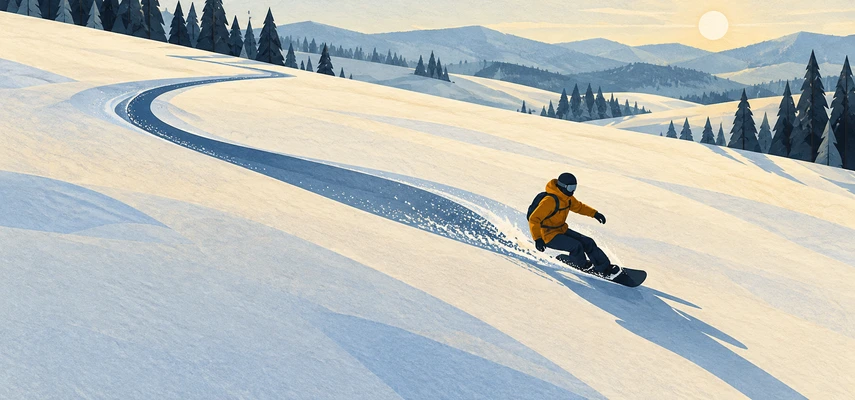

Strap both feet to a board, stand sideways and let gravity take over. As a transportation proposal, snowboarding raises a few questions. The first is usually how you’re supposed to stop.
Watch an experienced rider, though, and the arrangement starts to make sense. The board rolls onto an edge, sweeps across the slope and rolls the other way. What looked like an awkward plank becomes a remarkably expressive tool. One rider draws quiet curves on a groomed trail; another floats through fresh snow; another turns a snowbank into a playground.
Snowboarding is the sport of traveling over snow on a single board, usually with both boots secured in bindings and one foot leading. It can be leisurely, competitive, playful or intensely technical. You don’t need to jump off anything to belong. For a beginner, the first fascinating discovery is much smaller: you can learn to choose where that board goes.
One board, two feet, a sideways view
The basic contrast with downhill skiing is easy to see. Skiers have a separate ski beneath each foot and generally face along their direction of travel. Snowboarders stand across one board, looking toward its leading end. Their feet work together through the same platform rather than steering two separate skis.
That changes how movement feels. You can’t simply step one foot sideways to recover your balance while both feet are attached. Instead, you adjust your body over the board and use your ankles, knees and hips to influence it. The bindings connect those movements to the snowboard; they aren’t just there to prevent it from leaving without you.
A left-foot-forward stance is called regular. Right foot forward is called goofy, a name that’s a piece of board-sport vocabulary rather than a verdict on your coordination. Neither is inherently better. An instructor can help you explore which feels more natural without treating a quick living-room test as destiny.
Riders also move with one foot released. On flat ground, they can push with the free foot, rather like a skateboarder. That skill matters around lifts and when crossing short flat areas. Snowboarding includes a surprising amount of learning how to go almost nowhere before learning how to go downhill.
How a snowboard turns sliding into steering
Gravity supplies the downhill pull. The board’s base provides a sliding surface, while snow conditions, the base’s condition and friction affect how freely it travels. Fresh powder, wet spring snow and a firm groomed trail don’t offer the same ride. Wax helps a suitable base glide, but it doesn’t turn every kind of snow into the same surface.
The crucial steering tools run along the board’s sides: its metal edges. The heel-side edge lies beneath your heels; the toe-side edge lies beneath your toes. Tilting the board changes how an edge meets the snow. Think of the difference between laying a ruler flat on a soft surface and tipping it onto its narrow side. The contact changes dramatically, even though the object hasn’t changed.
That comparison has limits. Snow isn’t a tabletop, and a snowboard bends and twists. The edge, the board’s curved outline and the rider’s movements interact with a surface that can compress, break or slide away. An edge can grip, brush sideways through snow or lose its hold. Simply leaning farther doesn’t guarantee a tighter turn.
The American Association of Snowboard Instructors’ performance guide describes riding through coordinated control of pressure, tilt, pivot and twist. You don’t need to memorize that vocabulary before a first lesson. The useful idea is that turning involves several movements working together, rather than one dramatic swing of the shoulders.
Turning and stopping belong to the same conversation
A snowboarder manages speed partly by shaping a path across the slope instead of pointing continuously downhill. In a skidded turn, the board also slides somewhat sideways, displacing snow and dissipating energy. In a carved turn, the engaged edge follows a cleaner curved track with much less sideways slipping. Both have uses; carving isn’t a prerequisite for enjoying the sport.
Stopping commonly involves bringing the board farther across the direction of travel and managing edge engagement so the slide slows to a halt. This takes balance and practice on appropriate terrain. A written description can’t give you the timing or feedback an instructor provides.
The notorious edge catch happens when an edge engages abruptly while the board is moving across it. The board slows suddenly; your upper body may keep going. That’s one reason early instruction emphasizes controlled gliding, stopping and gradual changes between edges. REI’s beginner riding progression moves through these smaller skills before linking turns. There’s a method behind the apparently modest exercises.
Why the beginning can feel so strange
Walking has given you years of practice moving one foot independently of the other. Snowboarding temporarily removes that option and asks you to balance on something that slides. Being unfamiliar with that arrangement is a reasonable response, not evidence that you lack a sporting gene.
The sensations can also seem contradictory. Facing downhill may feel intimidating, yet stiffening up or leaning away from the direction of travel can make useful movements harder. A balanced, mobile stance gives you room to respond. Your instructor will help you find it rather than asking you to hold a rigid pose all day.
Progress varies. Some people connect turns quickly; others need more time with traversing, stopping and confidence. Previous skating or surfing experience may make the sideways stance familiar, but snow, edges and lifts still require their own learning. Claims that everybody learns in a weekend are better treated as sales copy than a timetable.
Choose a lesson and a dedicated learning area. A good first session can mean understanding your equipment, moving with one foot free and stopping deliberately. Distance covered is a poor measure of success if you can’t choose how to finish the journey.
There isn’t just one kind of snowboarding
For many riders, snowboarding means cruising resort trails: lift up, ride down, repeat with variations. All-mountain riding is a broad description for enjoying a mixture of terrain and conditions. It doesn’t mean every trail on the mountain is appropriate for every rider.
Freestyle emphasizes creative movements and features. Terrain parks may contain jumps, boxes and rails; halfpipes use opposing curved walls. But play can begin with small movements on suitable snow, not with copying a competition broadcast. Park features require their own etiquette, assessment and gradual progression.
Freeriding puts the emphasis on natural terrain and the line a rider chooses through it. Powder is fresh, relatively unconsolidated snow, and a board can feel wonderfully buoyant when conditions and technique come together. Neither term means the terrain is automatically safe or suitable for beginners.
Racing adds another goal: completing a course quickly. Alpine snowboard races involve precise turns around gates, while snowboard cross sends multiple riders through a course with banks and terrain features. These disciplines share the same basic board-and-edge relationship but ask different things of it.
Backcountry riding takes place beyond the managed resort environment. Splitboards separate into two touring pieces for uphill travel and reconnect for the descent. That equipment solves a transportation problem, not an avalanche problem. Formal education, current forecasts, suitable rescue equipment, trained partners and conservative decisions belong to that separate undertaking; Avalanche.org’s education resources explain the preparation involved.
From backyard invention to Olympic sport
Snowboarding didn’t appear fully formed in a terrain park. Earlier snow-sliding devices existed, but an important precursor to modern snowboarding was Sherman Poppen’s Snurfer, developed in Michigan in 1965. It was a board for standing sideways, with a rope at the front and no modern binding system.
The Vermont Ski and Snowboard Museum’s historical account traces how experimentation by riders and builders, including Jake Burton Carpenter and Tom Sims, helped turn backyard snow surfing into a sport with specialized equipment and competitions. Its growth also involved resistance from resorts that didn’t welcome snowboarders. Access had to be won, not merely assumed.
Snowboarding reached the Winter Olympics at Nagano in 1998, with giant slalom and halfpipe events, as the Australian Olympic Committee records. The pairing captures something enduring: speed and precision on one side, creative use of terrain on the other. Recreational riders don’t have to choose a permanent camp between them.
What you need before the first run
The essential riding equipment is a suitable snowboard, compatible bindings and properly fitted snowboard boots. Rental staff can match a beginner setup to your size and needs and explain its operation. Boots should hold you securely without painful pressure; buying a board before discovering whether your boots fit gets the priorities backward.
Add a properly fitted snow-sports helmet, goggles, gloves or mittens, and clothing that keeps you warm and dry. Waterproof outerwear is particularly welcome when learning involves time sitting or kneeling on snow. Layers let you adjust as exercise and weather change. Ask a qualified fitter about compatible protective equipment, including wrist guards; protection has limits and doesn’t replace technique or judgment.
A helmet helps protect against serious head injury, but it doesn’t make a rider concussion-proof. The CDC’s snowboard helmet guidance emphasizes fit and proper use. Treat protective equipment as part of preparation, alongside terrain choice, instruction and control.
Share the slope before you expand your territory
The National Ski Areas Association’s Responsibility Code applies to snowboarders as well as skiers. Keep your speed manageable, give people ahead room and look uphill before entering a trail. Stop where others can see you, obey closures and ask lift staff for help when needed. Learn the full code rather than relying on these examples.
Trail ratings compare terrain within a resort; they aren’t universal measurements. An easy-looking symbol at a new mountain doesn’t erase differences in steepness, width, snow or visibility. Let your instructor help choose terrain. Stay in designated open areas, and recognize that crossing a resort boundary can introduce uncontrolled hazards immediately beyond the sign.
The moment the board starts making sense
Snowboarding’s appeal isn’t limited to speed or spectacle. There’s pleasure in drawing a turn you intended to draw, noticing how snow changes beneath the board and finding a rhythm that felt impossible an hour earlier. A modest slope can provide plenty to work on.
Start by arranging a beginner lesson, confirming what the rental package includes and giving yourself time to learn the unglamorous essentials. The mountain will still be there after you’ve practiced stopping. When the movements begin to connect, that questionable transportation system starts to feel less like being carried downhill and more like having a conversation with the snow.










