










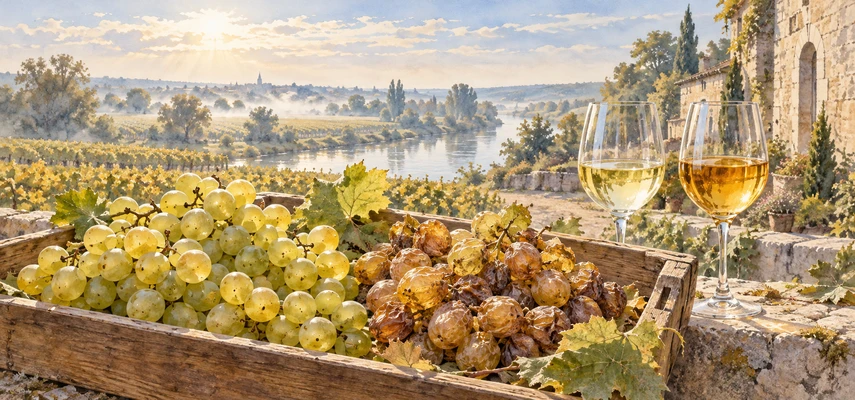

Two wines can share Sauvignon Blanc and Sémillon, then take remarkably different journeys. One becomes a fresh dry white, perhaps with oak and lees adding texture. Another begins with selectively harvested concentrated berries and finishes sweet, carrying the cost and uncertainty of waiting for the right kind of rot.
Bordeaux white and sweet wines show why grape names alone aren’t enough. Site, harvest objective, fruit condition, pressing, fermentation and maturation determine whether the result is crisp, broad, delicate, concentrated or ageworthy. Sugar is an important part of the sweet-wine story, but quality still depends on the whole wine.
This article completes the Bordeaux sequence’s focus on production, style and commercial consequences. The WSET Diploma specification includes both dry and sweet examples in its regional recommendations. Use them to compare decisions and evidence, rather than assuming that a famous sweet appellation guarantees every bottle’s balance or future development.
Separate the dry-white origins from the sweet ones
Graves and Pessac-Léognan produce important dry whites as well as reds. The CIVB’s Graves guide distinguishes these from the sweeter Graves Supérieures designation. Bordeaux’s broader dry-white offer also includes wines outside those prestigious Left Bank origins; a Bordeaux AOC Sauvignon Blanc is a useful comparison, not the same claim as Pessac-Léognan.
Sauternes is a sweet-white appellation covering five communes, including Barsac. Suitable wine from Barsac can be claimed under Barsac or Sauternes, subject to the relevant rules; a wine from another Sauternes commune cannot simply adopt the Barsac origin. These are geographical and regulatory distinctions, not a guaranteed ranking of quality.
Learn the location around the Garonne and its Ciron tributary, then distinguish local site conditions. Sauternes includes gravelly rises and varied underlying materials, while Barsac has important limestone and clay-related profiles. Soil names help explain water, drainage and vine response; they don’t directly prescribe sweetness or create a literal limestone taste.
The grapes contribute different possibilities
Sauvignon Blanc can bring aromatic fruit and fresh acid structure to dry blends. Sémillon can contribute body, texture and development, with its role changing according to fruit, blend and production. The combination can balance aromatic expression and weight, although neither variety has one fixed sensory effect in every wine.
Sémillon is especially important in noble-rot sweet production because it can develop suitable botrytis character and concentration under the right conditions. Sauvignon can help with freshness and aromatic detail. Muscadelle may provide another aromatic contribution; Sauvignon Gris is also permitted in relevant appellations such as Barsac. Muscadelle isn’t Muscat, despite the tempting resemblance between the names.
Variety, clone, rootstock and site must work together at establishment. Planting for a dry aromatic wine and planting for a selective sweet programme can involve different objectives, even where the permitted varieties overlap. Grafted material, drainage, vine balance and the applicable rules matter as much as a fashionable blend formula.
Maritime conditions need the right timing
Temperature and sunlight influence ripening, while rain and cloud can change fruit health and the chance to reach the intended harvest condition. Water availability depends on rooting, drainage and soil reserves as well as rainfall. Nutrient availability influences vigour, affecting canopy density and the work needed to maintain a suitable fruit zone.
For dry whites, protecting freshness and clean aromatic fruit usually makes a different harvest objective from waiting for concentrated botrytised berries. The latter extends exposure to autumn weather. Frost, hail, drought, heat and prolonged rain can all affect the crop, but at different stages and through different mechanisms.
The Sauternes-Barsac appellation body’s account connects autumn morning humidity with subsequent sunny conditions. Suduiraut’s own explanation also stresses the unpredictable development of noble rot. Moist conditions encourage the fungus; drying periods help suitable berries concentrate rather than allowing persistently wet destructive rot to dominate.
That sequence is an opportunity, not a service the weather reliably delivers on schedule. Too little useful development, damaging rain or deteriorating fruit can sharply reduce the intended wine. Explaining the uncertainty is more informative than describing fog as a guarantee of great Sauternes.
Manage the vineyard for a specific harvest
Canopy work balances airflow, exposure and protection, while nutrient and water management follow vine condition and permitted practice. A dense humid canopy can complicate fruit health; indiscriminate opening can overexpose berries. Disease and pest monitoring remains necessary even in a region that values one particular fungal effect.
Noble rot isn’t permission to ignore other disease. Downy and powdery mildew, damaging rot and grape pests need appropriate integrated management. The challenge is to maintain a healthy crop capable of the intended later development, using applicable permitted methods rather than treating all fungal activity as beneficial.
Dry-white harvest can prioritise clean fruit with the desired flavour, sugar and acid balance. A sweet programme may require several selective passages because bunches and individual berries don’t develop uniformly. The current Barsac specification, approved in March 2026, explicitly requires manual successive selections and the relevant overripe, noble-rot condition.
Selective harvest uses skilled labour and reduces saleable volume. Waiting can improve concentration but also lose fruit. Vineyard hazard management, picking logistics and rapid assessment therefore connect directly with production cost and the reliability of supply.
Press and clarify for the wine you intend
Grape transportation should preserve the selected fruit rather than undo careful picking through delay, crushing or unsuitable handling. Reception separates appropriate berries from unwanted material. Dry whites may use direct pressing or controlled skin contact according to style, but prolonged red-style skin fermentation isn’t the default explanation for classic dry white Bordeaux.
Pressing extracts juice before the principal alcoholic fermentation. Press fractions can differ in composition and suitability, so the winemaker evaluates their use. Highly concentrated, partly shrivelled sweet-wine berries give different juice recovery and processing demands from healthy grapes picked for a dry wine.
Pre-fermentation clarification adjusts the solids entering fermentation. Settling and other suitable methods can remove unwanted heavy material while retaining what the fermentation needs. Clearer isn’t automatically better without qualification: excessive removal can change fermentation performance and the desired texture.
Oxidation control, hygiene and monitoring need attention, particularly with compromised or botrytised fruit. The intended aroma and condition should guide decisions. Avoid treating either completely unprotected juice or maximum intervention as the universal Bordeaux method.
Fermentation takes the styles in different directions
Dry-wine fermentation aims to consume the relevant sugars to the intended dry result. Vessel, temperature, yeast and nutrient management influence aroma, texture and reliability. Tank can suit a fruit-led approach; barrel fermentation can support a different programme with additional cost and handling.
Domaine de Chevalier’s production account illustrates careful white-fruit handling and fermentation in barrels at one estate. It doesn’t establish that every Graves white uses the same vessel, new-wood proportion or maturation period. Assess the particular wine rather than turning an estate example into an appellation law.
Concentrated sweet must creates a more demanding fermentation environment. The producer needs the desired balance of alcohol, remaining sugar and freshness, with appropriate control when fermentation ends or is stopped. Sweetness isn’t produced by adding spirit to make a fortified Sauternes; these are unfortified wines.
Must adjustments are regulated, not a free means of manufacturing a legal style. Barsac’s 2026 rules allow certain tightly defined enrichment or concentration practices, so a blanket statement that every such practice is forbidden would be wrong. Equally, permission under conditions isn’t a claim that every producer uses it, or that sugar addition replaces the required harvest.
Manage texture, freshness and stability afterwards
Malolactic conversion can change acid and texture, so whether it is encouraged or prevented depends on the intended white wine. Don’t assume every barrel-fermented wine completes it or every creamy note proves it. Lees contact and other choices can influence texture too.
Maturation in suitable vessels, including oak where chosen, can integrate the wine and add development. Lees work has potential benefits and risks; stirring isn’t automatically required for every wine. Blending varieties, parcels or batches can build the intended balance of fruit, body, freshness and sweetness.
Post-fermentation clarification may include settling, fining or filtration as appropriate. Protein and tartrate stability require assessment rather than visual guesswork. Sweet wines also need protection against unwanted microbial activity, including refermentation when fermentable sugar remains.
Finishing and any permitted adjustments should follow analysis, trials and the legal framework. Appropriate filtration and other microbial controls, sound packaging and suitable storage help preserve the intended product. Residual sugar and prestige don’t make a wine intrinsically stable, and a filtered wine isn’t automatically stripped of quality.
Evaluate the styles through balance and development
A fruit-led dry Bordeaux can offer clear citrus or other fresh fruit with lively acidity and moderate weight. A more ambitious Graves or Pessac-Léognan white may combine greater concentration, texture, oak or lees influence and capacity for development. Expensive wood or a broad palate doesn’t by itself establish superior integration.
Sauternes and Barsac can combine concentrated sweet fruit, botrytis-related complexity, texture and freshness, sometimes developing further honeyed, dried-fruit or nutty interest with age. Actual notes must distinguish fruit, production and development rather than copying a list of expected aromas.
Barsac is often discussed through freshness and delicacy relative to some richer Sauternes examples, but producer, vintage and selection can outweigh the shorthand. Compare the actual wines before declaring one origin lighter, less sweet or better. Desirable flavour persistence and integration matter alongside concentration.
Ageing needs a separate argument. A dry white requires suitable fruit, structure and balance; a sweet wine needs more than a large sugar figure. Consider concentration, freshness, current development and the likelihood of positive change. Survival in bottle and beneficial development aren’t the same conclusion.
Read the rules and classifications separately
National and European recognition operate through each appellation’s specification, including delimited origin, varieties and production requirements. The current rules matter: a proposal, an old textbook threshold and an approved amendment have different status. Barsac’s March 2026 approval is a concrete reason to check the actual document before repeating legal detail.
The 1855 sweet-wine classification is separate from both the five red ranks and the Graves classification. It has a top Premier Cru Supérieur position held by Yquem, followed by Premiers Crus and Deuxièmes Crus. A dry wine from a classified Sauternes estate doesn’t automatically inherit its sweet-wine appellation or classification claim.
The Graves classification recognises specified red and/or dry white wines in Pessac-Léognan. Check the colour covered by recognition instead of extending it to every bottle an estate sells. Neither historic list replaces a sensory quality assessment or establishes one universal selling price.
Understand why the costs can be difficult to recover
Supply in noble-rot production is uncertain and labour-intensive. Multiple selections, low juice recovery, discarded fruit, barrels and stock held before sale can raise cost per saleable bottle. A legally permitted yield isn’t a promise that the vineyard will deliver it or that all harvested fruit becomes the principal wine.
Demand must still support the offer. Concentrated sweetness and an established reputation can create a distinctive proposition, but buyers need relevant occasions, availability and an acceptable price. More expensive production cannot force the market to cover every cost.
Dry whites can give a producer another style and customer occasion, but shouldn’t be described as a costless rescue for a sweet-wine business. Different harvest objectives, origin claims, cellar decisions and selling positions need planning. A brand extension works when its wine and route fit the intended customer.
Compare the evidence here with Burgundy’s Côte d’Or as a regional case, then apply the regional comparison framework to the comparison. Compare growing conditions, production decisions, style, quality and the commercial reasons for price. Establish the differences rather than assuming that one familiar name must be better.
Original Diploma practice
These exercises are original teaching material, not official WSET questions or marking keys. No real-bottle tasting observations are invented.
Question 1: explain noble-rot uncertainty
Compare the roles of humidity and subsequent drying in a selective sweet-wine harvest. Evaluate why simply extending hang time doesn’t guarantee better wine or a larger return.
Indicative answer points: fungal development; concentration; harmful rot; selection; labour; lost volume; demand.
Outline answer: Suitable humidity encourages development, while drying helps concentrate appropriate ripe berries. Persistently damaging wet conditions can lose the crop rather than create noble-rot quality. Selective picking adds labour and lowers saleable recovery; waiting increases exposure to weather. Evaluate fruit condition, eventual balance and net market return instead of assuming later always means better or more profitable.
Question 2: compare two dry-white programmes
A producer compares a fruit-led tank-fermented white with a barrel-fermented, lees-matured white. Explain plausible style and cost differences without declaring either automatically superior.
Indicative answer points: aroma; texture; wood; handling; capacity; intended market; integration and freshness.
Outline answer: Tank and protective handling can support a clear fruit-led style, while barrels and lees may add texture and other character according to the actual choices. The latter programme can use more equipment, labour and holding time. Judge whether those effects suit the fruit, freshness and target customer. Integration and sustained desirable flavour support quality, not the price of the vessel alone.
Question 3: evaluate a sweet-wine legal claim
A writer says Barsac is fortified, that any Sauternes can use the Barsac name, and that all enrichment is categorically forbidden. Explain how to correct the claims using authoritative evidence.
Indicative answer points: unfortified fermentation; delimited origin; one-way naming eligibility; current rules; conditional practice permissions.
Outline answer: These are unfortified sweet wines, not wines whose style is created through spirit addition. Barsac is a specific origin within the Sauternes area; eligibility doesn’t extend to every Sauternes parcel. Check the current Barsac specification, whose 2026 text permits certain defined practices rather than a blanket ban. Explain conditions and actual use separately; don’t substitute a general sweet-wine rule for the appellation document.
Analytical tasting preparation: compare dry and sweet balance
Select a good-quality Sauvignon Blanc Bordeaux AOC, a very good or outstanding Graves or Pessac-Léognan dry white, and a very good or outstanding Sauternes or Barsac. These correspond to the specification’s essential Bordeaux white recommendations. This is a proposed study flight, not an actual tasting report, and recommended samples don’t restrict examination selection.
For a complete Bordeaux study plan alongside these white wines, retain all the red categories too: the acceptable and good-quality comparisons, a very good communal red from outside the specification’s higher-quality named group, and that group’s Saint-Émilion, Pomerol and Haut-Médoc communal/Pessac-Léognan examples. The extra communal comparison fills a category beyond the narrower flights proposed in the red-wine articles. Contrasting vintages, additional age and a Cabernet Franc-dominated higher-quality blend are optional extensions, not replacements for the essential range.
Write full systematic notes blind, comparing sweetness, acidity, body, alcohol, aroma and flavour intensity, fruit character, production or development notes, and finish. Use comparable serving conditions and avoid allowing the sweetest or most oaky sample to dominate the quality ranking automatically.
Indicative review: Explain how freshness supports sweetness or how texture and oak relate to dry-white fruit. Evaluate concentration, integration, complexity and desirable flavour persistence using the actual bottles. Justify ageing separately from sweetness and price, identifying remaining fruit and likely positive development. The exercise provides no guaranteed aroma list, invented personal tasting, fixed official grade or exact drinking window.












