










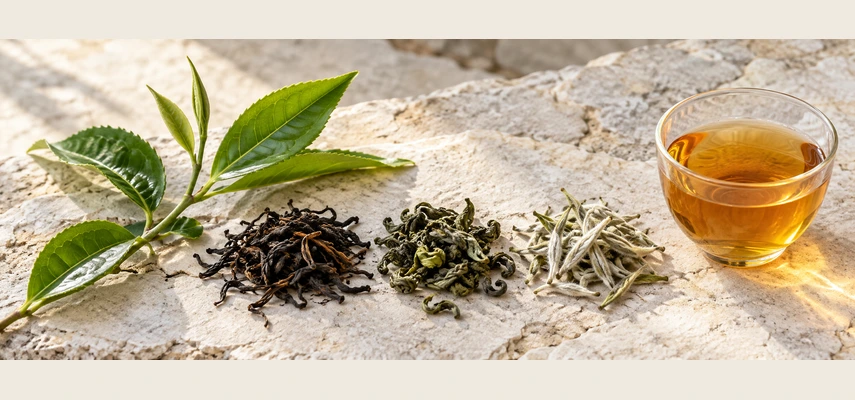

Put a cup of English breakfast beside a cup of pale green tea. One looks ready for milk; the other might smell faintly of steamed vegetables. They seem like different drinks with different origins. Yet both begin with the same plant species. So what is tea, exactly, and how does one leaf end up with such a crowded social calendar?
The short answer is that tea is a drink made from the processed leaves and buds of Camellia sinensis. The longer answer involves farming, chemistry, human ingenuity and your kettle. Once you understand how those pieces fit together, the tea aisle starts looking less like a collection of mysterious names and more like a set of interesting choices.
What is tea made from?
Camellia sinensis is an evergreen shrub or small tree. Its glossy leaves and white flowers make it look more like a garden plant than a beverage factory. That’s a useful reminder: before tea becomes a bag, a tightly rolled pellet or a powder, it’s a crop. North Carolina State University’s plant profile describes how the plant’s variety, climate, harvest and processing contribute to differences in the finished tea.
Tea growers commonly prune plants to encourage accessible new shoots. Leaves and leaf buds are harvested, then processed for a particular style. A bud here means a developing leaf shoot, not the flower bud you might picture in a vase. Those silvery tips in some teas are young plant material, not petals.
Two major botanical varieties are often discussed: Camellia sinensis var. sinensis and Camellia sinensis var. assamica. Broadly, the former has smaller leaves and the latter larger ones. These names describe groups within the species; they don’t divide the entire tea world into green plants and black plants.
There’s another useful word: cultivar, meaning a cultivated selection maintained for particular characteristics. Think of the differences among apple varieties rather than treating every apple as interchangeable. Kew’s tea-plant profile explains that cultivars and harvest timing can have different chemical profiles. Processing matters enormously, but the grower isn’t starting with identical raw material everywhere.
Why chamomile shares the shelf, but not the plant
In everyday conversation, tea can mean almost anything botanical steeped in water. Chamomile tea, peppermint tea and hibiscus tea are perfectly understandable names. Botanically, though, they’re herbal infusions. They don’t become Camellia sinensis because someone puts them in a teabag.
The distinction concerns ingredients, not prestige. A herbal infusion can be beautifully made; a true tea can be disappointing. The National Center for Complementary and Integrative Health’s tea overview separates tea from drinks made with other plants. You may also encounter the word tisane for a herbal infusion, although you don’t need to say it to order one.
Rooibos offers a good example. Its reddish-brown brew can look at home beside black tea, but SANBI’s botanical records identify its source as Aspalathus linearis, a South African shrub. Similar colors in the cup don’t establish a family relationship.
Yerba mate adds a useful complication. It comes from Ilex paraguariensis, a holly species, and its leaves contain caffeine, as Oregon State University’s plant account explains. So herbal doesn’t automatically mean caffeine-free. When ingredients or caffeine matter to you, read the package rather than relying on which shelf holds the box.
How one plant becomes different teas
A picked leaf isn’t a finished ingredient waiting to be dried. It contains water, enzymes and many other compounds. An enzyme is a biological helper that speeds up a chemical reaction. Change how the leaf is handled, and you change which reactions have time to happen.
You already know a version of this from cutting an apple. Break its cells, expose the contents to oxygen, and the cut surface browns. Tea processing uses controlled leaf damage and oxygen exposure to encourage related enzyme-driven changes. The apple comparison explains the principle, not every detail of tea chemistry.
In black-tea manufacture, rolling or cutting helps bring leaf compounds and enzymes into contact. Enzymatic oxidation transforms some catechins, a group of plant compounds, into other substances that contribute to the tea’s color and taste. In green-tea production, heating early in the process inactivates the relevant enzymes and limits that pathway. Research on tea catechin oxidation describes the chemical transformations behind this difference.
That doesn’t mean green tea is simply a raw leaf in a bag. It has been deliberately processed, often shaped and dried. Nor is black tea a leaf that someone forgot about. The timing and handling are part of the craft.
In a study using the cultivar Longjing 43, researchers subjected leaves from that single cultivar to six processing methods and found different chemical profiles. One starting material could take several routes. That doesn’t prove every cultivar makes equally good examples of every style, but it neatly separates plant identity from processing style.
You’ll sometimes see oxidation called fermentation in older or commercial tea descriptions. Keep the mechanisms separate: the enzyme-driven oxidation central to black tea isn’t the same as microbial fermentation. Microorganisms play a role in post-fermented dark teas. The vocabulary has history; the processes still deserve their own names.
A small map of the tea families
For a first visit, six category names are enough. ISO’s tea classification recognizes green, black, white, oolong, yellow and dark tea. Processing is the useful organizing idea, rather than a paint chart of the liquid.
Green tea uses early enzyme inactivation to limit oxidation. Black tea develops substantial enzymatic oxidation before drying. Oolong tea uses controlled partial oxidation, with a wide range of styles rather than one exact halfway point.
White tea is centered on withering and drying suitable buds and shoots. Withering means allowing fresh leaves to lose moisture under controlled conditions; chemical changes can occur during it too. Yellow tea includes a characteristic yellowing stage. Dark tea involves microbial post-fermentation. These are introductions to process families, not complete manufacturing instructions.
Don’t try to memorize the shelf in one afternoon. Start with the relationship: the category tells you something about what happened to the leaf. It won’t tell you everything about flavor, quality or how you will prefer to drink it.
The leaves don’t tell the whole story
Tea contains more than the compounds changed during oxidation. Amino acids, caffeine and aroma-producing substances are also part of its composition. NCCIH’s overview of tea constituents gives a sense of that chemical variety. This helps explain why two drinks can share a category and still smell or taste different.
Then you add water. Brewing transfers soluble compounds from the leaves into the drink. The amount of leaf, the water, the temperature and the time all affect what ends up in your cup. A tea’s name therefore describes an ingredient, not a guarantee that every preparation will taste identical.
Imagine making the same tea twice, once in a small cup and once in a large mug, using the same amount of leaf and water temperature. You have changed the concentration simply by changing the water quantity. Calling one cup stronger doesn’t necessarily mean you bought a stronger category of tea. Sometimes the explanation is sitting in the cupboard beside the teaspoons.
That’s encouraging for beginners. An unpleasant first attempt isn’t necessarily your final verdict on the ingredient. Change one thing at a time and notice what happens. You can learn more from two comparable cups than from a notebook full of elaborate tasting words you don’t yet believe.
A familiar drink with a global working life
Tea is both something people grow for a living and something people use to organize time together. Kew notes traditions ranging from British teatime and Indian chai breaks to Japanese tea ceremonies. Those examples share a plant connection without sharing one universal recipe or set of manners.
In China, the knowledge surrounding tea extends from growing and leaf picking to processing, serving and sharing. UNESCO’s 2022 recognition of these techniques and social practices emphasizes family relationships, hospitality and the transmission of skills through families and apprenticeships. Tea expertise lives in communities, as well as in written instructions.
The economic scale is easy to overlook while waiting for a kettle. FAO’s International Tea Day overview describes tea production and processing as a source of livelihoods for millions of families. The drink connects growers and harvesters with processors, traders and retailers. A packet on a supermarket shelf is the visible end of a much longer chain of work.
That also makes sustainability a practical question. Growing conditions, income and the way value is shared along that chain affect the people behind the leaf. Understanding tea starts with botany, but it doesn’t stop at the plantation gate.
Your first cup doesn’t need an entrance exam
Begin with a tea whose ingredients you can identify, and follow its brewing directions as a starting point. Smell the dry leaves, then notice how the aroma changes after brewing. Let the drink cool enough to taste comfortably. You don’t have to find six separate fruits in it to have paid attention.
Remember that tea naturally contains caffeine, and the amount isn’t fixed by the color of the brew. Tea quantity, serving size and preparation matter. The FDA’s caffeine guidance also stresses individual sensitivity and effects such as sleep disruption. If caffeine affects your rest, count tea among your sources.
Keep beverage enjoyment separate from medical promises. A brewed cup and a concentrated green-tea supplement aren’t interchangeable products. NCCIH’s green-tea safety guidance discusses medication interactions and liver injuries reported primarily with extracts. There is no need to turn an interesting drink into a cure-all to justify enjoying it.
The next time you open a packet, look at what came before it: a living shoot, choices made by a grower and processor, and one last set of decisions waiting at your kettle. The cup is small. The number of ways a leaf can arrive there is rather large.









