










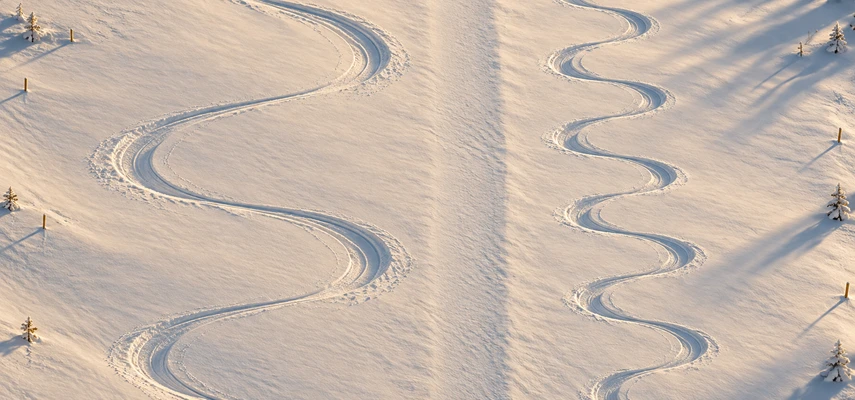

Two snowboarders can make the same number of turns and use very different amounts of mountain. One draws broad curves across the trail. The other stays within a much narrower corridor. Counting the turns tells you surprisingly little about where either person is going—or how fast they’ll get there.
Learning to vary turn size gives you a choice about that route. You can use the space available, respond to terrain and avoid being stuck with one familiar rhythm wherever you ride.
The skill builds on reliable linked turns and stopping. Work with an instructor on terrain you can already manage, rather than using a narrow trail to discover whether you can make smaller turns. Necessity isn’t always a helpful teacher.
Size, shape and rhythm are different things
Turn size describes the scale of the path: how much space a turn occupies. A longer turn generally develops across more distance; a shorter turn changes direction within a smaller area.
Turn shape describes how the path curves. A turn can be open, spending less of its route across the slope, or more finished, bringing the board farther around. Two turns of similar size can therefore produce quite different downhill progress.
Rhythm describes the timing between turns. Quick edge changes may accompany short turns, but moving your feet rapidly doesn’t guarantee a small, useful curved path. You can switch edges often while continuing almost straight down the fall line, the direction most directly downhill.
These distinctions matter because the AASI performance guide includes different sizes, shapes and movement patterns within skidded and carved riding tasks. There isn’t one universal turn called the short turn that every rider must reproduce exactly.
What actually makes the route smaller?
The board must change its direction of travel within less space. Depending on the task, that can involve a different blend of pivot, tilt, pressure and movement of the body relative to the board.
Pivot is the board rotating relative to its direction of motion. Tilt is its angle toward one long edge. Pressure includes both where support acts along the board and how strongly the board interacts with the snow. Those ingredients influence each other.
In a skidded short turn, controlled pivot and slipping can help redirect the board through a compact path. In a more carved turn, board shape, bending and edge engagement contribute to the arc. The movements aren’t interchangeable simply because both outcomes occupy less space.
This is why an instruction such as turn harder is unhelpful. It doesn’t specify whether you need a different route, earlier movement, less unnecessary rotation or a better-supported edge. An instructor can identify the missing ingredient in your actual riding.
Begin by choosing a corridor
On an open, gentle, consistently groomed run, ask the instructor to select a practice corridor. The corridor is an imagined area for your turns, not a claim to that section of the trail. Everyone else retains the right to use the slope.
Start with comfortable medium turns. Notice approximately how much space you need to complete each one without rushing or making an emergency stop. That establishes a useful baseline.
Then change one part of the task. You might aim for slightly wider turns over a short visible section, or somewhat narrower ones while maintaining a manageable pace. Don’t simultaneously demand smaller turns, greater speed, more carving and a steeper slope.
The PSIA-AASI Eastern workbook presents movement skills as things instructors can adjust within learning tasks. Keeping the experiment specific gives you clearer feedback than trying to improve everything at once.
Let a long turn develop
A longer turn gives you more space and time to guide the board through an arc. Allow the movement to build rather than throwing the board toward the finishing direction and waiting for the rest of the turn to happen.
Maintain mobility through the ankles, knees and hips so pressure and edge engagement can develop as the path changes. A longer turn doesn’t require holding one rigid pose for longer. The board is still moving through different relationships to the slope.
Look ahead through the intended arc, checking that the route remains clear. Don’t stare at a point across the trail and commit to reaching it regardless of other people. A planned turn needs an alternative whenever traffic changes.
Longer arcs can be useful for feeling gradual changes in support and board direction. They also need room. On a narrow or crowded run, choosing a huge turn because you’re practicing long turns is a planning error, however smoothly you execute it.
Avoid turning the long arc into a traverse
A broad turn and a prolonged traverse aren’t the same task. A traverse maintains a direction across the slope; a turn continuously changes the route. If you finish every long turn by traveling sideways for an extended distance, you may be practicing a different pattern than intended.
That pattern can still be useful when appropriate, but notice it. Ask whether the task is to create a larger rounded arc or to use a traverse to manage the descent. Clear names help you reproduce the useful movement deliberately.
Make a shorter turn without rushing it
A shorter turn usually gives you less time to reorganize between changes of direction. Helpful movements need to arrive sooner and more efficiently. That doesn’t mean every action must become bigger or more forceful.
Think of shortening a sentence without removing the words that make it understandable. You reduce the unnecessary parts; you don’t simply shout the remaining ones. On snow, the equivalent may be reducing a delayed edge release or an excessive upper-body swing.
An instructor may develop compact skidded turns before asking for tighter carved outcomes. Controlled slipping can provide room to learn timing without demanding a clean edge-guided arc that your current speed, board or terrain won’t support.
Keep the body able to move while the legs guide the board. If your shoulders make a large swing for every change, the movement may consume the time you’re trying to save. If the tail is kicked abruptly around, the turn may become a brake-and-release pattern rather than the rounded route you intended.
Smaller doesn’t automatically mean slower
A sequence of tiny wiggles directed downhill can build speed. A larger rounded turn that brings the board farther across the slope can produce less downhill progress. Turn shape and route matter alongside size.
The PSIA-NW snowboard guide connects turn shape with speed control. Apply that idea by noticing what happens over several turns, rather than judging speed from the energy of a single movement.
If each turn begins faster than the previous one, the pattern isn’t managing speed for that task. Return to a familiar controlled turn or stop where appropriate. Don’t respond by making increasingly frantic movements inside an unsuitable corridor.
Likewise, a long turn doesn’t guarantee low speed. An open arc can carry substantial momentum, especially through a steeper section. The test is whether your chosen path leaves you able to stop or avoid others within the space available.
Read the differences between your two edges
Many riders discover that one turn naturally uses more room than the other. One edge releases comfortably while the other remains engaged longer. One side may produce a rounded arc; the other a quick pivot followed by a traverse.
A perfectly symmetrical drawing isn’t the immediate goal. However, identifying the difference helps explain why a planned corridor slowly shifts across the slope or why the rhythm becomes uneven.
Describe the outcome to the instructor. Does the heel-side turn finish farther across the trail? Does the toe-side turn start late? Does the smaller-turn task magnify a pattern that was easy to overlook in longer arcs?
These observations can guide a specific adjustment. Trying to force symmetry by adding more effort to the awkward side may leave the underlying timing unchanged.
Let the terrain set the useful scale
On a wide, quiet groomer, you may have several sensible choices. Near a junction, a narrowing or a change in visibility, the available choices shrink. Make the adjustment before the space disappears.
Steeper slopes, bumps, hard snow and deep snow change the task further. Short turns used by experienced riders in those conditions aren’t a reason to attempt the terrain before you’re ready. Build range on manageable snow, then seek instruction for the new environment.
Remember that trail ratings are relative to each resort. A sign doesn’t guarantee that yesterday’s practice pattern fits today’s run. Pitch, surface, traffic and runout are the relevant details.
The NSAA Responsibility Code still governs the exercise: remain in control, avoid people ahead and look uphill before starting. Stop only where visible without restricting traffic. A practice corridor doesn’t suspend any of those responsibilities.
Measure choice, not the number of turns
After a short attempt, ask what changed. Did the route become wider or narrower as intended? Did speed remain manageable? Could you alter the pattern again without a large recovery movement?
You don’t need a tape measure or a target number of turns per run. A useful progression is being able to select a slightly different scale, recognize the result and retain familiar stopping and speed-control options.
Over time, long and short stop feeling like two separate modes. They become parts of a range you can use. The mountain keeps changing the amount of room it offers; your riding becomes more useful when you can answer with more than one size of turn.











