










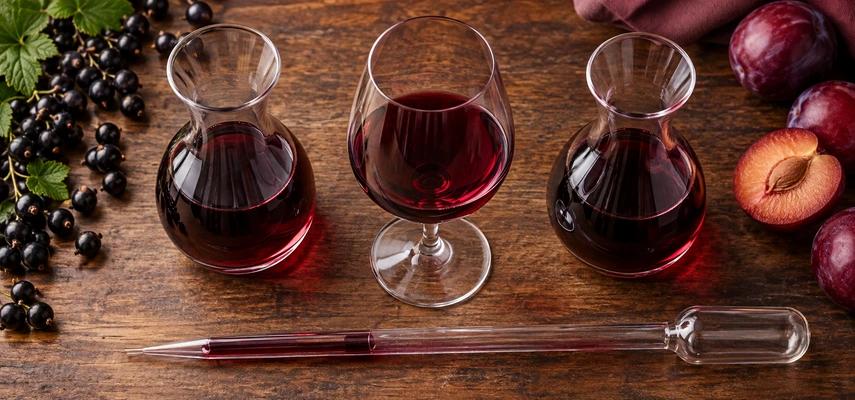

Blending wine can sound suspicious if mixing is assumed to mean hiding a problem. In fact, it can be an ordinary way to build a desired balance. One grape supplies a firmer frame; another brings a different fruit profile and a rounder impression.
Cabernet Sauvignon and Merlot explained together make that logic clear. Both commonly produce dry red wines, but their typical tannin, acidity and fruit character differ. Bordeaux supplies the famous regional connection, while the principles work well beyond one place.
What WSET Level 1 expects you to know
Learning Outcome 2 in the official Issue 1.2 specification includes Cabernet Sauvignon and Merlot among the principal black grapes. It also includes Bordeaux as a named red-wine example associated with principal varieties.
Know typical fruit, tannin, acidity and body, plus the reason complementary grapes may be blended. Detailed Bordeaux classifications and lists of individual estates are enrichment beyond this lesson. This is an independent TFE guide without WSET affiliation; its questions are original.
Cabernet Sauvignon: dark fruit and a firm structure
Cabernet Sauvignon typically makes dry red wine with high tannin and high acidity. Body commonly ranges from medium to full. Blackcurrant and black cherry are useful black-fruit references; herbaceous notes such as green bell pepper or mint may also occur.
These descriptions concern different senses. Blackcurrant suggests aroma or flavour; tannin suggests drying grip; acidity suggests tart freshness. A wine can show all three without one cancelling another. Calling it strong is much less precise.
WSET’s Cabernet comparison describes how origin and ripeness create different expressions. For Level 1, the central anchor remains the grape’s typical dark fruit and firm tannic structure, qualified by actual growing and winemaking conditions.
Why tannin changes the drinking experience
Tannin creates drying grip rather than sweetness or sourness. In a young Cabernet Sauvignon, it can be noticeable along the gums and inside the mouth. Its presence doesn’t by itself prove that the wine is faulty or that it must be aged for decades.
Skin contact during red-wine production helps extract tannin along with colour. The grape supplies potential material; winemaking influences how much of that material enters the wine and how the finished texture feels.
That connection explains why two Cabernet wines can differ. A typical high-tannin profile is a useful study fact, not a guarantee that every example feels equally forceful. Price, bottle weight and a dramatic label are no substitute for a description of the actual style.
Merlot: a rounder reference point
Merlot commonly makes dry, medium- to full-bodied red wine with medium acidity and medium tannin. Fruit can range from red plum and strawberry to blackberry and black plum, depending on ripeness and origin.
Compared with the introductory Cabernet profile, Merlot often seems softer in tannic structure. Softer doesn’t mean sweet. It also doesn’t mean flavourless, low in alcohol or automatically light-bodied. Several different features can make a wine feel approachable.
WSET’s Merlot profile offers background on the grape’s identity and range. For this lesson, the useful contrast is relative tannin, acidity and fruit character rather than a cartoon of Cabernet as difficult and Merlot as simple.
Red fruit, black fruit and the ripeness connection
Red-fruit terms include strawberry and red plum. Black-fruit terms include blackcurrant, blackberry and black plum. These comparisons help describe sensory differences; they aren’t evidence that the winemaker added those fruits.
Merlot can show either red or black fruit, so don’t make red fruit a compulsory answer for every Merlot. Cabernet’s blackcurrant association is particularly useful, but a real wine may carry several fruit and non-fruit notes.
Ripening and growing conditions influence that expression. Riper fruit character can accompany greater potential alcohol, while wine sweetness still depends on the finished sugar balance. A richly fruity red can remain dry.
Oak: an additional layer, not a new grape
Both varieties may be matured with oak influence. Vanilla, cedar, toast or spice can then accompany the fruit. Oak isn’t required for the wine to retain its grape identity, and the presence of a wood-related note doesn’t establish sweetness.
Think of grape and oak as different contributors to a description. “Blackcurrant with cedar” communicates more than treating cedar as another form of black fruit. It also avoids claiming the grape naturally contains a tiny wooden barrel.
Detailed oak regimes and maturation chemistry belong to more advanced study. At this level, recognizing fruit alongside possible oak characteristics is enough to make the style comparison useful.
Bordeaux: connect the regional name with the grapes
Bordeaux is a region in France. For the prescribed red-wine example, associate it with blends commonly involving Cabernet Sauvignon and Merlot. A label may emphasize Bordeaux or a more specific origin rather than displaying one grape name prominently.
Not every red Bordeaux blend uses the same proportions, and other permitted black grapes can contribute. Bordeaux also produces white wines, so the lesson’s red-wine association should not become the false claim that every Bordeaux bottle is red.
The Bordeaux wine body’s Merlot guide supports the regional connection. The basic study task is to recognize the relationship, not to memorize which bank of every river dominates every possible blend.
Why blend Cabernet Sauvignon and Merlot?
Imagine two hypothetical wines awaiting blending. One has a particularly firm tannic structure and blackcurrant character. Another brings a rounder impression and different plum-like fruit. Combining them can create a balance the producer prefers to either component alone.
Merlot can soften the overall impression of a Cabernet-led blend and add fruit/body. Cabernet Sauvignon can bring additional tannin, acidity and black-fruit character to a Merlot-led blend. These are possible contributions, not promises about fixed blending percentages.
WSET’s explanation of blending describes the broader principle. Blending is a production choice used to achieve a style; it doesn’t automatically mean a lesser wine or a producer trying to conceal inferior ingredients.
Compare the profiles clearly
| Feature | Cabernet Sauvignon | Merlot |
|---|---|---|
| Typical sweetness | Dry | Dry |
| Tannin | High | Usually medium |
| Acidity | High | Usually medium |
| Body | Medium to full | Medium to full |
| Fruit references | Blackcurrant, black cherry | Red/black plum, strawberry, blackberry |
| Shared named association | Red Bordeaux blends | Red Bordeaux blends |
Use the table comparatively. Body overlaps, while tannin and acidity provide a clearer introductory contrast. Overlap isn’t a defect in the lesson; it reflects why one feature alone cannot identify every real wine.
Common misconceptions and exam traps
Merlot isn’t automatically sweet because it feels softer. Cabernet Sauvignon isn’t Sauvignon Blanc: similar-looking names refer to different grapes. Bordeaux isn’t a grape variety, and blending isn’t automatically a quality problem.
If asked which grape typically has higher tannin in this comparison, Cabernet Sauvignon is the useful answer. If asked why blend, think complementary contributions and balance. Don’t replace those tasks with a claim that one variety is universally superior.
Build a blend in a thought experiment
Take a hypothetical Cabernet component with particularly firm tannin and a hypothetical Merlot component with softer grip and plum fruit. A producer might compare small combinations to decide which balance suits the intended wine. There is no single correct proportion implied by the grape names alone.
The thought experiment also shows why blending doesn’t have to erase identity. Fruit from both components can contribute, while the overall texture and freshness change. A producer isn’t necessarily seeking the arithmetic average of two tasting notes; the goal is the experience of the combined wine.
Now reverse the question. If a Merlot component feels too soft for the intended style, Cabernet may supply additional structure and acidity. That doesn’t establish that Cabernet is always the senior partner. The desired result determines which contribution is useful.
For a beginner’s revision note, record grape, fruit, tannin and acidity in separate columns. Then write one sentence explaining the blend’s purpose without ranking the varieties. A sentence such as “the producer combines complementary fruit and structure to achieve a chosen balance” demonstrates more understanding than calling one grape powerful and the other easy. The comparison remains useful while leaving room for the many actual Bordeaux and international blends.
Knowledge check: 10 original questions
1. Which fruit is a classic Cabernet Sauvignon reference?
- Blackcurrant
- Only lemon
- Only pear
- Only lychee
2. Which grape typically has higher tannin in the basic Cabernet–Merlot comparison?
- Sauvignon Blanc
- Cabernet Sauvignon
- Merlot in every example
- Neither has tannin
3. Which profile is typical for Merlot?
- Sparkling with no fruit
- Fortified and always brown
- Dry, medium tannin and acidity, medium/full body
- Always sweet and light
4. Which named red example commonly blends Cabernet Sauvignon and Merlot?
- Chablis
- Sancerre white
- Prosecco
- Bordeaux
5. What can blending achieve?
- A preferred balance of complementary features
- Guaranteed lower quality
- Automatic sweetness
- A change of country
6. Which description may fit Merlot fruit?
- No fruit under any conditions
- Red plum through black plum or blackberry
- Only lime and grass
- Only salt and seaweed
7. What does a softer tannic impression establish about sweetness?
- It proves the wine has no alcohol
- It proves the wine is sparkling
- Nothing by itself
- It proves the wine is sweet
8. Which note may oak add to these reds?
- Carbon dioxide by definition
- Only grape sugar
- A new grape variety
- Vanilla or cedar
9. Which name identifies a region rather than a grape?
- Bordeaux
- Merlot
- Cabernet Sauvignon
- Pinot Noir
10. What can Cabernet contribute to a Merlot-led blend?
- A mandatory sweet finish
- Additional tannin and acidity
- Guaranteed removal of all tannin
- Automatic bubbles
Answers and explanations
1. A — Blackcurrant. Blackcurrant is a useful black-fruit association for Cabernet Sauvignon.
2. B — Cabernet Sauvignon. The introductory Cabernet profile has high tannin versus Merlot’s usual medium level.
3. C — Dry, medium tannin and acidity, medium/full body. Merlot commonly has a rounder dry red profile with medium tannin and acidity.
4. D — Bordeaux. Red Bordeaux is the principal named blending association for these grapes.
5. A — A preferred balance of complementary features. Blending can combine fruit, body, tannin and acidity toward a chosen style.
6. B — Red plum through black plum or blackberry. Merlot’s fruit range varies with ripeness and growing conditions.
7. C — Nothing by itself. Tannin texture and sugar sweetness are separate dimensions.
8. D — Vanilla or cedar. Oak can add flavours alongside the grapes’ fruit character.
9. A — Bordeaux. Bordeaux is a French wine region with several wine styles.
10. B — Additional tannin and acidity. Cabernet’s typical structure can complement a rounder Merlot component.
One-page revision summary
Cabernet Sauvignon: dry red, typically high tannin and acidity, medium/full body, blackcurrant and other black fruit. Merlot: dry red, typically medium tannin and acidity, medium/full body, red or black fruit. Both are associated with red Bordeaux blends; their complementary features help explain the purpose of blending.












