










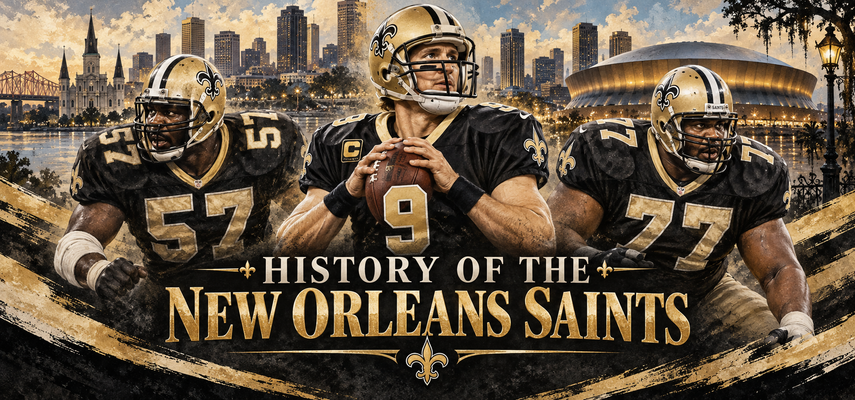

The New Orleans Saints developed one of the NFL’s strongest local identities long before they became champions. Early defeats, memorable individual players and the Superdome’s atmosphere connected the franchise to its city. The Dome Patrol eventually brought consistent winning, while Drew Brees and Sean Payton transformed expectations after Hurricane Katrina. Their Super Bowl victory became the central achievement of a longer story involving resilience, controversy and difficult postseason endings. This account follows the Saints through the completed 2025 season, keeping their championship record clear and separating verified results from developments during the ongoing 2026 campaign and its unfinished outcome.
Franchise at a glance
| Field | Details |
|---|---|
| Founded | November 1, 1966; NFL franchise awarded |
| First season | 1967, National Football League |
| Original city and name | New Orleans, Louisiana — New Orleans Saints |
| Current city and name | New Orleans Saints; New Orleans, Louisiana |
| Previous cities and names | None; temporary 2005 home arrangements did not relocate the franchise |
| League and conference/division | NFL — National Football Conference South |
| Home venue | Caesars Superdome; opened in 1975 |
| League championships | 1 Super Bowl victory: 2009 |
| Other recognized championships | 1 NFC championship: 2009 |
| Historical coverage | 2025 NFL season, including postseason completed in February 2026; later developments through October 16, 2026 |
Origins and early years
The NFL awarded New Orleans a franchise on November 1, 1966, fittingly All Saints Day. John Mecom Jr. became the principal owner, and Tom Fears was named the first head coach. The Saints began play the following season at Tulane Stadium. Strong ticket demand and large crowds reflected a city ready to make professional football part of its existing culture of music, celebration and neighborhood allegiance.
The first regular-season game supplied an unforgettable beginning when John Gilliam returned the opening kickoff for a touchdown. The Rams nevertheless won, an early example of how an exciting moment could coexist with a disappointing result. New Orleans finished 3–11 in that inaugural season. Experienced players helped introduce the new team, but it would take far longer to assemble a consistent winner. The early relationship with supporters therefore developed around more than victories. The Saints became a civic institution while still searching for competitive respectability, creating a bond that later successful teams would deepen rather than invent.
Defining eras
1967–1984: Memorable moments during a long struggle
The Saints’ first extended period was marked by losing seasons and occasional moments that became disproportionately important to supporters. Tom Dempsey’s 63-yard field goal to beat Detroit in 1970 supplied one such landmark. Archie Manning’s arrival the following year gave the offense a talented quarterback, although surrounding weaknesses prevented his ability from producing a sustained contender. The team continued to search through coaching and personnel changes for a dependable structure.
The move to the Superdome in 1975 gave New Orleans a distinctive indoor home and a setting for its growing football traditions. George Rogers and other accomplished players provided further individual highlights, but the franchise still had not achieved a winning season. Some supporters’ visible frustration became part of the public image, without eliminating the underlying attachment. By the mid-1980s, the Saints had established an enduring place in their city while remaining far from the league’s strongest organizations. A change in ownership and football leadership would finally alter that competitive pattern.
1985–1996: The Dome Patrol establishes a winning standard
Tom Benson purchased the team in 1985, and the organization built a new leadership structure around executive Jim Finks and head coach Jim Mora. Their approach emphasized discipline, roster construction and dependable defense. Rickey Jackson, Sam Mills, Vaughan Johnson and Pat Swilling became known collectively as the Dome Patrol, giving New Orleans a linebacker group capable of shaping games. The defense’s strength helped make winning a realistic expectation rather than an occasional surprise.
The 1987 Saints finished 12–3 and reached the playoffs, finally securing the franchise’s first winning season. Further postseason appearances followed, including the first division championship in 1991. Yet the team could not win a playoff game during Mora’s tenure. The contrast between regular-season progress and postseason frustration became an important part of this era’s assessment. Its contribution remained substantial: the Saints had learned how to build and sustain a competitive roster. The next challenge was to turn that standard into success beyond the regular schedule.
1997–2005: A first playoff win and a city in crisis
Mike Ditka’s coaching period did not restore the momentum of the strongest Mora teams. Jim Haslett took over in 2000 and produced an immediate division champion. The Saints then defeated the defending champion Rams 31–28 for the first playoff victory in franchise history. The achievement ended a long wait and established a new postseason benchmark, even though the following years did not produce a stable contender.
Hurricane Katrina changed the context entirely in 2005. The disaster devastated New Orleans and damaged the Superdome, forcing the Saints into temporary home arrangements. Games were played in San Antonio and Baton Rouge, with another nominal home game held at the Giants’ stadium. The disruption was a civic crisis as well as a football problem. Questions about the franchise’s future became inseparable from uncertainty about the city’s recovery. By the end of the season, the organization needed new football leadership and a clearer sense of how it would reconnect with its permanent home.
2006–2009: Brees and Payton complete the breakthrough
Sean Payton became head coach in 2006, and Drew Brees signed after his earlier career in San Diego. Their partnership immediately transformed the offense. The return to the Superdome, highlighted by Steve Gleason’s blocked punt against Atlanta, became a powerful public moment in the city’s recovery. New Orleans reached the NFC Championship Game that season, where Chicago ended the run, but the organization’s expectations had already changed.
The 2009 Saints completed the pursuit. A balanced offense and a defense capable of producing decisive takeaways carried them to the NFC championship and Super Bowl XLIV. New Orleans defeated Indianapolis 31–17, with Brees earning MVP honors. Payton’s second-half onside kick and Tracy Porter’s interception return became defining plays. The victory supplied the franchise’s first league championship and its only completed Super Bowl title through 2025. It also linked football success to a broader recovery story, while the players’ and coaches’ specific achievements remained central to the result.
2010–2016: Offensive excellence and a serious reckoning
Brees and Payton continued to produce accomplished offenses, supported by players such as Marques Colston and Jimmy Graham. The 2011 team appeared capable of another championship run before a dramatic divisional defeat at San Francisco. The repeated ability to score did not always coincide with the defensive consistency needed to advance, creating seasons in which individual production exceeded the team’s final standing.
The league’s investigation of a bounty program brought major discipline in 2012, including Payton’s suspension for the season. The episode is part of the franchise’s history alongside its championship achievement and cannot be reduced to an ordinary coaching absence. Payton later returned, but the Saints still needed to rebuild the defense and supporting roster. Several seasons ended without playoff appearances despite Brees’ continued passing excellence. The period demonstrated the limits of relying on an exceptional quarterback alone, while the organization worked toward another roster capable of supporting a serious postseason opportunity.
2017–2025: Near misses and the transition after Brees
A stronger roster restored regular contention from 2017. Alvin Kamara and other young contributors complemented the established quarterback, while improved defensive play gave New Orleans a more complete team. Painful postseason endings followed: Minnesota’s last-play touchdown after the 2017 season and the overtime NFC Championship Game loss to the Rams after 2018 became particularly prominent. The latter included a missed pass-interference call that remained central to discussion of the game.
Brees’ final season ended with a playoff defeat to Tampa Bay following the 2020 campaign. He announced his retirement in 2021, and Payton left after the 2021 season. Dennis Allen’s tenure did not reproduce their sustained contention and ended during 2024. Kellen Moore became head coach for 2025, beginning another offensive and organizational transition. The Saints finished 6–11. Their history had moved beyond its defining quarterback–coach partnership, leaving the next group to establish a competitive foundation rather than assume that the earlier standard would continue automatically.
Recent history
New Orleans completed the 2025 regular season 6–11 and did not reach the playoffs. Moore’s first season as head coach included a developing role for rookie quarterback Tyler Shough, whose late-season progress became an important part of the organization’s assessment. The franchise’s most recent completed playoff appearance remained the 2020 season, and its title total remained one Super Bowl victory and one NFC championship, both from 2009.
Moore continued as head coach in 2026. Brees entered the Pro Football Hall of Fame that year, adding national recognition to the central playing figure of the Saints’ championship era. As of October 16, 2026, the current season was still underway and its final outcome was not assigned. Caesars Superdome remained the home venue. The historical account therefore separates the completed record from the ongoing work of a new coach and younger quarterback group, while preserving the importance of the franchise’s earlier achievements.
Greatest players and influential figures
Archie Manning
Manning gave the early Saints a gifted quarterback during years when the team rarely supplied him with a consistent supporting cast. His mobility and passing kept him central to the franchise’s public identity. His importance rests partly in the contrast between individual ability and the difficult competitive circumstances around him.
Rickey Jackson
Jackson’s range, pressure and durability made him a foundational part of the Dome Patrol defense. He helped establish the first sustained winning period in Saints history and later received Hall of Fame recognition. His subsequent championship elsewhere does not add a second Super Bowl victory to New Orleans’ team record.
Willie Roaf
Roaf provided exceptional play at left tackle during an era that crossed several coaching arrangements. His protection and run blocking gave New Orleans a dependable strength even when the team struggled to sustain success. His later Kansas City years belong to a wider Hall of Fame career rooted in his Saints beginning.
Drew Brees
Brees transformed the Saints’ offensive expectations and quarterbacked their Super Bowl XLIV victory. His accuracy, preparation and partnership with Payton sustained a long period of contention. His New Orleans service also connected the team’s football success with the city’s recovery, and he entered the Pro Football Hall of Fame in 2026.
Marques Colston
Colston developed from a late draft choice into one of Brees’ most dependable receiving partners. His size, precise work and consistency helped define the passing offense through its championship and later productive seasons. His entire NFL playing career belonged to New Orleans, giving that partnership unusual continuity.
Alvin Kamara
Kamara’s running and receiving gave the later Brees-era offense a versatile threat. His ability to contribute in different formations helped the Saints challenge defenses without relying on one conventional backfield role. He also became an important bridge to the seasons after Brees, when offensive continuity was much harder to maintain.
Jim Mora
Mora coached the Saints to their first winning season and established an expectation of disciplined, competitive football. His teams reached the playoffs repeatedly behind the Dome Patrol defense. The absence of a postseason victory limits the era’s final achievements but does not erase its importance in changing the franchise’s standards.
Sean Payton
Payton built the offensive partnership with Brees and coached New Orleans to its only Super Bowl victory. His aggressive decisions and detailed passing design defined a long competitive era. The league suspension in 2012 also belongs to his Saints record alongside the championship, later division titles and postseason near misses.
Championships and postseason milestones
The 2000 victory over the Rams was New Orleans’ first playoff win. The 2009 team later won the NFC and Super Bowl XLIV, supplying one conference title and one league championship within the same season. The selected table distinguishes those levels of achievement and uses season years for games played the following January or February.
On smaller screens, scroll horizontally to see all columns.
| Season/year | Competition | Opponent | Result | Defining figure(s) |
|---|---|---|---|---|
| 2000 | First playoff victory; NFC wild card | St. Louis Rams | Won 31–28 | Aaron Brooks; Jim Haslett |
| 2009 | NFC Championship | Minnesota Vikings | Won 31–28, overtime | Drew Brees; Garrett Hartley; Sean Payton |
| 2009 | Super Bowl XLIV | Indianapolis Colts | Won 31–17 | Drew Brees; Tracy Porter; Sean Payton |
Rivalries, venues and team identity
Rivalries
Atlanta remains the Saints’ most established division rival, with regional proximity and decades of shared competition giving the matchup a particular intensity. Carolina and Tampa Bay complete the NFC South rivalries. Repeated postseason encounters with Minnesota and the Rams add important episodes to the franchise’s wider competitive history.
Home venues and traditions
Tulane Stadium hosted the early seasons before the Superdome opened in 1975. Its commercial names changed without creating a new venue. The fleur-de-lis, black-and-gold colors, Who Dat support and musical traditions connect the team to New Orleans. The 2006 return carries a particular place within that relationship.
Retired numbers and team honors
The Saints’ team Hall of Fame and Ring of Honor preserve the contributions of major players, coaches and organizational figures. Brees, Jackson and Roaf also received Pro Football Hall of Fame recognition for their wider careers. Those honors reflect the passing, defensive and offensive-line traditions that helped carry New Orleans from its early struggles to sustained contention.
Legacy
The Saints became a New Orleans institution before they became a winning team, making the eventual championship the culmination of a much longer relationship. The Dome Patrol established competitive respectability, and Brees and Payton turned it into a sustained title pursuit. Katrina and the return to the Superdome added civic significance without replacing the football achievements themselves. The franchise’s record also includes controversy and painful defeats. Its continuing task is to build a new successful era while preserving the distinctive connection between the team, its supporters and the city that shaped it.
Where to eat in New Orleans
Planning a visit? Explore our best restaurants in New Orleans guide.












