










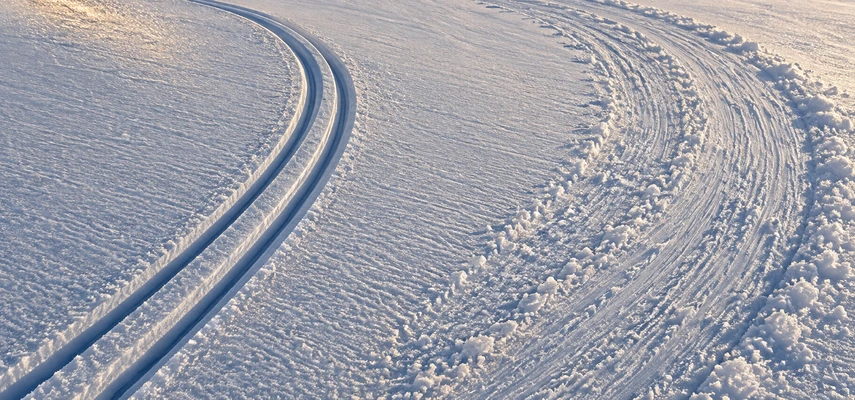

Two skiers can make similar-looking curves and leave very different evidence. One draws narrow lines. The other brushes a wider band through the snow. Both may be doing exactly what the situation requires.
Carving and skidding describe how a ski moves relative to the snow, not whether the skier deserves congratulations. A carved arc minimizes sideways displacement; a skidded arc includes it. Real skiing often blends the two within a single turn.
Understanding that distinction helps you choose a useful result instead of chasing one preferred appearance. It also explains why a beautiful clean carve may be the wrong choice when you need less speed, a tighter corridor, or a different response to the surface.
Start with the direction the ski points and the direction it travels
Imagine sliding a ruler along its length across a table, then moving it partly sideways. The two motions can follow a curve, but the orientation of the ruler and its actual travel differ in the second case.
A ski is more complicated because it bends, tips and meets deformable snow. Still, the simple distinction helps: in a skid, some movement occurs across the ski’s length. In a carved section, the tail follows close to the path cut by the tip.
There isn’t a universal visible boundary where every real turn switches categories. A skier may brush the entrance, grip more cleanly through the middle, then release with another small drift. Describe those phases rather than treating the entire descent as a purity test.
PSIA-AASI Eastern’s task descriptions include both basic skidded parallel turns and turns with strong edging and ski bending. They’re different performances, each with a purpose.
A skid creates a useful interaction with snow
When skis brush sideways, they work against and displace snow. That interaction can dissipate energy and help regulate speed. The skier manages steering, edge angle, balance and pressure to make the slide intentional.
The word skid can sound like something has gone wrong, as it might on a road. On skis, a controlled skid is often an essential part of the plan. It can let you adjust direction and speed without committing to the cleaner arc the skis would otherwise follow.
The distinction is control. An unintended washout, an abrupt tail throw or an uncontrolled sideways slide isn’t automatically good technique because skidding is useful. The objective is a predictable path and pace appropriate to the setting.
Learn to regulate that response with instruction on suitable terrain. Don’t interpret the principle as a request to jam the edges in or turn the shoulders suddenly. A useful ski performance still needs coordinated movement.
A carve makes more use of an engaged, bending ski
Many skis have sidecut, with a narrower waist between wider ends. When the ski tips onto an edge and bends under appropriate load, its contact with supportive snow can help guide an arc.
The shape doesn’t do the job alone. Snow conditions, edge engagement, loading and the skier’s movement all matter. A printed radius is a design reference, not a guarantee that every arc has that size.
Compared with a more heavily brushed turn under similar conditions, a clean carve generally retains motion efficiently. That can feel smooth and direct. It also means carving isn’t an automatic braking strategy.
PSIA-AASI Central’s carved-turn framework describes coordinated tipping, ski bending and turn shape. It doesn’t turn every recreational situation into an invitation to maximize edge angle or speed.
Parallel is a separate description
Parallel skis point broadly in the same direction as each other. They may carve, skid or blend both behaviors. Keeping them beside each other doesn’t establish how they interact with snow.
Likewise, a skier can make a wedge turn that uses purposeful edge engagement and steering without producing a clean carved arc. The ski relationship and the snow interaction answer different questions.
This matters when evaluating progress. A developing parallel skier may be learning a reliable brushed turn. Telling them to eliminate all skidding immediately can remove a useful speed-control tool before another appropriate skill is established.
REI’s parallel-turn guide explicitly includes willingness to skid while learning. The practical goal is controlled coordination, not matching a distant skier’s photograph at any cost.
Compare the result you need, not the prestige of the name
On a wide suitable groomer, an established skier may choose clean arcs to explore edge performance and enjoy the connection. In a more confined corridor, a more brushed turn may better fit the desired path and speed.
Those are examples, not universal terrain rules. There is no promise that every narrow place can be solved by skidding, or that a wide run is automatically appropriate for carving practice. Ability, surface, traffic and consequences still decide.
SkierLab’s discussion of skiing objectives usefully connects technique to the path and pace a skier wants. The question becomes what should happen next, followed by which coordinated movements can make that happen.
A skier who can choose among several performances has more options than one committed to a single style everywhere. Versatility includes recognizing when the desired result exceeds your current skills and choosing easier terrain instead.
Speed depends on the whole route
A heavily brushed turn can still be too fast if its path remains directed downhill and the skier isn’t managing the motion. A carved arc can finish farther across or somewhat uphill and change the influence of gravity on the travel direction.
Neither category substitutes for planning. Starting speed, pitch, turn shape, snow interaction and available room all contribute. There is no universal carved-speed or skidded-speed number.
Don’t use a late emergency-looking skid to justify an otherwise uncontrolled descent. Build a manageable pace through the sequence and leave margin for people ahead. If the necessary turn won’t fit the space, choose a different route or task.
The NSAA responsibility code requires being able to stop or avoid people and objects. It doesn’t distinguish stylish tracks from practical ones when assigning that responsibility.
Tracks are informative, but not a complete diagnosis
Narrow grooves suggest limited sideways displacement where the marks were made. A wider brushed band suggests more sideways travel. Surface texture, traffic and the ski’s passage can complicate the picture.
You can’t reliably infer every body movement from the track alone. A broad mark might have been a deliberate adjustment, a loss of support, a response to uneven snow or part of a particular exercise.
Use tracks with an instructor’s observation and your description of the sensation. Did the ski grip, catch, wander or release? Did the pace remain intentional? Those questions give context to the visible result.
Only inspect marks from a suitable visible stopping place without blocking the run. The snow doesn’t need an immediate gallery opening in the middle of moving traffic. A photograph or delayed discussion may be more useful than stopping abruptly to examine one turn.
Snow can change which performance is practical
Very firm snow may offer less forgiving grip. Soft or broken snow may not support the same edge behavior as a consistent groomer. A skier’s preferred movement must adapt to the support actually available.
Don’t conclude that every brushed mark on difficult snow proves poor technique. Equally, don’t assume a clean track means the route or speed was appropriate. The outcome needs to be judged in context.
REI’s instructor-supported steep-skiing guidance explains why controlled skidding can help with demanding terrain. Its advanced exercises require suitable prerequisites; they’re not instructions to learn a new response in the middle of an unsuitable slope.
For developing skiers, choose a consistent easy setting where the difference can be observed. Add new surface demands separately rather than asking one session to explain every combination of snow and turn style.
Learn the contrast through a small, supervised task
Ask an instructor to select an appropriate progression and demonstrate the intended ski behavior. You should already have the stopping and turning skills needed for that setting.
Focus on one change, such as a modest adjustment in tipping or steering, and notice the response. Don’t simultaneously change speed, slope and turn size, then try to deduce which ingredient mattered.
If the skis catch abruptly, accelerate beyond comfort or stop following your intended path, simplify the task. More force or speed isn’t automatically the answer. The instructor can identify whether movement, surface or equipment needs attention.
You may discover that the useful difference is smaller than expected. A slightly cleaner edge engagement or a more controlled brush can be a meaningful improvement without producing a textbook-perfect track.
Keep both tools available
Good skiing is not a one-way journey from embarrassing skids to permanent carving. It is an expanding ability to choose and blend useful responses.
A clean arc is satisfying when the route, snow and space support it. A controlled brushed turn is equally satisfying when it provides the direction and pace you need. Both require practice, feedback and judgment.
Look behind when it’s safe, notice what the skis drew, and connect that evidence to the choice you made. The most useful track is the one that belongs to a deliberate, controlled route—not the one that wins an argument about names.












