










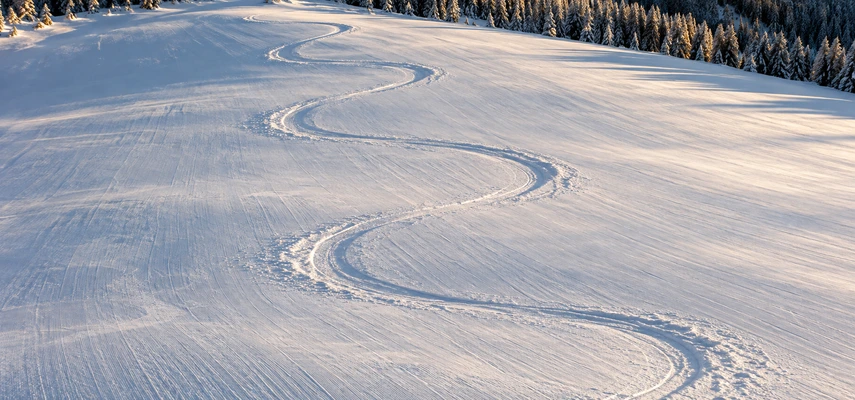

A skier can make plenty of turns and still arrive at the bottom faster than intended. The ski tips moved left and right, but the overall path kept heading mostly downhill. Activity happened; useful speed management did not necessarily follow.
That distinction is the starting point for better control. Managing speed means shaping the whole descent so it stays appropriate to your ability, the terrain, and the people around you. It isn’t simply keeping an emergency stop available for the moment things become uncomfortable.
Work with an instructor on open terrain suited to your current skills. You should already have reliable stopping and basic turning in the setting you’re using. The ideas here explain useful decisions and mechanisms, not permission to test unfamiliar speeds or steeper slopes.
Choose a speed you can actually manage
There isn’t one correct recreational skiing speed for every person or run. A speed that feels easy on a quiet, wide slope may be inappropriate near a lesson group, in poor visibility, or on firmer snow.
The practical test is whether you can deliberately choose a route, maintain adequate space, and stop or avoid what is ahead. If your plan depends on nobody changing direction, it leaves too little margin.
The NSAA responsibility code makes control an ongoing requirement. It doesn’t define control as looking relaxed or keeping up with friends.
Begin conservatively and reassess as conditions change. Confidence can increase faster than reliable performance. Give repeated controlled results more influence than the feeling that you ought to be ready for something quicker.
Notice where the fall line appears in your route
The fall line is the direction straight down the slope at your location. Traveling closer to it generally gives gravity a stronger opportunity to accelerate you along your path than traveling more across the hill.
That doesn’t mean any sideways movement automatically slows a skier. Existing speed, friction, gradient, snow, and the exact trajectory all matter. It explains why direction belongs in the speed-control conversation.
Look at the path as a whole. Are the turns developing into rounded curves across the slope, or are the skis briefly changing direction before pointing downhill again? Those patterns can produce different outcomes even if both look busy.
An instructor can watch the track you actually create rather than the one you intended. Describe where the speed starts building: at the beginning, through the middle, or after several turns. That information helps identify a useful change.
Let turn shape do part of the work
A rounded turn guides you progressively from one direction toward another. An appropriate finish across the hill changes the descent’s geometry, while a suitable uphill component can help reduce speed further.
Compare that with a sequence of shallow zigzags. If each turn ends before the path develops, much of the travel may remain directed down the hill. Increasing the number of quick direction changes doesn’t necessarily solve the problem.
The REI beginner-turn guide connects speed and direction to turn shape. The useful principle is a deliberate path, not a compulsory letter drawn identically on every slope.
Don’t suddenly sweep across an entire trail to complete a theoretical perfect turn. Your corridor must fit traffic and available space. If you need more room than the run provides, choose an easier or more suitable route rather than claiming the whole hill for the exercise.
Understand why skidding can help
A controlled skid includes sideways movement of the skis through the snow. That interaction can dissipate energy and help manage speed. It is a normal part of versatile skiing, not a lesser substitute you must abandon as soon as possible.
A clean carved turn generally preserves speed more effectively than a brushed turn in comparable circumstances. Carving is an enjoyable skill, but its efficient glide isn’t automatically the answer when the immediate objective is slowing down.
SkierLab’s discussion of skiing objectives relates speed to both route shape and ski performance. The distinction helps explain why two skiers following similar-looking arcs may carry different speeds.
Learn to regulate that ski-snow interaction with instruction. Jamming an edge abruptly or throwing the upper body sideways isn’t a substitute for controlled steering, support, and edging. A useful skid has a purpose and a manageable result.
Keep the support that lets you steer
When speed feels alarming, leaning backward and becoming rigid are understandable reactions. They can also make it harder to guide the skis, leaving you with fewer useful options just when you want more control.
Maintain the adaptable stance your instructor has helped you develop. Comfortable joint movement and support through the feet allow steering and edge adjustments. The exact relationship changes through a turn; it isn’t a rigid pose to hold while gravity does everything else.
A very large wedge or a forceful last-second push may add strain without producing the desired path. If the movement isn’t working reliably, reduce the task and seek feedback. Don’t compensate by moving to a longer slope where the same problem has more time to grow.
The PSIA-AASI Eastern framework blends steering, edging, and pressure across different tasks. Speed control comes from that coordination and suitable tactics, not one universal command to lean harder.
Plan a manageable corridor before you start
Look at the next section of run while stopped somewhere visible and clear of traffic. Identify a route with enough room for the turns you can perform and a suitable place to stop if necessary.
Consider narrowing sections, intersections, visibility changes, and people ahead. Your intended corridor should leave margin rather than use every available patch of snow. You may need to wait for a clearer gap before setting off.
Short manageable sections can help keep attention on deliberate decisions. They aren’t an instruction to stop unpredictably after every turn. Choose stops in advance where possible, and never stop below a crest or where you block the route.
If the only plan you can imagine depends on a technique you haven’t learned, choose another run or ask for assistance. Route planning is useful partly because it reveals a mismatch before you’re committed to it.
Adjust to the snow you’re on today
Firm snow may provide a different edge response from softer snow. Chopped surfaces, bumps, or slush can change the support and resistance beneath the skis. A familiar trail can therefore demand a different speed and tactic.
Don’t infer today’s conditions from the trail color or yesterday’s enjoyable run. Begin with room to reassess and ask staff about the relevant open terrain. A snow report for the whole resort doesn’t describe every patch you’ll cross.
Visibility changes the useful speed too. If you can’t read the surface or see far enough ahead, reduce the demand or choose a different setting. Being able to ski the underlying pitch isn’t the same as having adequate information about it.
Big Sky’s collision-prevention guidance emphasizes speed, space, and awareness together. Those are connected variables: less visibility or more traffic should change the margin you keep, not merely the intensity of your concentration.
Practice changes on easier terrain
Ask an instructor to select a gentle practice slope and one clear objective, such as maintaining a manageable speed through a short series of rounded turns. The task should be within your stopping and turning ability.
Make one adjustment at a time. Changing turn shape, stance, edge use, and starting speed simultaneously makes it difficult to know which change helped. Feedback is more useful when the experiment remains small enough to interpret.
Notice whether speed stays manageable from turn to turn, not only whether the final stop succeeds. If speed builds steadily, discuss the path and ski action rather than waiting for the ending to become a test of braking effort.
Progress is a repeatable outcome in the selected conditions. It doesn’t require trying the same task on harder terrain immediately. Give the skill enough appropriate practice to become dependable before adding another demand.
Recognize an unsuitable situation early
If you need an emergency stop after every few turns, feel unable to choose a line, or cannot maintain room for people ahead, reduce the terrain demand. Surviving repeated recoveries isn’t the same as managing the descent.
Fatigue, cold, or distraction can change the result even when the slope stays the same. Stop for a break or end the session if deliberate movement and attention are deteriorating.
Don’t rely on poles, a friend below, an untested hockey stop, or a deliberate fall as routine brakes. Learn new stopping skills before they are needed, in an appropriate supervised setting.
If you’re stuck on terrain you cannot manage, seek staff or patrol assistance. A conservative response preserves options; continuing because you don’t want to inconvenience the group can remove them.
Make the speed a choice throughout the run
Ask yourself whether the next section fits the turns you can currently make, whether the snow and traffic permit the intended path, and whether you have a visible clear place to finish. These questions become quicker with experience, but they remain useful.
You don’t need to ski at one unchanging pace. Small adjustments are normal. The objective is for them to remain intentional and within your control rather than a series of accelerating surprises.
The satisfying change is subtle: the turns stop feeling like interruptions to the descent and start becoming the way you manage it. Speed is no longer something you tolerate until the brakes arrive. It becomes part of the route you are choosing.












