










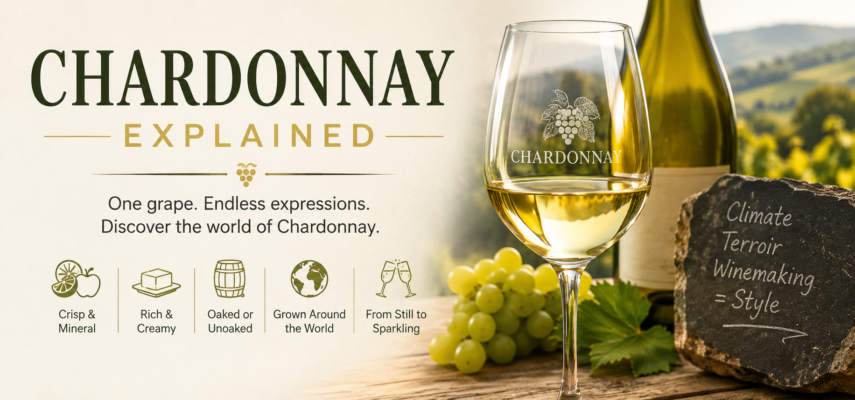
Chardonnay may be the most misunderstood white wine in the world.
For some people, Chardonnay means rich, buttery, oaky wine that tastes like vanilla, toast, and movie-theater popcorn. For others, it means crisp, mineral, citrus-driven wine that tastes nothing like that at all. Both impressions can be correct.
That is what makes Chardonnay so important. It is not one single style of wine. It is a grape that can become many different things depending on where it is grown, how ripe the grapes are when picked, and how the winemaker chooses to make it.
Chardonnay can be lean and refreshing. It can be full-bodied and creamy. It can be sparkling. It can be unoaked, lightly oaked, heavily oaked, or somewhere in between. It is one of the most flexible grapes in the world, which is why it appears in some of the most famous white wines ever made.
To understand Chardonnay, you have to separate the grape from the style.
What Is Chardonnay?
Chardonnay is a white wine grape originally associated with Burgundy, France. Today, it is grown almost everywhere wine is made, including France, California, Australia, Chile, South Africa, Italy, New Zealand, and many other regions.
The grape itself is relatively neutral compared with highly aromatic grapes like Sauvignon Blanc, Riesling, or Gewürztraminer. That does not mean Chardonnay is boring. It means Chardonnay is highly responsive to climate, soil, ripeness, and winemaking.
Think of Chardonnay as a blank canvas. The grape gives the winemaker structure, body, acidity, and fruit. The place and winemaking choices determine whether the final wine tastes crisp and mineral, rich and buttery, or somewhere in the middle.
That flexibility is the reason Chardonnay became so popular. It can appeal to many different palates, fit many price points, and pair with a wide range of foods.
What Does Chardonnay Taste Like?
Chardonnay’s flavor depends heavily on climate and winemaking.
In cooler climates, Chardonnay often tastes like lemon, green apple, pear, citrus peel, chalk, and sometimes a salty or mineral note. These wines tend to feel crisp, focused, and refreshing.
In warmer climates, Chardonnay often shows riper fruit flavors such as yellow apple, peach, pineapple, melon, mango, and baked pear. These wines usually feel rounder and fuller in the mouth.
When oak is used, Chardonnay can develop flavors of vanilla, toast, baking spice, coconut, cedar, caramel, or roasted nuts.
When malolactic fermentation is used, Chardonnay can take on a creamy, buttery texture and flavor. This is where the famous “buttery Chardonnay” style comes from.
So when someone says they dislike Chardonnay, the useful question is: what kind of Chardonnay?
They may dislike heavy, oaky Chardonnay but enjoy crisp Chablis. Or they may dislike sharp, lean Chardonnay but love a richer California style.
Why Is Some Chardonnay Buttery?
The buttery taste in Chardonnay usually comes from a winemaking process called malolactic fermentation.
This process converts sharper malic acid into softer lactic acid. Malic acid is the type of acid associated with green apples. Lactic acid is associated with milk and cream. The result is a rounder, softer wine with a creamier texture.
A compound called diacetyl can also contribute buttery aromas. In small amounts, it can make the wine seem rich and luxurious. In larger amounts, it can become very obvious, giving the wine a strong buttered-popcorn character.
Not all Chardonnay goes through full malolactic fermentation. Some producers block it entirely to preserve crisp acidity. Others use it partially to add texture without making the wine too buttery.
This is one of the biggest reasons Chardonnay can taste so different from bottle to bottle.
Oaked vs. Unoaked Chardonnay
Oak is another major factor in Chardonnay’s personality.
Oaked Chardonnay is aged in oak barrels or exposed to oak influence. This can add flavors of vanilla, toast, spice, smoke, caramel, or nuts. Oak can also give the wine a rounder, fuller texture.
Unoaked Chardonnay is typically aged in stainless steel, concrete, or neutral vessels that do not add strong flavors. These wines tend to emphasize fruit, acidity, freshness, and minerality.
Neither style is automatically better. They are simply different.
If you enjoy creamy, rich white wines, you may prefer oaked Chardonnay. If you like crisp, clean whites, unoaked Chardonnay may be more appealing.
A helpful clue on a wine list or label: words like “unoaked,” “stainless steel,” “Chablis,” or “village Burgundy” often point toward a fresher style. Words like “barrel fermented,” “barrel aged,” “reserve,” or “California Chardonnay” may suggest a richer, oak-influenced style, though there are exceptions.
Chardonnay in Burgundy
Burgundy is Chardonnay’s spiritual home.
In Burgundy, Chardonnay produces some of the world’s most respected white wines. The region’s best examples can be complex, age-worthy, and expensive, but Burgundy also produces simpler and more affordable Chardonnay.
The most famous Burgundy Chardonnay regions include Chablis, the Côte de Beaune, Mâconnais, and Côte Chalonnaise.
Chablis is usually the leanest and most mineral-driven expression. It often tastes like lemon, green apple, chalk, oyster shell, and wet stone. Many Chablis wines see little or no new oak, though higher-end examples can have some oak influence.
Meursault is often richer, rounder, and more nutty, with flavors of ripe apple, hazelnut, butter, and cream.
Puligny-Montrachet is known for elegance, precision, and structure.
Chassagne-Montrachet can combine richness with power and depth.
Mâconnais wines, such as Mâcon-Villages or Pouilly-Fuissé, are often more approachable and fruit-forward, making them a good entry point into white Burgundy.
If you want to understand classic Chardonnay, Burgundy is essential.
Chardonnay in California
California helped make Chardonnay a global phenomenon.
California Chardonnay can range from fresh and restrained to bold, ripe, and heavily oaked. The state’s warmer climate often produces fuller-bodied wines with ripe fruit flavors like apple, pear, peach, pineapple, and tropical fruit.
The classic California Chardonnay style became famous for richness: oak, butter, vanilla, cream, and ripe fruit. This style remains popular, but it is not the only style California produces.
Today, many producers in cooler areas such as Sonoma Coast, Santa Barbara County, Santa Lucia Highlands, Anderson Valley, and parts of Napa make Chardonnay with more freshness, acidity, and balance.
If you like a plush, generous white wine, California Chardonnay can be a great choice. If you prefer leaner styles, look for cooler-climate producers or bottles that mention lower oak influence.
Chardonnay Around the World
Chardonnay is grown globally because it adapts well to many climates.
In Australia, Chardonnay ranges from rich and tropical to sharp and elegant. Modern Australian Chardonnay, especially from cooler areas like Margaret River, Yarra Valley, Adelaide Hills, and Tasmania, can be very refined.
In New Zealand, Chardonnay often combines bright acidity with ripe fruit, especially from regions like Hawke’s Bay and Marlborough.
In Chile, Chardonnay can offer excellent value, with styles ranging from fresh and citrusy to round and tropical.
In South Africa, Chardonnay can be balanced and textured, especially from cooler coastal regions.
In Italy, Chardonnay appears in both still and sparkling wines, though it often shares attention with local grapes.
Chardonnay is also one of the key grapes in Champagne, where it contributes elegance, acidity, citrus, chalky minerality, and aging potential.
Chardonnay and Champagne
One of Chardonnay’s most important roles is in sparkling wine.
In Champagne, Chardonnay is one of the three major grapes, alongside Pinot Noir and Pinot Meunier. When Champagne is made entirely from Chardonnay, it is called Blanc de Blancs, meaning “white from whites.”
Blanc de Blancs Champagne is often elegant, bright, citrusy, mineral, and refined. With age, it can develop flavors of brioche, almond, cream, and toasted pastry.
Chardonnay is also used in many sparkling wines outside Champagne, including Crémant, Franciacorta, English sparkling wine, and high-quality traditional-method sparkling wines from California, Australia, and other regions.
This is another reason Chardonnay is so important: it is not only a still white wine grape. It is also one of the world’s great sparkling wine grapes.
Is Chardonnay Dry or Sweet?
Most Chardonnay is dry.
That means it does not usually contain noticeable sweetness. However, Chardonnay can still taste fruity, creamy, or rich, which some beginners may mistake for sweetness.
A ripe California Chardonnay with pineapple, vanilla, and butter may seem “sweet” because of its fruit and oak flavors, but it is usually technically dry.
If you want a dry white wine but dislike sharp acidity, Chardonnay can be a good option, especially in a rounder style. If you want an actually sweet white wine, Riesling, Moscato, or certain dessert wines are usually better choices.
Is Chardonnay Full-Bodied?
Chardonnay is usually medium- to full-bodied for a white wine.
Unoaked Chardonnay from cooler climates can feel light to medium-bodied, especially when it is crisp and citrusy. Richer oaked Chardonnay can feel full-bodied, creamy, and almost luxurious.
This body is one reason Chardonnay pairs well with food. It has enough weight to handle chicken, seafood, cream sauces, butter, cheese, and roasted vegetables.
Where Sauvignon Blanc often cuts through food with acidity, Chardonnay often complements food with texture.
What Food Pairs With Chardonnay?
Chardonnay is one of the most food-friendly white wines, but the best pairing depends on the style.
Crisp, unoaked Chardonnay pairs well with oysters, shrimp, crab, sushi, grilled fish, goat cheese, salads, lemon chicken, and lighter vegetable dishes.
Richer oaked Chardonnay pairs well with roast chicken, lobster with butter, scallops, creamy pasta, mushroom risotto, pork, turkey, butternut squash, and dishes with butter or cream sauces.
Sparkling Chardonnay, especially Blanc de Blancs, pairs beautifully with oysters, fried foods, caviar, sushi, soft cheeses, and salty appetizers.
The key is to match weight with weight. Light Chardonnay works with lighter dishes. Rich Chardonnay works with richer dishes.
A heavily oaked Chardonnay can overwhelm delicate seafood, while a very lean Chardonnay may feel too sharp next to creamy, buttery food.
Why Do Some People Hate Chardonnay?
Chardonnay became so popular that it eventually suffered from its own success.
In the 1980s and 1990s, many mass-market Chardonnays leaned heavily into oak, butter, high alcohol, and ripe fruit. For some drinkers, the style became too obvious, too heavy, or too sweet-tasting.
This led to the “ABC” movement: “Anything But Chardonnay.”
But many people who say they hate Chardonnay are reacting to one specific style, not the grape itself.
A crisp Chablis, a balanced white Burgundy, a modern cool-climate California Chardonnay, and a buttery supermarket Chardonnay can taste dramatically different from one another.
Chardonnay’s reputation problem is really a style problem.
How to Choose a Chardonnay
If you are buying Chardonnay, start with the style you want.
For a crisp, clean, refreshing Chardonnay, look for Chablis, unoaked Chardonnay, stainless steel Chardonnay, or cool-climate regions.
For a richer, creamier Chardonnay, look for California, Napa, Sonoma, barrel-aged, reserve bottlings, or wines that mention oak, butter, vanilla, or cream.
For value, look at Mâcon-Villages, Bourgogne Chardonnay, Chile, South Africa, Australia, and some California Central Coast bottles.
For sparkling wine, look for Blanc de Blancs Champagne or traditional-method sparkling wines made from Chardonnay.
When in doubt, ask one simple question at a wine shop or restaurant: “Is this Chardonnay more crisp and mineral, or more rich and buttery?”
That question will usually get you much closer to the bottle you actually want.
Good Chardonnay for Beginners
Beginners should try Chardonnay in a few different styles because one bottle will not explain the grape.
Start with an unoaked Chardonnay to understand the fresh, fruit-driven side. Then try Chablis to see the lean, mineral side. Then try a California Chardonnay to understand the richer, oakier style. Finally, try Blanc de Blancs sparkling wine to see how Chardonnay performs in Champagne-style wines.
A simple beginner tasting could include:
- Unoaked Chardonnay
- Chablis
- California Chardonnay
- White Burgundy or Mâcon-Villages
- Blanc de Blancs sparkling wine
Taste them side by side and the differences become obvious. The grape is the same, but the results can feel like completely different wines.
Chardonnay vs. Sauvignon Blanc
Chardonnay and Sauvignon Blanc are two of the world’s most popular white wines, but they are very different.
Sauvignon Blanc is usually more aromatic, sharper, and more obviously citrusy or grassy. It often tastes like lime, grapefruit, green apple, passion fruit, herbs, and sometimes jalapeño or cut grass.
Chardonnay is usually rounder, fuller, and less aggressively aromatic. It often tastes like apple, pear, lemon, peach, pineapple, butter, vanilla, toast, or cream depending on the style.
If Sauvignon Blanc is bright, zippy, and refreshing, Chardonnay is often broader, softer, and more textured.
People who want crispness may prefer Sauvignon Blanc or unoaked Chardonnay. People who want body and richness may prefer oaked Chardonnay.
Chardonnay vs. Pinot Grigio
Pinot Grigio is usually lighter, simpler, and more neutral than Chardonnay. It is often crisp, clean, and easy-drinking, with flavors of lemon, pear, green apple, and almond.
Chardonnay usually has more body, more texture, and more stylistic range. It can be simple and refreshing, but it can also become complex, rich, oak-aged, age-worthy, and expensive.
Pinot Grigio is often a casual white wine. Chardonnay can be casual too, but it also has a higher ceiling.
Can Chardonnay Age?
Some Chardonnay can age very well, but not all of it is meant to.
High-quality white Burgundy, Chablis Premier Cru or Grand Cru, top California Chardonnay, and Blanc de Blancs Champagne can develop beautifully with time. Aged Chardonnay can show flavors of honey, nuts, brioche, baked apple, cream, spice, and toast.
Most everyday Chardonnay, however, is best consumed young, usually within a few years of release.
If the bottle is inexpensive, fruit-forward, and made for freshness, drink it young. If it is from a serious producer, a top region, and has strong acidity and structure, it may have aging potential.
Serving Chardonnay
Chardonnay is best served chilled, but not ice-cold.
If it is too cold, the aromas and texture disappear. If it is too warm, the alcohol and oak can feel heavy.
A good serving range is around 45–55°F. Lighter unoaked Chardonnay can be served closer to the cooler end. Richer oaked Chardonnay can be served slightly warmer so the texture and complexity show.
If you pull a bottle straight from the refrigerator, let a richer Chardonnay sit for 10–15 minutes before drinking. That small change can make the wine taste much better.
The Big Takeaway
Chardonnay is not one flavor. It is a spectrum.
It can be crisp or creamy, lean or rich, mineral or tropical, still or sparkling, simple or profound. That flexibility is why it is loved, hated, copied, criticized, and collected.
For beginners, the most important lesson is this: do not judge all Chardonnay by one bottle.
If you dislike buttery Chardonnay, try Chablis. If you dislike sharp Chardonnay, try California. If you want elegance, try white Burgundy. If you want bubbles, try Blanc de Blancs.
Chardonnay is not just a popular white wine. It is one of the clearest examples of how much place and winemaking can shape what ends up in the glass.











