










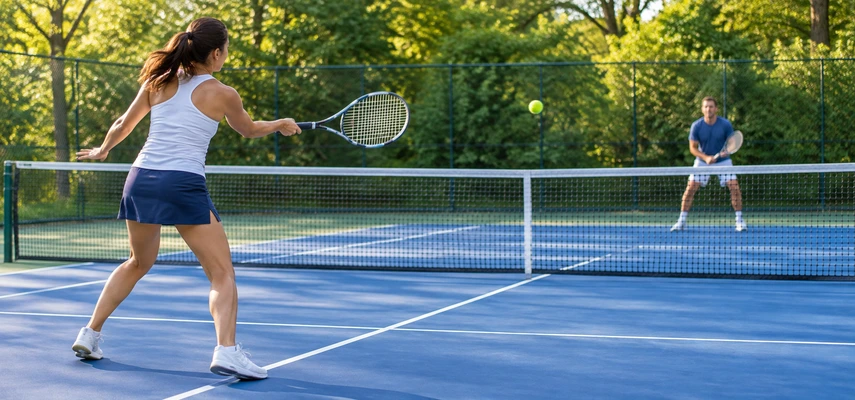

A tennis court offers a peculiar bargain: you may send the ball almost anywhere inside a large rectangle, but someone on the other side is doing their best to make that inconvenient.
At first, the difficulty seems to be hitting it hard enough. Then you meet a player who barely appears to hurry, sends back one comfortable-looking shot after another, and somehow has you running everywhere. Tennis has introduced its second lesson: speed is useful, but space and time are the real currency.
That combination makes the sport absorbing. The basic task is easy to understand. Learning to do it reliably opens up a game of movement, geometry, nerve and the occasional astonishing recovery. You don’t need a professional serve to start enjoying it. You need a racket, a suitable ball, somewhere to play and another person willing to keep the exchange going.
A small ball, a large collection of possibilities
Tennis is a racket sport played across a net, either between two opponents in singles or between two teams of two in doubles. During an ordinary rally, you try to return the ball into the opponent’s court before its second bounce. You can also intercept it before it bounces, except when receiving a serve.
You win a point when your opponent cannot make a legal return: perhaps the ball bounces twice, their shot lands out, or it fails to cross the net. There are other ways a point can end, but this is the central conversation: send a playable ball over, receive a problem back, solve it before time runs out.
That doesn’t mean every shot should try to finish the point. A ball comfortably inside the lines can be valuable because it keeps you in the exchange. One extraordinary winner counts for one point; so does a sensible return followed by your opponent’s mistake.
Doubles adds a partner and a different spatial puzzle. Two people can cover more ground, but they must decide who takes which ball. The useful shout of "mine" can accomplish more than two impressive swings arriving simultaneously.
What the lines are telling you
A full-sized court is 78 feet long. Singles uses a width of 27 feet; doubles extends that to 36 feet by including the side alleys. The baseline marks the back of each end. Near the net, the service lines and center service line divide the landing areas for serves. The net is 3 feet high at its center, according to the ITF’s court glossary.
Those smaller service boxes aren’t the limits of an ordinary rally. Once the serve is in play, a return may land deeper, all the way back to the baseline. In doubles, the alleys are available during the rally, but the serve still has to land in the same diagonal service box used in singles.
How an exchange becomes a match
A point begins with a serve. The server starts behind the baseline and sends the ball into the diagonally opposite service box. Under standard rules, a missed first serve allows a second attempt. Missing both loses the point. A serve that touches the net and otherwise lands correctly is normally replayed; approved alternative formats can differ.
The receiver must let a legal serve bounce before returning it. After that, players can hit after one bounce or volley before the bounce. A ball touching the relevant boundary line is in. The 2026 ITF Rules of Tennis set out these rules and their exceptions.
The scoring system nests smaller contests inside larger ones: points make games, games make sets, and sets decide matches. Think of each game as a short chapter rather than treating the match as one enormous running total.
In a standard advantage game, the score moves from love, meaning zero, through 15, 30 and 40. Four points win the game if the winner leads by two. At 40-all, or deuce, someone must win two consecutive points. A set commonly goes to the first player or team to reach six games with a two-game lead; many formats use a tiebreak at six-all. Match lengths and deciding-set arrangements vary. The USTA’s scoring guide is a useful next stop when you’re ready for the full arithmetic.
For a first casual hit, though, you can agree to count consecutive successful returns. Keeping a rally alive is already a worthwhile game.
Your racket has more than one answer
The strokes are different solutions to different incoming balls. A forehand is usually played on the racket-hand side of the body; a backhand works on the other side and can use one hand or two. Both commonly appear as groundstrokes, meaning shots played after a bounce.
A volley intercepts the ball before the bounce, often near the net. A serve starts the point, and an overhead deals with a high ball using an action that resembles part of a service motion. You don’t need to master the entire collection before playing. Recognizing them helps you understand why a player moves forward, retreats or changes their racket preparation. Tennis Australia’s introduction to playing brings these basic actions together.
Why a gentle shot can be difficult
Imagine an opponent standing well to your left. A controlled shot into the open space on your right may make them travel much farther than a faster shot directly toward them. Placement changes the distance they must cover. Your position determines how much distance you must cover next.
Footwork is what gets you into a usable relationship with the ball. If you’re crowded against it, even a lovely-looking swing has little room to work. Small adjustment steps can make an ordinary stroke useful. After hitting, recovering toward a sensible position helps you prepare for the opponent’s likely replies; the exact spot depends on the situation.
Experienced players also gather clues from an opponent’s position and racket movement. Anticipation isn’t mind-reading. It’s making a better-informed guess, then staying ready to correct it.
So the game isn’t simply a test of arm strength. You are continually arranging your body, the ball and the available space so that the next shot is manageable.
The surface joins the conversation
Tennis is played on several surfaces, most famously hard courts, clay and grass. They change what happens when the ball lands and how players can move.
Clay generally slows the ball after the bounce and produces a higher rebound. Grass often produces a lower, quicker bounce. Hard courts span a range of speeds and offer their own combinations of bounce and grip. Tennis Australia’s surface guide describes these broad differences, but surface labels aren’t guarantees: construction, maintenance, weather and the ball matter too.
For a beginner, the practical question is simpler than which surface produces champions. Is the court available, in good condition and appropriate for your session? Wet patches, loose debris and unfamiliar traction deserve attention before you start chasing shots.
Getting equipped without opening a laboratory
Start with a racket you can swing comfortably, balls suited to your level and shoes appropriate for the court. A borrowed or rental racket can help you discover what feels manageable before committing to a purchase. Children need equipment scaled to their size rather than an adult racket chosen because they’ll supposedly grow into it.
Tennis shoes are designed around repeated lateral movement, with support and outsole patterns intended for court use. Ask the facility about its footwear requirements and the surface. There is no need to begin by optimizing every gram of racket weight or debating string tension as though you’re tuning a satellite.
The ball offers a particularly useful shortcut into enjoyable play. Slower red, orange and green balls give learners more time and can be paired with smaller playing areas. They aren’t all interchangeable, and a coach can choose the right combination. The ITF’s Play and Stay program includes scaled tennis for children and Tennis Xpress for adult beginners.
Making the task manageable lets you experience the point of tennis sooner: an actual exchange, rather than a succession of ball-retrieval expeditions.
An old idea that kept changing
Modern tennis grew from earlier European hand-and-racket games, including the indoor game now known as real tennis. Lawn tennis emerged in nineteenth-century Britain; it wasn’t simply today’s sport dropped fully formed onto a garden.
Walter Clopton Wingfield helped popularize a packaged version and patented a portable court in 1874. As English Heritage’s account explains, the underlying principles weren’t entirely new. Calling any one person the unquestioned inventor misses the game’s broader development.
The first Wimbledon championships took place in 1877. The International Tennis Hall of Fame’s museum overview follows the subsequent growth of tournament tennis. Another major shift came in 1968, when the Open Era began allowing professionals and amateurs to compete together in open events. The LTA’s account of the first Open Era tournament places it in Bournemouth that April.
Equipment, opportunities and playing styles continued to evolve. The recognizable bargain remained: a shared court, a net and a ball that won’t wait while you decide.
Make the first visit worth repeating
A beginner lesson or introductory group gives you somewhere to ask the questions that watching television won’t answer. A coach can adjust the distance, ball and task to your current ability. Starting close to the net with cooperative exchanges can make control easier to explore before moving farther apart.
Build the workload gradually. Begin with easy movement and gentle hitting, leave space around other players, and clear loose balls from the area where you’ll run. Plan water, shade breaks and sun protection for outdoor sessions. The USTA’s heat guidance emphasizes preparation, hydration and cooling. Stop if you feel unwell; pain that persists or changes how you move deserves professional assessment rather than more determined hitting.
Courtesy makes the shared space work. Wait for a break in play before crossing behind another court. Give your opponent the benefit of doubt on uncertain line calls. Return stray balls considerately. These are practical habits rooted in the USTA’s Code, not entrance examinations to an exclusive club.
The appeal soon becomes personal. You might enjoy the movement, the company, the tactical problem or the satisfying sound of a clean contact. A cooperative rally can be as rewarding as winning a close game. Both ask you to pay attention to something immediate and interesting.
For the first session, choose a small ambition: send the ball to your partner often enough that they can send it back. When the exchange begins to flow, the court stops looking like a collection of confusing lines. It becomes a place full of possibilities, and you have just learned how to join in.










