










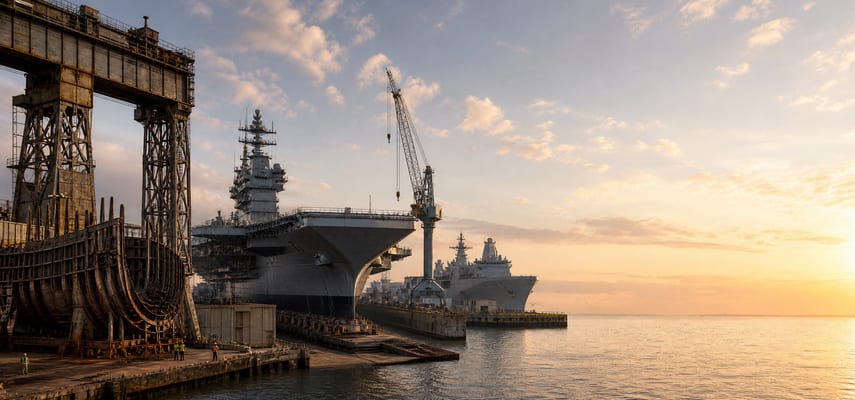
History of Huntington Ingalls Industries
The history of Huntington Ingalls Industries (HII) shows that when it appeared as an independent company in 2011 it did not emerge from nowhere. It was the product of two long-established American shipyards — Newport News and Ingalls — being folded into a single public company, carrying forward more than a century of naval construction on the Atlantic and Gulf coasts. The story of HII is therefore two stories in one: the deep technical culture of the shipyards, and the modern pressures of defense procurement, complex systems, and corporate reinvention.
Timeline: key milestones in the history of Huntington Ingalls Industries
- Late 19th century / 1886: Newport News Shipbuilding traces its lineage to this period and was founded in 1886 in Newport News, Virginia.
- 20th century: Ingalls Shipbuilding was established in Pascagoula, Mississippi, and grew into a major Gulf Coast yard for amphibious and surface combatants.
- March 2011: Northrop Grumman completed the separation of its shipbuilding operations as a stand-alone publicly traded company, creating Huntington Ingalls Industries.
- 2010s–2020s: Major program activity and industrial investments — including Ford-class carrier work and participation in long-term submarine efforts — and a focus on workforce development and digital tools.
Newport News Shipbuilding: a century of carriers
Newport News Shipbuilding traces its lineage to the late 19th century and the growth of the U.S. Navy. Founded in 1886 in Newport News, Virginia and founded by Collis P. Huntington, the yard was originally set up to build large commercial and naval vessels to serve a growing American maritime presence. Over the 20th century Newport News won contracts to build capital ships, including battleships and, later, nuclear-powered aircraft carriers. That long history built institutional knowledge about heavy industrial assembly, nuclear propulsion, and the logistics of delivering leviathan warships.
Aircraft carriers are not merely ships but floating industrial ecosystems that integrate nuclear reactors, complex electrical systems, aviation handling gear, and thousands of trained crew. Newport News developed techniques for integrating diverse systems at scale; those skills would later underpin the carrier work that carried into the Huntington Ingalls era.
Ingalls Shipbuilding: a Gulf Coast naval center
On the Gulf Coast, Ingalls Shipbuilding grew into a complementary yard focused on amphibious and surface combatants. Founded in 1938 in Pascagoula, Mississippi and founded by Robert Ingersoll Ingalls Sr., Ingalls was established to build the amphibious and surface ships the Navy required as the fleet expanded. Ingalls built guided-missile destroyers, amphibious transport docks and other major ships for the Navy and the Coast Guard. Its location and workforce made it the United States’ principal shipyard for many classes of non-nuclear surface combatants and amphibious platforms.
Ingalls’ experience with modular construction, serial production of surface combatants, and a deep supplier base in the Gulf region made it a workhorse for the Navy’s expeditionary and surface fleets. The yard’s strengths balanced Newport News’s nuclear and carrier expertise.
Spin-off and creation of Huntington Ingalls Industries (2011)
In March 2011 Northrop Grumman completed the separation of its shipbuilding operations as a stand-alone publicly traded company, creating Huntington Ingalls Industries and listing it on the New York Stock Exchange under the ticker HII. The new company brought together Newport News Shipbuilding and Ingalls Shipbuilding under a single corporate roof.
Northrop Grumman said the separation was intended to give the shipbuilding business greater strategic and customer focus, direct access to capital markets, and management attention tailored to its capital-intensive, long-cycle operations.
At independence, HII also inherited several material program- and site-level challenges from its predecessors. Notably, the San Antonio-class lead ship (LPD 17) experienced design, manufacturing and supplier-quality problems that produced a multiyear delivery delay and substantial cost growth, and the company assumed the difficult wind-down of the Avondale yard — actions that raised estimated costs on later LPD contracts and produced a significant pre-tax charge. These legacy program and facility issues shaped early contractual, staffing and cash-flow priorities for the newly independent company.
The newly independent company established its initial leadership and later set a path of services-focused acquisitions. Mike Petters became HII’s first president and CEO at the spin-off in 2011; Chris Kastner succeeded him as president and CEO on March 1, 2022, with Petters serving temporarily as executive vice chairman during the transition. In December 2016 HII acquired Camber Corporation and formed the Technical Solutions segment; on August 19, 2021 HII completed its acquisition of Alion Science and Technology and later reorganized and renamed the services group (Technical Solutions) as Mission Technologies in March 2022 as it expanded into advanced defense-technology markets.
Early years: consolidating programs and identity
Once independent, HII had to balance the predictable rhythm of long-running Navy programs with the need to modernize production methods. The company continued the core work at its two shipyards: Newport News on nuclear-powered aircraft carriers and major carrier-related sustainment; Ingalls on amphibious ships, guided-missile destroyers and other surface combatants.
At the same time HII built a services arm to offer maintenance, nuclear support and systems integration to the federal government — work that could smooth the peaks and valleys inherent in new ship procurement. That dual posture — shipbuilding and sustainment — became central to the company’s strategy.
Major platforms: carriers, amphibious ships, and the modernization impulse
HII’s program portfolio showed the contrast between the two yards’ specializations.
- Newport News continued to execute the U.S. Navy’s aircraft carrier program, including the transition from the long-running Nimitz class to the next-generation Gerald R. Ford class. Carrier work involved not only new construction but also long-term refueling and complex overhauls that sustained the fleet.
- Ingalls sustained serial production of amphibious ships and a range of surface combatants, carrying forward programs that required a steady throughput of steel, modules, and systems integration.
Technological inflection: the Gerald R. Ford class and integration challenges
The Ford-class carrier program introduced technologies such as the Electromagnetic Aircraft Launch System (EMALS) and the Advanced Arresting Gear (AAG) as part of a major redesign of the Navy’s nuclear-powered carrier. Newport News Shipbuilding, the nation’s sole designer and builder of nuclear-powered aircraft carriers, constructed the lead ship and continues Ford-class construction.
USS Gerald R. Ford (CVN-78), the first ship of the class, encountered significant technical, testing, and integration problems. Government Accountability Office and Defense Department testing reports linked immature or unreliable systems — including EMALS and AAG — to cost growth, rework, and schedule delays, while substantial corrective and completion work continued after the ship’s 2017 delivery and commissioning. The experience underscored the risks of installing and integrating immature technologies while ship construction was underway.
Industrial partnerships and submarine work
In the 2010s and into the 2020s the Navy launched additional long-term acquisition programs, among them the replacement of the Ohio-class ballistic missile submarine force. The Columbia-class program required industrial teaming between established submarine builders and shipyards capable of producing and supporting nuclear vessels. HII’s nuclear expertise at Newport News made it a key participant in the industry effort to sustain U.S. strategic submarine construction capacity.
Participation in that program meant that HII would be tied into the Navy’s most consequential procurement for strategic deterrent platforms, and it reinforced the company’s role in nuclear shipbuilding beyond carriers.
Organizational evolution: skills, safety and modern production
Through the 2010s and 2020s HII invested in workforce development, apprenticeship programs and digital tools intended to accelerate production while protecting safety and quality. Shipbuilding remains a highly skilled trade: welders, electricians, pipefitters and nuclear-trained technicians are at the core of delivery. HII’s efforts to modernize — employing modular construction, digital design and better project controls — were practical responses to the twin pressures of shrinking tolerances for cost and the Navy’s demand for a predictable delivery schedule.
Services, sustainment and the pivot toward lifecycle support
HII expanded its activities beyond pure new construction by offering sustained logistics, nuclear maintenance and technical services. Delivering carriers and amphibious ships creates a long tail of maintenance and modernization work that follows a ship over decades. Recognizing that, the company sought to capture lifecycle work — mid-life refuels, overhauls, and modernization docks — to create steadier revenue streams than the lumpy cadence of new construction contracts.
Governance, transparency and public scrutiny
As a public company built on large, visible defense programs, HII encountered the scrutiny that follows cost and schedule overruns in major weapon systems. Government oversight bodies and congressional committees focused attention on the company’s program management, supply chain performance and the Navy’s contract structures. Such oversight aimed to protect taxpayer interests and to push the industry toward more reliable performance.
Why these developments mattered
Taken together, the company’s program mix, technological challenges, workforce investments and governance environment explain why HII’s performance matters to the Navy, to voters and to local economies. Delays or rework on flagship platforms affect operational planning and budget estimates; investments in workforce and digital practices influence quality and schedule; and public scrutiny shapes contracting incentives that determine how risk is allocated between industry and government.
Recent years: steadying production and digital transition
In the years after the company’s formation, HII’s priorities centered on converting lessons from the Ford-class to more predictable production practices, supporting long-term submarine programs, and strengthening the supply chain for serial production at Ingalls. The company also continued to expand its services and sustainment offerings so that it could balance the peaks and troughs of new construction programs. As of 2024, HII also reported and continued activity on major submarine workstreams: the company was awarded contracts to construct Columbia-class submarine modules and described its Newport News yard as a key participant in nuclear submarine module construction and support.
Two practical themes dominated HII’s more recent efforts:
- Production reproducibility. HII focused on techniques to make serial building more predictable — standardizing modules, improving quality control early in the cycle, and reducing the need for late-stage rework.
- Digital integration. The yard increasingly adopted digital design tools and model-based engineering to detect fit and interface problems on paper before steel arrived at the yard. This shift aimed to reduce costly retrofits and shorten test cycles.
Community, workforce and the national industrial base
HII’s shipyards are anchors in their respective communities. Jobs in skilled trades, supplier networks of small and medium-sized firms, and the local economic activity surrounding a major yard mean that HII’s fortunes have ripple effects beyond its balance sheet. During periods of program growth the yards generate hundreds of supplier contracts and maintain apprenticeship pipelines; during downturns, the effect is felt across entire regional economies.
Beyond simple economics, shipyards preserve trades that are vital to national security. Policies that sustain yards — whether to maintain surge capacity for wartime production or to ensure continuity in nuclear ship maintenance — are often debated in Congress because they have real local and strategic consequences.
Challenges ahead: schedule, suppliers and national demand
HII’s future depends on several interlocking factors that are not entirely under the company’s control. The Navy’s procurement decisions — the size and composition of future carrier and submarine buys, as well as the schedule for amphibious and surface combatant classes — determine the company’s backlog. Supplier health is another limiting factor: many critical components are produced by a handful of specialized firms. Finally, the company must continue to adapt its production processes to meet modern systems-integration demands.
The interaction between customer demand, supplier capacity and internal execution determines whether the company can deliver complex platforms on time and at planned cost. Missed assumptions in any of those elements reverberate through program cost growth and schedule slips.
Why Huntington Ingalls Industries matters today
HII occupies a particular place in the U.S. defense industrial landscape. The company handles ship classes that are central to the Navy’s ability to project power and to sustain deterrent and amphibious capability. Its two major yards are repositories of unique skills in nuclear propulsion, carrier aviation systems, and high-complexity surface ship construction.
That combination — deep technical specialty, large-scale industrial capacity, and a workforce trained in the trades the Navy cannot easily replace — makes HII a strategic asset for national defense. It also makes the company a bellwether for whether the U.S. industrial base can modernize to deliver 21st-century naval forces on predictable schedules.
Conclusion: the history and strategic importance of Huntington Ingalls Industries
Huntington Ingalls Industries is the modern steward of a long American shipbuilding tradition. Formed in 2011 from venerable yards, the company’s recent decades have been defined by the demands of integrating new technologies, sustaining aging fleets, and industrializing complex production. The stakes are practical and strategic: whether carriers, submarines and amphibious ships appear on schedule affects naval readiness, congressional budgets and regional economies. HII’s history is therefore both an industrial chronicle and a continuing lesson about how to build and sustain the platforms that undergird maritime power.












