










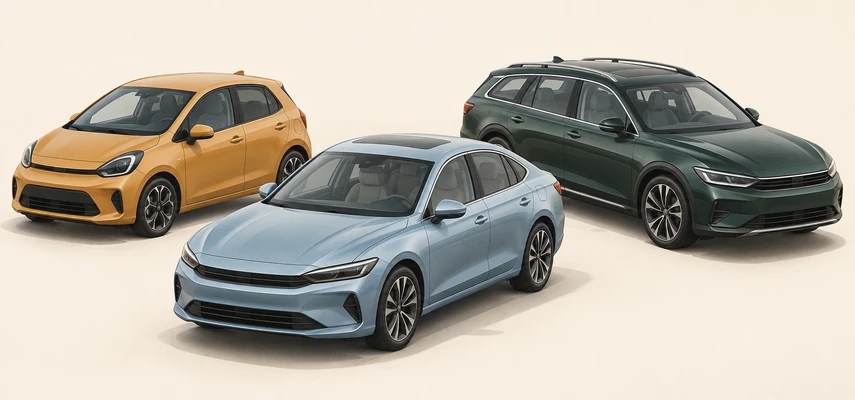

A slight movement of a foot can send a machine weighing well over a ton rolling toward the horizon. Another pedal brings it back to a stop. Meanwhile, the people inside can discuss dinner as if moving themselves, their luggage and a small living room down the road were entirely ordinary.
What is an automobile, once we stop taking that trick for granted? It’s a passenger vehicle that carries its own means of propulsion and travels on roads. But the interesting answer lies underneath: a car combines energy conversion, control, shelter and manufacturing in one object that an ordinary person can operate.
Understanding those connections makes almost any car more interesting. A modest hatchback has to solve many of the same fundamental problems as an expensive grand tourer. The budget changes; gravity remains remarkably indifferent.
What makes an automobile a car?
In everyday language, automobile usually means a self-propelled road vehicle designed primarily to carry people. Most modern examples have four wheels, a passenger compartment and space for belongings. Sedans, hatchbacks, sports cars and many SUVs fit that broad description, despite their different shapes.
The boundaries aren’t perfectly tidy. A motorcycle also carries people using its own motor, but belongs to a different vehicle family. A bus prioritizes carrying larger groups; a freight truck prioritizes goods. A train follows rails, while a car can choose its route through a road network. Legal classifications vary, so this everyday definition isn’t a substitute for registration rules.
Nor does automobile mean gasoline-powered. An electric car is still a car, and an early three-wheeler doesn’t cease to count because it lacks a fourth wheel. The National Motor Museum describes Karl Benz’s three-wheeled petrol vehicle as an important early motor car. Familiar appearance is a useful clue, rather than a complete definition.
Every journey starts with stored energy
A stationary car needs a source of energy before it can move. In a gasoline car, fuel stores chemical energy. Burning it inside the engine releases heat; expanding gases push moving parts, which turn a shaft. That rotation can then be delivered to the wheels. The engine converts energy rather than creating it.
Diesel engines follow the same broad fuel-to-motion idea, although their ignition method differs. The Department of Energy’s guide to gasoline-car components distinguishes the usual spark ignition of gasoline engines from the compression ignition used in diesels. Those details matter, but the introductory point is simpler: the fuel tank stores energy, and the engine turns some of it into mechanical work.
A battery-electric car follows another route. Its traction battery stores energy electrochemically; power electronics manage the electrical supply to a motor, which produces rotation. The Department of Energy’s electric-car component guide shows this relationship between battery, controller, motor and wheels. A hybrid combines combustion and electric propulsion, with the arrangement varying by design.
Picture two kitchens preparing the same meal with different appliances. The equipment and supply arrangements change, while the purpose remains recognizable. Likewise, combustion and electric cars solve the same transportation problem through different energy pathways. Comparing them properly means examining the whole system, rather than treating one missing component as the entire story.
Getting rotation to the road
An engine or motor is only part of the propulsion system. The powertrain is the collection of components that produces and delivers driving power. The drivetrain generally refers to the parts carrying that power toward the driven wheels, although usage varies between sources and manufacturers.
A transmission matches the power source’s rotation to the job at the wheels. Think of bicycle gears: starting uphill calls for a different relationship between pedaling and wheel rotation than cruising on level ground. Many combustion cars use several gear ratios because their engines work usefully within a limited speed range. Many electric cars use a single fixed reduction ratio, rather than a conventional multi-speed gearbox; SAE describes the popularity of single-speed electric gearboxes.
Further along, shafts and related components carry rotation to the driven wheels. A differential commonly allows the left and right driven wheels to turn at different speeds on a curve. Some cars drive the front wheels, others the rear wheels, and others both axles. These are alternative engineering layouts, rather than a simple ranking from bad to good.
Finally, the tires push against the road, and the road pushes back on the car. More engine output is of limited help if that contact cannot support the requested force. NHTSA’s tire guidance explains the importance of tread, condition and correct inflation. Acceleration, braking and steering all depend on those unglamorous patches of rubber doing their work.
The rest of the car makes movement usable
Propulsion gets the headlines, but a car that only accelerates would be a rather incomplete purchase. It must support its occupants, follow a chosen path, manage uneven surfaces and slow down predictably. Those jobs require several systems working together.
Structure, suspension and steering
The body encloses people and luggage; the underlying structure carries loads and holds major components in position. In many passenger cars, the body and load-bearing structure form an integrated assembly. Other vehicles use a separate frame. Either way, the structure has to withstand everyday forces while helping manage a crash.
Suspension lets the wheels move relative to the body as the road changes height. Springs support loads and allow movement; dampers control that movement so the car doesn’t continue bouncing. The UK’s vehicle-inspection manual treats springs and shock absorbers as distinct suspension components. Steering changes the direction of the wheels to guide the vehicle. Their interaction helps explain why a comfortable ride and accurate control require more thought than simply fitting soft seats.
Brakes, protection and electronic coordination
Conventional friction brakes turn motion into heat. Pressing pads against a disc is one common arrangement. Electrified cars can also recover some energy through regenerative braking, using a motor as a generator. They still need a means of stopping when regeneration is limited or insufficient.
Electronics help coordinate these mechanical systems. For example, Transport Canada explains electronic stability control as a system that can apply braking to individual wheels when the vehicle begins to lose directional stability. Its usefulness depends on available grip; software cannot negotiate an exemption from physics.
Crash protection has another job: reducing harm if a collision happens. Occupant restraints and a carefully designed structure complement measures intended to prevent the crash in the first place. Meanwhile, driver assistance should be understood according to its actual capabilities. NHTSA’s automation guidance distinguishes assistance that requires attentive supervision from systems with greater driving responsibility. An impressive dashboard isn’t evidence that a car can drive itself.
Why no car can be best at everything
Imagine specifying a vehicle for narrow city streets, long family trips and occasional muddy tracks. A shorter body helps with parking, but leaves less room to arrange passengers and luggage. Greater ground clearance can help over obstacles, while changing the vehicle’s proportions and engineering requirements. Each decision creates work somewhere else.
Energy use makes the tradeoffs especially visible. Accelerating mass takes energy; moving through air and rolling tires also require it. The government’s vehicle energy-flow explanation shows how fuel energy is divided among useful movement, engine and drivetrain losses, accessories and braking losses. Quiet cabins and comfortable temperatures also require materials, equipment or energy.
Consequently, a car’s quality depends on how well its choices fit its purpose. A light city car needn’t imitate a long-distance luxury sedan to be thoughtfully engineered. Conversely, an excellent highway cruiser may be awkward in an old town with tight parking. Cost adds another constraint: money spent on one feature is unavailable for another unless the selling price rises.
Good design makes those compromises feel coherent. Controls should be understandable, seats should suit their occupants, and useful space should be accessible. An expensive material can be pleasant, but the shape of a door opening may matter more during a week of loading a child seat. Engineering excellence often appears in things that simply don’t become irritating.
From experimental machine to everyday product
The automobile didn’t arrive fully formed from one workshop. Steam, electric and gasoline vehicles were all part of its early development. The Department of Energy’s history of the electric car describes electric vehicles emerging in the nineteenth century and competing with other forms of propulsion. Electric motoring is therefore an old idea undergoing new development, rather than a concept invented alongside the smartphone.
Benz’s 1886 patent is a major landmark in the gasoline car’s development, but turning a workable invention into everyday transport required much more. Manufacturers needed repeatable parts, reliable production and ways to sell and maintain vehicles. Roads and energy supplies also had to support their use beyond an experimental demonstration.
The Henry Ford’s assembly-line collection documents the moving automobile assembly line introduced at Ford’s Highland Park plant in 1913. Bringing work to workers helped change production economics. Ford didn’t invent the automobile; the achievement lay in making a particular approach to building cars work at far greater scale.
That distinction matters. A brilliant prototype proves that something can be done. A useful industry must also build it repeatedly, supply replacement parts and make ownership manageable. The car in a driveway is evidence of both mechanical ingenuity and a much larger system of factories, suppliers, workshops and infrastructure.
A machine that reshaped its surroundings
Personal cars let people arrange journeys around their own destinations and departure times, subject to roads, traffic and the cost of ownership. That flexibility changed where people could live, work, shop and spend leisure time. It also encouraged places to spread out in ways that could make a car increasingly necessary.
The Smithsonian’s City and Suburb exhibition uses Park Forest near Chicago to show suburban life organized around family cars. The relationship runs both ways: transport changes development, and development changes the transport people need. Parking, road space, pollution and collision risks belong in the account alongside freedom of movement.
Cars also became objects through which people express taste. Size, color, proportions, materials and even the sound of a closing door communicate choices about how a machine should feel. A humble runabout can be as revealing about its place and period as an extravagant collector’s car. Price alone explains neither.
The next time a car pulls away, consider what has quietly agreed to cooperate: stored energy, rotating machinery, tires, structure, controls and the people who designed and built them. The everyday miracle isn’t simply that the car moves. It’s that such a complicated collection of decisions can feel like one understandable object beneath a driver’s hands.










