










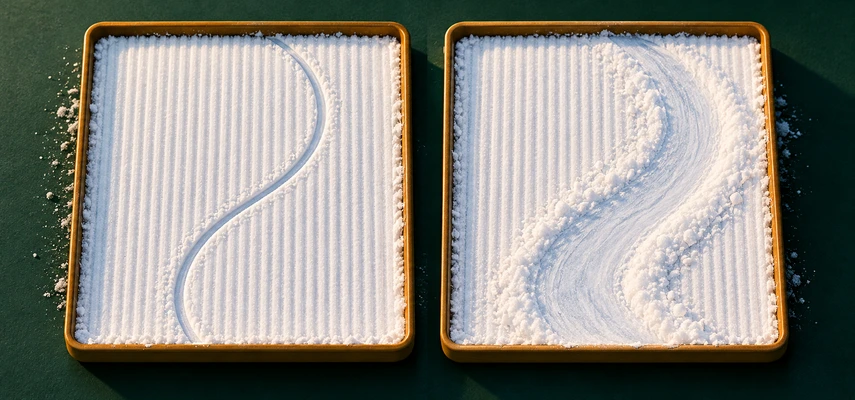

A snowboarder draws a beautifully thin curve across fresh corduroy. Another rider leaves a broad fan of scraped snow. It’s tempting to give the first one a gold star and ask the second to practice more. The snow, however, hasn’t told you what either rider was trying to accomplish.
Perhaps the first rider had an empty groomer. Perhaps the second was deliberately slowing for a busy junction. A turn is useful when it fits the situation. Its track is evidence of how the board moved, not a complete report on the rider’s judgement.
Carving and skidding describe different relationships between the board and its path. Understanding that difference makes both more useful—and helps explain why a good rider doesn’t spend an entire day trying to eliminate every sideways slip.
The difference is under the board
Picture the nose and tail moving through a turn. In a substantially carved turn, the engaged edge guides the board along a curve, with the tail following close to the nose’s path. There is relatively little sideways movement across that path.
In a skidded turn, the board also moves sideways relative to the direction its length is pointing. Its edge can still engage the snow, but the tail follows a wider or different path from the nose. That movement brushes snow into a broader track.
The distinction isn’t whether the board is on edge. A skidded turn normally uses an edge too. Nor is it whether the rider is turning: both methods change direction. The useful distinction is how much the board travels along its edge compared with how much it slips across the snow.
The AASI technical performance guide distinguishes skidded and carved outcomes while treating both as part of riding performance. These aren’t separate sports, and neither tells the whole story of someone’s ability.
Why a carved turn leaves a narrow track
Tip a suitably shaped snowboard against supportive snow and its curved edge can help guide a turning path. The board’s flex and the pressure acting through it affect that path. Rather than pushing a broad strip of snow sideways, the edge follows a comparatively narrow channel.
You can imagine a curved blade following its own cut. The analogy has limits—the snowboard bends, the snow deforms and the rider moves—but it captures the difference between following a line and brushing across one.
Sidecut, the inward curve along the board’s sides, contributes to this behavior. It doesn’t independently dictate one exact turning radius. Snow conditions, tilt, loading and construction all affect what the board actually does.
A narrow track is therefore a useful clue, not a miniature engineering certificate. Some sections may drift, and soft or irregular snow can make the evidence ambiguous. The track needs to be interpreted alongside the rider’s movements and the surface.
Why a skidded turn brushes snow sideways
Rotate a moving board so its length points at an angle to its actual travel and some motion happens across the board rather than directly along it. The engaged edge and base interact with the surface, displacing and scraping snow as the board continues through the turn.
The rider can regulate that interaction. A low, progressive edge angle may permit a smooth controlled slip; a different combination of tilt, pressure and pivot can increase braking. None of those movements works independently of the snow beneath the board.
Don’t confuse a deliberate skid with an accidental slide. A rider who can choose the amount and timing of sideways movement has a tool. A rider whose edge breaks away unexpectedly has a problem to investigate. The resulting tracks may look similar for a moment while the degree of control is entirely different.
This is one reason instruction matters. A coach can observe the intended task as well as its outcome, rather than diagnosing every broad track as the same mistake.
What happens to speed?
Skidding commonly dissipates more energy through sideways snow interaction than a comparatively clean carve. That makes it useful for adjusting speed. Carving often preserves more momentum, which helps explain its flowing feel—and why a rider may reach the next turn sooner than expected.
But neither label predicts your speed by itself. Gravity, slope angle, snow resistance and the route all matter. A long traverse may reduce downhill progress, while a direct line toward the fall line can build speed even if the board is scraping.
Imagine two riders leaving the same point. One follows a rounded arc that spends substantial time across the slope. The other makes small sideways checks while continuing almost straight downhill. You can’t settle which will be slower simply by identifying who skidded more.
The PSIA-NW snowboard guide treats turn shape and speed management as connected outcomes. That’s the practical lesson: judge the whole route and its result, not just the sound coming from the edge.
Different turns need different space
A carved arc can carry the rider across a significant part of a trail. The available space must suit the board’s path, the rider’s control and everyone else using the run. A clean carve doesn’t grant right of way over a person ahead.
A skidded turn can offer more freedom to redirect or shorten a route, but that doesn’t make every sudden sideways movement considerate or controlled. Abrupt braking beside another person can create a collision risk. Space and predictability remain essential.
Choose movements according to visibility and traffic before thinking about the prettiest line. The NSAA Responsibility Code requires control and avoidance of people downhill or ahead, with uphill checks before starting or entering a trail.
If the route doesn’t provide room for your intended arc, change the plan. The trail isn’t obliged to accommodate the turn you practiced yesterday.
Most riding lives between the labels
Everyday turns frequently blend carving and skidding. A rider might allow some drift while establishing direction, then guide the board more cleanly along the edge. Another turn might begin with firm edge guidance and finish with deliberate slip to manage speed.
Those combinations aren’t automatically compromises. They can be purposeful responses to terrain, snow and traffic. A rigid demand for a completely carved turn may remove the very adjustment the situation requires.
It’s useful to describe which part of the turn does what. Saying that the tail drifts during the middle of the heel-side turn gives an instructor more information than announcing that you can’t carve. Saying you intentionally brushed speed before a narrow section communicates something different again.
The labels become most useful when they help you notice and choose board behavior. They become less useful when they turn into badges of membership.
Where each approach earns its place
Consistent groomed snow, appropriate pitch, good visibility and ample space can make carving enjoyable to explore. The edge can find support, the surface is relatively predictable and the rider has room to let an arc develop.
That doesn’t make carving the automatic answer to firm snow. Very hard surfaces may provide less penetration and require finely managed movements. Adding angle or force without the necessary grip can lead to a loss of support. An instructor should assess the conditions and the rider’s readiness.
Skidded movements are particularly useful when adjusting speed, organizing early turns or making tactical changes to a route. They remain relevant as riders develop. The beginner’s controlled brushed turn is a foundation worth refining, not an embarrassing habit to conceal.
Deep or irregular snow introduces other interactions and deserves its own instruction. Avoid extending a groomer-based explanation into a promise that one turn style will solve every surface. A board doesn’t read the chapter headings before meeting a snowbank.
Learn to recognize an intentional change
On terrain selected by an instructor, you can compare small, manageable tasks: a controlled brushed arc and a short edge-guided arc, for example. The aim is to feel a difference without needing extra speed or a steeper slope.
Notice the sound, the pressure through the boots and the way the board follows your intended route. From a suitable visible stopping place, inspect the tracks if they’re still identifiable. REI’s beginner guide describes progressive turning tasks that can give these observations a practical foundation.
Don’t look over your shoulder while moving simply to grade the track. Don’t arrange experiments across traffic or ask a friend to stand in a blind spot with a phone. The observation should fit the run, not take priority over it.
A useful outcome is being able to say what you intended, what happened and whether speed stayed manageable. It isn’t achieving a perfectly narrow mark on every attempt.
Equipment influences the conversation
Board shape, flex, edge condition and the boot-binding connection all affect the response to your movements. They don’t make a good turn inevitable. A specialized setup can’t choose a suitable route or notice someone entering the trail.
If an edge repeatedly releases in situations where you previously had reliable grip, ask an instructor and qualified shop to help separate movement issues from equipment concerns. Don’t assume the solution is sharper edges, a stiffer board or an aggressive binding change.
Suitable fit and properly maintained compatible equipment provide a clearer starting point. Once those are established, you can learn which adjustments change the board’s behavior and which merely add effort.
Two tools, better choices
Carving offers the particular pleasure of following a clean edge-guided arc. Skidding offers adjustable sideways movement that can help shape a route and manage speed. Both require skill when performed deliberately and precisely.
The rider worth watching isn’t necessarily the one leaving the thinnest line. It’s the one who notices the changing situation and selects a turn that fits it, with enough control to change the plan again.
Once you understand that, tracks become more interesting. A pencil line shows one kind of movement. A broad brushstroke shows another. The real achievement is knowing which mark you meant to leave—and why it belonged there.












