










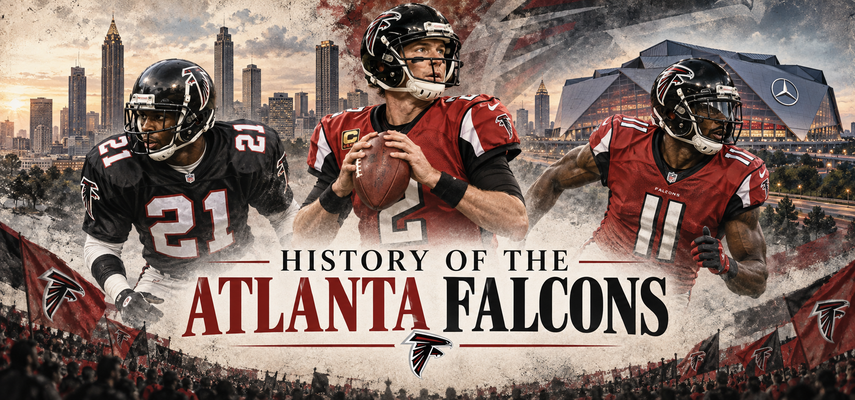

The Atlanta Falcons’ history combines long rebuilding periods with teams that came close to the sport’s highest prize. Early defensive stars established credibility, the 1998 Dirty Birds brought a first Super Bowl appearance and Matt Ryan later led an exceptional offense to another. Those achievements coexist with painful postseason defeats and repeated efforts to sustain success. Atlanta’s identity has changed across outdoor football, the Georgia Dome and Mercedes-Benz Stadium, while remaining tied to a growing Southern sports city. This account follows the franchise through the completed 2025 season and distinguishes those results from the leadership changes of 2026.
Franchise at a glance
| Field | Details |
|---|---|
| Founded | June 30, 1965; NFL franchise awarded |
| First season | 1966, National Football League |
| Original city and name | Atlanta, Georgia — Atlanta Falcons |
| Current city and name | Atlanta Falcons; Atlanta, Georgia |
| Previous cities and names | None |
| League and conference/division | NFL — National Football Conference South |
| Home venue | Mercedes-Benz Stadium; opened in 2017 |
| League championships | 0 Super Bowl victories |
| Other recognized championships | 2 NFC championships: 1998, 2016 |
| Historical coverage | 2025 NFL season, including postseason completed in February 2026; later developments through October 16, 2026 |
Origins and early years
The NFL awarded Atlanta an expansion franchise in June 1965, with Rankin Smith becoming its founding owner. The team began play in 1966, providing a major professional football identity for a city whose sports ambitions were expanding quickly. A public naming process produced Falcons, and strong early ticket demand demonstrated local enthusiasm even before the organization had played a regular-season game.
Norb Hecker became the first head coach, while linebacker Tommy Nobis was the first draft selection. Nobis represented the sort of foundational talent an expansion team needed: a player around whom standards could develop before the roster as a whole became competitive. Atlanta lost its first nine games before defeating the New York Giants for its inaugural victory. The early years demanded patience from supporters at Atlanta-Fulton County Stadium. The franchise had established a place on the NFL map, but creating a dependable winning team would prove much harder than generating initial excitement. Its later history would repeatedly return to that difference between promise and sustained performance.
Defining eras
1966–1982: Building credibility through defense
Atlanta’s first decade brought gradual improvement rather than an immediate breakthrough. Nobis gave the defense a respected leader, and Claude Humphrey developed into an exceptional pass rusher. Norm Van Brocklin coached the team to its first winning season in 1971. The franchise remained uneven, but those players and occasional strong seasons helped establish a football identity beyond the novelty of expansion. Supporters could identify real strengths even when the overall record remained disappointing.
The defense reached a remarkable level in 1977, allowing only 129 points across a fourteen-game season. Leeman Bennett’s teams then made the playoffs in 1978, 1980 and the strike-shortened 1982 season. Steve Bartkowski and William Andrews helped the offense develop alongside the established defensive tradition. The 1978 wild-card victory over Philadelphia was Atlanta’s first postseason win. A division title in 1980 raised expectations further, although the team did not reach the Super Bowl. These years supplied the franchise’s first sustained evidence that it could compete seriously.
1983–1997: A changing personality and a new indoor home
The Falcons struggled to sustain the progress of Bennett’s best teams. Coaching changes and inconsistent results kept them from becoming regular contenders, even while individual players supplied memorable performances. Deion Sanders’ arrival gave Atlanta a nationally recognizable personality whose coverage, returns and confidence changed the team’s public image. Under Jerry Glanville, the 1991 Falcons returned to the playoffs and defeated New Orleans before Washington ended their run.
The franchise moved into the Georgia Dome in 1992, replacing its outdoor home with a setting that would host the next major chapters. The new venue did not immediately resolve the football problems. Atlanta continued to search for the combination of coaching, quarterback play and roster balance needed to become dependable. Dan Reeves’ arrival eventually gave the organization another experienced leader. By the late 1990s, a team built around a physical running game and an effective passing attack was beginning to emerge, setting up a breakthrough few of the preceding seasons had suggested was imminent.
1998–2000: The Dirty Birds reach the Super Bowl
The 1998 Falcons produced the best season of their history to that point. Jamal Anderson’s running supplied the offense’s physical center, Chris Chandler directed the passing game and the defense helped make the team difficult to beat. Atlanta finished 14–2 and adopted a celebratory personality associated with the Dirty Bird dance. The excitement reflected both a talented roster and the novelty of seeing this franchise remain near the top of the conference all season.
The decisive breakthrough came at Minnesota in the NFC Championship Game. Atlanta won 30–27 in overtime against a heavily favored opponent, earning its first Super Bowl appearance. Denver defeated the Falcons 34–19 in Super Bowl XXXIII, preventing the season from ending with a league title. The following years did not reproduce the same level of success. Nevertheless, the 1998 team permanently changed the franchise’s reference points. Atlanta now had a conference championship, a recognizable signature team and an example of how its strongest players could combine into a genuine contender.
2001–2007: Vick changes the possibilities
Michael Vick arrived as the first overall draft choice in 2001 and introduced a different kind of quarterback threat. His speed and ability to escape pressure gave Atlanta an offense that could change a game outside its original design. Arthur Blank bought the franchise in 2002, beginning a new ownership period. That season’s playoff victory at Green Bay became one of the young quarterback’s defining early moments.
Jim Mora coached the Falcons to the NFC Championship Game following the 2004 season, where Philadelphia ended their run. The team’s promise did not become a stable championship cycle. Vick’s federal dogfighting conviction and suspension removed its central player, while Bobby Petrino’s brief 2007 tenure ended before the season was complete. The organization faced both football and reputational damage. Atlanta needed a different leadership structure and a new offensive foundation, making the following draft and coaching decisions unusually important to the franchise’s recovery.
2008–2017: Ryan leads another championship opportunity
Matt Ryan and head coach Mike Smith arrived in 2008 and immediately restored credibility. Ryan developed with receivers including Roddy White and later Julio Jones, while Atlanta became a regular playoff participant. The 2012 team reached the NFC Championship Game but lost narrowly to San Francisco. Another coaching transition brought Dan Quinn in 2015, with offensive coordinator Kyle Shanahan helping build a particularly productive attack.
Ryan earned AP NFL MVP honors for the 2016 season, and Atlanta defeated Green Bay 44–21 for its second NFC title. Super Bowl LI produced the franchise’s most painful defeat: New England recovered from a 28–3 deficit and won 34–28 in overtime. The result does not erase the offense’s excellence, but it remains central to how that team is remembered. Mercedes-Benz Stadium opened in 2017, and the Falcons returned to the playoffs, winning at Los Angeles before Philadelphia ended their run. Sustaining the contender beyond that period proved difficult.
2018–2025: The long search for another stable contender
The seasons after the second Super Bowl run brought declining results and a gradual separation from the Ryan-era core. Quinn’s tenure ended during 2020, and Arthur Smith coached the next rebuilding phase. Julio Jones and later Ryan departed, changing an offense whose leading partnership had defined much of the preceding decade. The team continued to invest in skill-position talent without finding a lasting combination that returned it to the postseason.
Raheem Morris became head coach in 2024. Kirk Cousins’ arrival and the selection of Michael Penix Jr. created another consequential quarterback transition, but neither that season nor the next produced a playoff appearance. Atlanta finished 2025 at 8–9. The outcome extended the gap since its last postseason following the 2017 season and led to another reorganization. The franchise’s challenge remained familiar: translating individual ability and short periods of promise into the stable performance needed to join the conference’s strongest teams again.
Recent history
Atlanta completed the 2025 regular season 8–9 and missed the playoffs. The franchise’s most recent completed postseason appearance therefore remained the 2017 campaign. Its title record still consisted of two NFC championships and no Super Bowl victories, with the 1998 and 2016 seasons supplying the two conference-winning teams.
The organization changed its leadership structure for 2026. Former quarterback Matt Ryan became president of football, Kevin Stefanski was hired as head coach and Ian Cunningham became general manager. Those appointments began a new chapter under Blank’s ownership rather than changing the franchise’s statistical continuity. As of October 16, 2026, the new season remained underway and its final record and playoff outcome were not known. Mercedes-Benz Stadium continued as Atlanta’s home. The account therefore distinguishes the verified results of Morris’ final completed season from the still-unfinished work of the new football leadership.
Greatest players and influential figures
Tommy Nobis
Nobis was the franchise’s first draft choice and gave the expansion defense a player around whom to establish its standards. His tackling and leadership became associated with Atlanta’s earliest identity. His importance extends beyond the first teams’ difficult records to the credibility he supplied during the organization’s formative years.
Claude Humphrey
Humphrey gave Atlanta an exceptional defensive end during years when the team struggled to sustain success. His pass rushing helped make the defense a respected unit before the franchise became a regular playoff participant. His later Hall of Fame recognition reflected a career whose central early chapter belonged to the Falcons.
Deion Sanders
Sanders brought exceptional coverage, return ability and an unmistakable personality to Atlanta. His early Falcons years helped change the team’s national visibility and contributed to the 1991 playoff run. Championships he later won elsewhere belong to those teams and do not add Super Bowl victories to Atlanta’s franchise record.
Jamal Anderson
Anderson’s powerful running gave the 1998 Falcons a dependable offensive center. His workload and celebratory Dirty Bird identity became closely associated with the franchise’s first Super Bowl team. The peak was relatively brief, but its importance to Atlanta’s first conference championship makes him an essential figure in that era.
Matt Ryan
Ryan supplied long-term quarterback stability, led repeated playoff teams and earned AP NFL MVP honors for the 2016 season. His partnership with Jones helped produce the franchise’s second Super Bowl appearance. His 2026 return as president of football opened a separate executive chapter after his playing career.
Julio Jones
Jones’ speed, size and ability to make difficult catches gave Ryan an exceptional receiving partner. He became central to the offense that reached Super Bowl LI and produced numerous memorable performances. His later seasons with other teams belong to his wider career rather than extending his Atlanta playing tenure.
Dan Reeves
Reeves coached Atlanta to its first NFC championship and Super Bowl appearance. His 1998 team combined a powerful running game with experienced quarterback play and a competitive defense. That achievement gave the franchise a new historical benchmark after years in which individual promise had rarely produced sustained championship contention.
Arthur Blank
Blank’s ownership began in 2002 and encompassed the Vick and Ryan eras, three conference-final runs and the move to Mercedes-Benz Stadium. His role includes the broader organization and its relationship with Atlanta. Repeated leadership changes also form part of his continuing effort to build a consistently successful football operation.
Championships and postseason milestones
Atlanta’s two NFC championships led to Super Bowl appearances but not Super Bowl victories. Listing both rounds shows the full outcome of each run without treating a conference title as a league championship. The season year remains the same even when the corresponding championship game or Super Bowl occurred the following January or February.
On smaller screens, scroll horizontally to see all columns.
| Season/year | Competition | Opponent | Result | Defining figure(s) |
|---|---|---|---|---|
| 1998 | NFC Championship | Minnesota Vikings | Won 30–27, overtime | Jamal Anderson; Chris Chandler; Dan Reeves |
| 1998 | Super Bowl XXXIII | Denver Broncos | Lost 19–34 | Jamal Anderson; Chris Chandler |
| 2016 | NFC Championship | Green Bay Packers | Won 44–21 | Matt Ryan; Julio Jones; Dan Quinn |
| 2016 | Super Bowl LI | New England Patriots | Lost 28–34, overtime | Matt Ryan; Julio Jones; Dan Quinn |
Rivalries, venues and team identity
Rivalries
New Orleans is Atlanta’s most deeply rooted divisional rival, combining regional proximity with decades of close competition. Carolina and Tampa Bay complete the NFC South schedule. Postseason meetings with Minnesota, San Francisco and New England add important historical episodes without replacing the recurring significance of the Saints matchup.
Home venues and traditions
Atlanta-Fulton County Stadium housed the early years, the Georgia Dome the first two Super Bowl runs and Mercedes-Benz Stadium the period beginning in 2017. Red, black and the falcon emblem connect those settings. The Dirty Bird celebration remains a particularly recognizable tradition associated with the breakthrough 1998 team.
Retired numbers and team honors
Atlanta recognizes major contributors through its Ring of Honor rather than officially retiring jersey numbers. Honorees include early leaders such as Nobis and Bartkowski, along with Ryan and owner Blank. The tributes preserve different parts of the franchise’s story, while Humphrey’s and Sanders’ Canton recognition represents a separate professional distinction.
Legacy
Atlanta’s strongest teams demonstrated that the franchise could reach the edge of a championship, while its longer rebuilding periods revealed how hard that level is to sustain. The Dirty Birds and the Ryan-led offense gave supporters distinct versions of success, each ending with an unresolved final step. The Falcons’ history also follows Atlanta’s development through changing venues and generations of players. Its next durable contender will inherit both the accomplishments and the disappointments of those earlier teams, adding to a record that remains ambitious, uneven and closely tied to its city.
Where to eat in Atlanta
Planning a visit? Explore our best restaurants in Atlanta guide.












