History of HF Sinclair
HF Sinclair Corporation is the public company established through a March 2022 holding-company reorganization and the acquisition of Sinclair Oil, alongside Holly Energy Partners’ acquisition of Sinclair Transportation. It combines refining, renewables, midstream and branded fuel-marketing operations under a single corporate identity.
A dinosaur and a refiner meet: why HF Sinclair matters
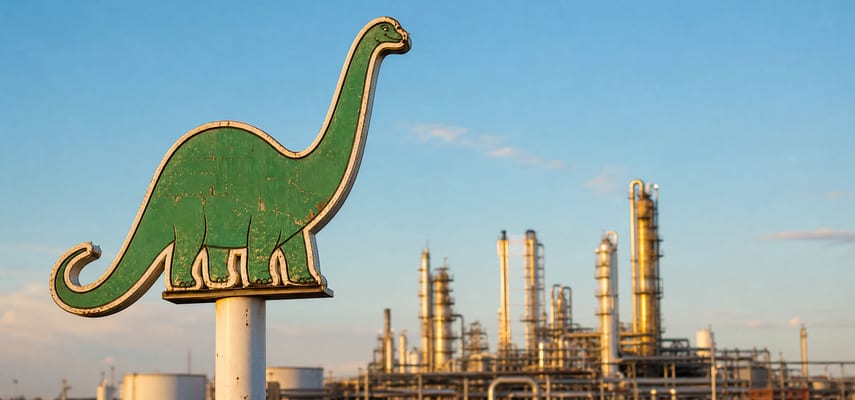
HF Sinclair is a recent corporate fusion whose odd pairing—one century-old oil brand and a modern independent refiner—helps explain why the company exists. The dinosaur logo of Sinclair Oil is one of the most durable brand images in American retail gasoline; HollyFrontier was a practical, operationally focused refinery company.
Their combination in 2022 created a single public company that married a widely recognized consumer brand with a network of refinery and midstream assets. That combination, not simply the name, is the underlying story: HF Sinclair is an attempt to reconnect downstream production with a retail identity at scale in an era when refiners face changing fuels, volatile margins, and shifting investor expectations.
Origins: Sinclair’s 1916 founding and the iconography of Dino
Sinclair’s origins are among the best-documented pieces of the HF Sinclair story. Harry F. Sinclair founded Sinclair Oil in 1916, building his business in the era when motor fuel was becoming an everyday commodity. Through the 1920s and 1930s Sinclair expanded its refining and marketing presence and adopted a prehistoric theme that became central to its public image.
The green dinosaur—commonly referred to as “Dino”—was introduced in the 1930s and later became a visible part of Sinclair’s station signage, promotional materials, and sponsorships. That mascot turned Sinclair into more than a local refiner; it became a consumer-facing brand.
Sinclair’s early history is not free of controversy. Harry F. Sinclair and his Mammoth Oil Company were central to the Teapot Dome scandal after Interior Secretary Albert B. Fall leased the federal Teapot Dome oil reserve to Mammoth. Sinclair was acquitted of conspiracy to defraud the government, but he later served prison time for contempt of Congress and contempt of court arising from the investigation and trial. The scandal left a long shadow over early federal oil politics and is one of the reasons the Sinclair name figures in American industrial history as well as in retail petroleum folklore.
HollyFrontier: a modern independent refiner
HollyFrontier represented the operational, industrial half of the later HF Sinclair equation. Operating refineries, marketing fuels to wholesalers and retailers, and supplying asphalt and other products, HollyFrontier evolved through acquisitions and organic investment into one of the larger independent refiners in the United States.
It headquartered operations in Dallas and concentrated on midsize refineries and conversion units that could process a range of crudes. Unlike integrated majors, HollyFrontier’s business emphasized refining margins, feedstock flexibility and cost control—attributes that made it a potential consolidator in a fragmented downstream sector.
Management emphasized asset-level optimization: improving throughput, converting simpler refineries to handle heavier, cheaper crudes, and maintaining a low-cost supply chain. Those capabilities became part of the operational rationale for the later combination: the company brought the industrial muscle while Sinclair supplied an enduring consumer brand and retail footprint.
How Sinclair remained a retail brand while changing owners
Across the 20th and 21st centuries Sinclair’s public-company ownership changed several times. The Sinclair name continued to live largely as a brand for retail gasoline, even as the corporate entities behind it evolved. Through licensing, regional marketing agreements and selective ownership stakes, the Sinclair dinosaur retained visibility at service stations across the United States.
That continuity in branding is critical to understanding the 2022 transaction: Sinclair offered a recognizable route to market that refiners covet when they want to capture more margin by controlling both production and retail sales.
Reasons for consolidation in refining before 2022
The years before the HF Sinclair deal saw a broader industry trend: independent refiners consolidated to gain scale, spread fixed costs across more throughput and secure outlets for product. Refining margins are cyclical and sensitive to regional supply-demand imbalances; owning retail outlets or long-term supply contracts can blunt those swings.
Regulators, environmental rules and shifting crude flows—especially the expansion of U.S. shale production—altered feedstock economics and made flexibility an asset. In that environment, a recognized retail brand was a strategic tool.
The 2022 combination: HollyFrontier and Sinclair Oil
On March 14, 2022, a new holding company, HF Sinclair Corporation, became HollyFrontier’s parent and acquired Sinclair Oil through a contribution of Sinclair’s parent company in exchange for HF Sinclair shares. In a related transaction, Holly Energy Partners acquired Sinclair Transportation. The acquired businesses included Sinclair’s branded marketing operations, two Wyoming refineries, a renewable diesel unit, and pipeline and terminal assets. HF Sinclair replaced HollyFrontier as the publicly traded company and began trading on the New York Stock Exchange under the ticker DINO on March 15, 2022.
Operations
Operationally, the transaction required combining acquired operations across refining, renewables, marketing and midstream. HF Sinclair reported acquisition and integration costs after closing, while the transaction materials identified logistical, procurement, feedstock and operational synergies as objectives.
Finance and governance
The transaction raised balance-sheet and governance questions: how to honor legacy agreements for Sinclair-branded dealers, how to rationalize overlapping administrative functions, and how to present a unified capital-allocation plan to investors. Reconciliation of corporate systems and reporting included re-aligning refining margins, feedstock hedging, and capital expenditure plans across formerly separate suites of assets.
Branding and retail
For HollyFrontier, Sinclair’s brand and retail relationships offered potential distribution lift and durable demand channels. The transaction also brought Sinclair’s refining, renewables and midstream businesses into the broader HF Sinclair enterprise.
Decisions about dealer agreements, signage, reward programs and pricing strategies shaped how retail value would be preserved while protecting refinery margins.
Major milestones after the combination
The transactions and establishment of HF Sinclair in 2022 are the pivot on which the company’s modern history turns. The immediate milestones after closing were largely practical:
- Adoption of the HF Sinclair corporate name and the DINO stock ticker, which publicly signaled the combined identity.
- Incorporation of the acquired Sinclair businesses into HF Sinclair’s refining, renewables, marketing and midstream operations.
- Post-closing acquisition and integration work across the combined organization.
These items mattered because they were the mechanisms through which the anticipated logistical, procurement, feedstock and operational synergies could be pursued. The company initially focused on integrating the combined asset base.
Leadership and organizational adjustments
After a transaction involving two established businesses the question always narrows to management: who runs the combined company, and what strategy will they execute? HF Sinclair inherited experienced operations teams from HollyFrontier and a brand-focused marketing apparatus from Sinclair. Merging executives had to reconcile two different cultures: the industrial discipline of an independent refiner and the consumer-marketing orientation of a retail brand owner.
Those organizational choices shaped subsequent investment decisions. A management team that prioritized refining throughput would invest differently than one focused on retail expansion. In practice, HF Sinclair emphasized steady production, maintenance of critical refinery assets and gradual integration of Sinclair-branded retail into its supply chain.
Acquisitions, divestitures and ownership changes
The 2022 transaction was the principal ownership event that created HF Sinclair. It was not a roll-up driven by dozens of small tuck-ins; it was a single, large combination of an independent refiner with Sinclair’s refining, renewables, branded marketing and midstream businesses. After the close, HF Sinclair focused more on extracting synergies from the combined asset base than on pursuing a rapid sequence of additional acquisitions.
Where smaller, targeted asset purchases can add local distribution or incremental capacity, HF Sinclair’s most consequential ownership change was the 2022 transaction itself—because it changed what the corporate entity sold to investors and how it generated cash. The transaction expanded HollyFrontier’s existing refining, lubricants and midstream-linked operations by adding Sinclair’s refining, renewables, branded marketing and transportation businesses.
Challenges and controversies
HF Sinclair’s formation did not eliminate the structural challenges of the petroleum business. Two sets of pressures were immediate and persistent.
First, market volatility. Refining margins are sensitive to regional imbalances, seasonal demand and the global price of crude. Integrating a retail network reduces some exposure by providing a destination for product, but retail margins can be thin and subject to local competition.
Second, regulatory and environmental pressures. Refiners and fuel marketers operate under evolving rules for emissions, fuel specifications and renewable-fuel obligations. Those rules impose capital costs and can change the competitive calculus for particular refineries—especially older, less complex plants. Managing permit requirements, compliance investments and the political dimensions of local refinery operations remained a practical challenge after the transaction.
HF Sinclair also had to navigate the reputational legacy of the Sinclair name. The dinosaur logo is beloved by many consumers, but the Sinclair corporate history includes episodes—such as the Teapot Dome aftermath—that complicate a straightforward brand narrative. The company leaned into Dino as a marketing asset while trying to maintain the operational credibility expected of modern refinery management.
Recent developments and HF Sinclair’s present shape
The most consequential recent chapter begins with the 2022 combination and continues through the subsequent integration years. In the years after the combination, HF Sinclair’s activity centered on three historical tasks:
- Integrating logistics and supply networks so that refineries could reliably supply Sinclair-branded stations that had previously sourced from multiple suppliers.
- Managing capital expenditure across a geographically dispersed set of refineries to prioritize reliability and compliance with fuel and emissions standards.
- Maintaining brand value at the retail level—reward programs, signage, and dealer relationships—while aligning pricing and supply strategies to protect refinery margins.
By year-end 2025 HF Sinclair reported seven complex refineries with about 678,000 barrels per day of crude-processing capacity and a network of 1,744 branded fuel sites; in the first half of 2026 the company reported $17.5 billion in sales and $1.54 billion in net income, underscoring the combined firm’s material operating scale and recent financial performance.
Those specifics matter because they define what HF Sinclair sells to the market: not a single new technology or product, but a reconstituted operating model that attempts to capture more of the value chain between crude oil and the pump. The company’s principal revenue streams remain traditional for the industry—refining margins, wholesale sales and branded retail margins—but the balance among these streams depends on how successfully HF Sinclair can match production to retail demand and keep logistics costs down.
Geographically and legally, HF Sinclair retained the corporate identity created by the combination; the company continued to operate the acquired asset base under the HF Sinclair name. The adoption of the DINO ticker on public markets underscored the company’s willingness to trade on consumer recognition as part of its investor narrative.
Legacy and significance: what HF Sinclair inherited and what it preserved
HF Sinclair’s historical significance rests on two legacies that converged in the 2022 combination. The first is Sinclair’s cultural legacy: a memorable consumer icon that made gasoline sales a retail exercise, not merely a commodity transaction. The second is HollyFrontier’s industrial legacy: the operational playbook of an independent refiner working to squeeze efficiency and flexibility from mid-sized refinery assets.
The combination illustrates a recurring pattern in the petroleum industry: brand equity and operational scale are complements. Owning production alone leaves a company exposed to merchant cycles; owning a brand and outlet network increases the ability to lock in demand. HF Sinclair therefore matters as a case study in vertical stitching—bringing the pump and the plant under a single public company in an age of tighter environmental rules and uncertain fuel demand trajectories.
That legacy is pragmatic rather than revolutionary. HF Sinclair did not invent new fuels or transform the energy system. Instead, it repurposed a historic brand into the capital structure of a modern refiner. The long-run test of that strategy will be whether the company can preserve retail value while also keeping refinery operations competitive through cycles and regulatory change.
Conclusion: from separate histories to a combined experiment
HF Sinclair is, at its core, a corporate synthesis: the century-old Sinclair retail brand folded into a contemporary refining operator. The 2022 transaction addressed a persistent mismatch in the downstream sector—how to combine steady retail outlets with variable refining economics—by placing both under a single corporate roof.
Key turning points in this story were clear: Harry F. Sinclair’s creation of the consumer-facing oil brand in 1916, the decades in which that brand became an American icon, and the practical consolidation of assets and brand through the 2022 combination with HollyFrontier. The post-combination years were not marked by a single, dramatic reinvention but by the less glamorous, historically essential work of integration: aligning supply chains, managing compliance and trying to make a single company deliver both reliable barrels and recognizable pumps.
If HF Sinclair’s central theme can be summarized succinctly, it is this: an experiment in reconnecting production to consumers in an industry that has long been pulled between commodity volatility and brand-driven retailing. Whether the experiment proves enduring depends on execution and on how broader market and policy forces reshape demand for hydrocarbons in the years ahead. For now, HF Sinclair stands as a contemporary answer to an old question—how to keep legacy brands relevant while running efficient, modern industrial operations.