










History of Burger King
A flame-broiled idea that grew into a global brand
The defining idea behind Burger King was simple and concrete: sell a larger, customizable hamburger cooked on a broiler and priced for the growing American car-and-suburb economy. That practical difference—the Whopper-sized sandwich and the chain’s insistence that customers could “have it your way”—helped Burger King matter in a fast-food market dominated by McDonald’s. Founded in the 1950s, the company became a vehicle for recurring episodes of reinvention: franchise-driven expansion, corporate takeovers, heavy private-equity restructuring, and a modern pivot to digital sales and global franchising under a new parent, Restaurant Brands International. The story of Burger King traces how a regional burger shop became a multinational brand and how successive owners altered its menu, marketing and structure to meet competitive pressure and changing customer habits.
Origins and founding: Insta-Burger King, Jacksonville, and a Miami restart
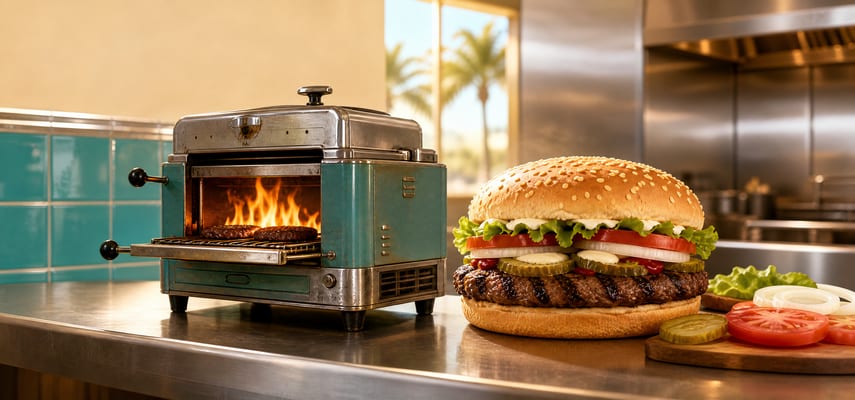
Burger King’s roots go back to 1953 in Jacksonville, Florida, where Keith G. Cramer and Matthew Burns developed the Insta-Burger King concept and Cramer opened a restaurant using an “Insta-broiler” machine to cook burgers quickly. The following year, David Edgerton opened an Insta-Burger King franchise in Miami, and James McLamore joined him as a partner. McLamore and Edgerton later acquired the Burger King name rights from the Jacksonville operation and standardized the products and procedures in a way that turned the Miami business into an extendable concept.
The McLamore–Edgerton era introduced a larger sandwich that company histories credit as the Whopper, first sold in 1957, and emphasized cooking on a broiler rather than a griddle. That positioning—bigger burger, flame-broiled taste, and a promise of custom orders—helped the chain stand apart from competitors who prioritized speed and uniformity over customization.
Building the Whopper and the early chain: franchising, menu identity, and marketing
Through the late 1950s and the 1960s, Burger King expanded via franchising, opening dozens of outlets across the United States. The Whopper became the center of Burger King’s identity: a larger, more customizable hamburger that the chain promoted as a premium alternative to smaller standard burgers. Marketing through the 1960s and 1970s emphasized that customers could alter toppings and condiments, culminating in the long-running “Have It Your Way” campaign launched in 1974. That slogan crystallized the company’s tactical difference—choice—and gave it a clear counterpoint against McDonald’s uniform menu.
Operationally, Burger King during this phase balanced company-owned stores and a growing network of franchisees. Franchising enabled faster geographic reach but also sowed the seeds of recurring tensions between the brand and independent operators over promotion, food costs and modernization investments—a theme that would repeat under later owners.
Pillsbury ownership and national expansion (1967–1989)
In 1967 Burger King was acquired by the Pillsbury Company. Under Pillsbury, the chain pushed further into national expansion and professionalized many corporate functions. Pillsbury’s resources accelerated advertising, real estate acquisition and menu experimentation while corporate ownership sought efficiencies that were harder to achieve in a loose franchise system.
The Pillsbury era transformed Burger King from a regional upstart into a national competitor. Pillsbury invested in television advertising, expanded the chain’s footprint into new U.S. markets and overseas, and maintained the Whopper as the menu anchor. Yet corporate ownership also brought bureaucratic pressures that sometimes clashed with franchisee expectations, and Pillsbury’s later corporate fate would reshape Burger King’s ownership again.
Changing corporate parents: Grand Metropolitan, Diageo, and the move toward private equity (1989–2002)
Corporate ownership changed hands when Pillsbury was purchased by Grand Metropolitan in 1989. Grand Metropolitan later merged with Guinness in 1997 to form Diageo. Throughout the 1990s Burger King continued to expand internationally but also struggled at times with inconsistent branding and the challenge of updating restaurants and menus in a competitive landscape dominated by McDonald’s marketing muscle and growing fast-casual competitors.
By the early 2000s, Diageo concluded that Burger King did not fit its portfolio and sold the chain to a private-equity group led by TPG Capital, Bain Capital and Goldman Sachs in 2002. That sale marked a turning point: Burger King moved from corporate conglomerates into private-equity ownership, a change that imposed a sharper focus on cost control, franchise economics and a potential exit via public offering or resale.
Private equity, an IPO, and the pressure to modernize (2002–2010)
The 2002 purchase by private-equity firms ushered in a decade of heavy restructuring and attempts to reposition Burger King as a more modern, consistent global brand. The new owners pursued a three-part strategy:
- refresh the menu and restaurants;
- professionalize operations; and
- reduce corporate exposure by selling company-owned stores to franchisees.
Franchisees became central to execution as the chain moved toward an asset-light model that depended on local owners to finance remodeling and new openings. In 2006 Burger King returned to the public markets with an initial public offering. The IPO provided liquidity for the private-equity owners and signaled a new phase of investor scrutiny. Public shareholders expected growth and predictable margins—pressures that shaped later strategic decisions. In practice, the first half of the 2000s produced a series of menu experiments, branding changes and leadership turnover as the company sought sustained same-store sales increases.
The 3G takeover, refranchising and the playbook of cost focus (2010–2014)
In 2010 the Brazilian private-equity firm 3G Capital acquired Burger King. 3G’s approach, seen at other investments, emphasized cost discipline, streamlined management and a broad refranchising push: selling company-owned restaurants to franchisees to create a low-capital corporate model. 3G installed executives experienced in aggressive cost management and sought to standardize operations globally.
The practical effects were visible:
- the company shrank its corporate store base;
- royalty and fee income from franchisees increased; and
- control over the brand’s global strategy was tightened.
3G also pursued marketing refreshes aimed at younger customers and introduced product experiments meant to generate headlines and traffic. This period reoriented Burger King into a largely franchised global brand with a central corporate role in brand management, marketing and international development rather than day-to-day restaurant operations.
Merger with Tim Hortons and the creation of Restaurant Brands International (2014)
In 2014 3G Capital engineered a merger between Burger King and the Canadian coffee-and-donut chain Tim Hortons, creating Restaurant Brands International (RBI) as the parent company domiciled in Canada. The transaction combined two large quick-service brands under a single Canadian holding company, with 3G Capital retaining roughly half of the new company’s equity and public shareholders of Burger King and Tim Hortons holding the balance. It also established a platform for further acquisitions and global expansion.
The merger mattered for several reasons. It created a publicly traded parent with multiple top-tier brands—Burger King as the global burger anchor and Tim Hortons as a Canadian powerhouse—giving the sponsors scale and diversification. The transaction’s Canadian domicile prompted debate and scrutiny over corporate tax inversion and executive governance in Canada. The new structure also set up Burger King to benefit from RBI’s centralized development resources while continuing to operate largely through franchisees. RBI later used the same platform to acquire other chains, converting Burger King into one of several flagship brands under a private-equity-grown conglomerate.
RBI’s expansion: Popeyes, global brands and platform economics (2017 onward)
Under RBI, Burger King remained the group’s largest fast-food burger brand while the parent pursued further acquisitions to build a portfolio. In 2017 RBI acquired Popeyes Louisiana Kitchen, adding a fried-chicken brand to the group and signaling an intent to grow by buying recognizable quick-service names. The acquisition strategy expanded RBI’s reach into diverse segments and gave Burger King potential operational lessons on menu innovation, limited-time offers and global franchising patterns.
For Burger King itself, RBI’s ownership meant continued emphasis on refranchising, international master-franchise deals, and investment in digital channels. RBI’s centralized approach treated each brand as a franchise-platform business: corporate teams defined marketing campaigns, launched national promotions and negotiated supply-chain deals, while local franchisees executed daily operations and funded real estate and remodels.
Menu experiments, the Impossible Whopper and digital acceleration (2014–2021)
Burger King’s product strategy after 2014 mixed classic continuity—keeping the Whopper at the center—with experiments meant to deliver newsworthy items and appeal to shifting tastes. One of the clearest examples was the partnership with Impossible Foods to introduce the Impossible Whopper in the United States in 2019. Offering a plant-based patty as a direct analog to Burger King’s signature sandwich allowed the chain to compete with similar moves from other quick-service brands and to reach customers seeking meat alternatives without changing the core Whopper identity.
The COVID-19 pandemic in 2020 accelerated another transformation that had already been underway: digital ordering, delivery partnerships and contactless pickup. Burger King and RBI prioritized investments in mobile apps, third-party delivery integration, and loyalty programs to shift more revenue to digital channels. In 2021 Burger King launched a national loyalty program in the United States, Royal Perks, marking a major upgrade in how the chain tracked repeat customers and monetized digital engagement. Those initiatives changed the economics of marketing: instead of relying primarily on broad TV campaigns, Burger King increasingly used app offers, targeted promotions and delivery fees to drive traffic.
Recent years: global franchising, marketing risks, and technology
From roughly 2020 through the early 2020s, Burger King’s strategic pattern was clear: convert as many restaurants as possible to franchise ownership; pursue global master-franchise agreements to enter markets quickly; and invest in digital channels to capture higher-margin sales. RBI’s expansion in Latin America, Europe and Asia relied heavily on local partners who bore real-estate costs and adapted the brand to local tastes. In developed markets, Burger King focused on limited-time products, value offers and improved digital convenience to defend traffic against fast-casual entrants and aggressive value menus from rivals.
Marketing under RBI continued to court attention—sometimes deliberately edgy or contrarian—to win short-term buzz. That approach produced high-visibility campaigns that helped maintain brand awareness but also risked missteps and uneven public reception. At the same time, investments in remodeling and kitchen modernization aimed to improve speed and delivery performance, addressing problems exposed during the pandemic when order volume shifted dramatically toward takeout and delivery.
Challenges and recurring tensions
Burger King’s history shows recurring structural tensions that have persisted through owners and eras. Franchisee relations remain a perennial issue: the move to an asset-light company relies on franchisees to invest in restaurants, yet franchisees sometimes resist marketing decisions or menu changes that raise their operating costs. Private-equity ownership and repeated ownership changes have produced waves of leadership turnover and strategic reset, complicating long-range planning.
Competition is another persistent challenge. McDonald’s remained Burger King’s largest and most consistent rival, and the rise of fast-casual chains and delivery-only players put pressure on margins and required continuous menu innovation. Regulatory scrutiny—most visibly around the Tim Hortons merger and corporate inversion debates—has sometimes complicated high-level governance decisions. Operationally, the shift to delivery and digital ordering exposed gaps in kitchen layout and staff training that required significant capital and policy responses.
Legacy and significance: what Burger King changed in quick service
Burger King’s historical influence is practical rather than ideological. It proved that a fast-food brand could survive—and thrive—by offering a larger, more customizable flagship sandwich. The Whopper carved out space for premium-sized burgers within a market where smaller burgers were the norm. The “Have It Your Way” positioning introduced customization as a brand promise, a concept competitors eventually matched in different forms.
Operationally, Burger King’s repeated transitions—into corporate ownership, private equity and finally into a multi-brand franchising platform—illustrate modern franchise economics: the shift toward an asset-light corporate role, royalties and fees rather than company-owned store profits. Under 3G and RBI, Burger King became an example of how a global franchised brand can be scaled through master franchises, local partners and centralized marketing while leaving day-to-day capital investment to franchisees.
Finally, Burger King’s marketing posture—willing to take gambits for the sake of attention—shows how quick-service brands use campaigns to punch above their size. That approach has had mixed returns but has kept the brand culturally visible in an industry where habit and familiarity shape consumer choices.
Conclusion: from a Jacksonville broiler to a global franchising platform
Burger King began as a modest experiment in Jacksonville—an early operator of a mechanized broiler and a bigger burger—and grew into one of the world’s best-known fast-food brands. Key turning points shaped that trajectory: McLamore and Edgerton’s standardization and the creation of the Whopper in the 1950s; Pillsbury’s national push in the late 1960s; the shift into private-equity ownership in the 2000s; 3G Capital’s 2010 takeover and heavy refranchising; and the 2014 combination with Tim Hortons to create Restaurant Brands International.
Across ownership changes and marketing experiments, Burger King’s identity has remained anchored by a simple proposition: a larger, flame-broiled hamburger that customers can customize. What has changed is the firm’s corporate form and how that proposition is sold globally—a franchised platform managed by a multi-brand parent that leans on digital ordering, loyalty, and local franchise partners to compete in an era of rapid change. Burger King’s history is therefore both a story of a product that stuck—and of the evolving corporate machinery that has sought to keep that product visible and profitable in an increasingly crowded quick-service market.












