










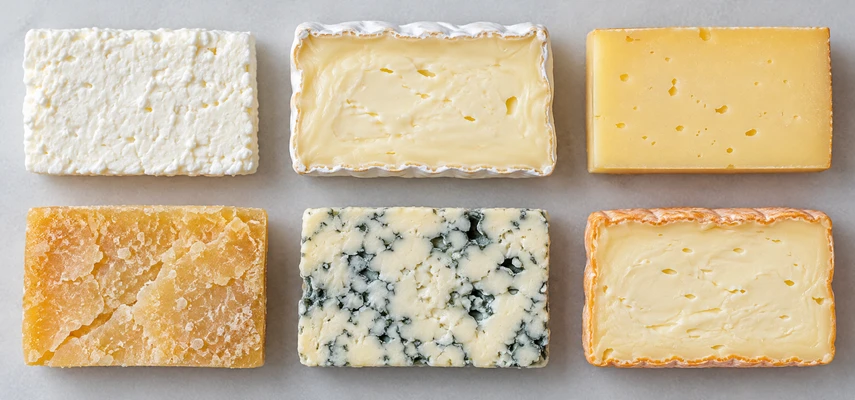
At a cheese counter, “soft,” “blue,” “goat” and “aged” can sound like competing answers to the same question. In fact, they describe different things. A cheese can be made from goat’s milk, have a bloomy rind and feel soft in the center—all at once. Understanding those layers is more useful than trying to memorize a single list of varieties.
The different types of cheese are usually grouped by texture, maturation, rind or production method. Milk source and place of origin add further information. These descriptions help you imagine what a cheese might be like, compare unfamiliar names and explain what you want to a cheesemonger.
If you are new to the subject, our beginner’s guide to cheese introduces the fundamentals. This guide introduces the main families you are likely to encounter. It also explains the overlaps that make cheese classification both useful and occasionally confusing.
Why there is more than one way to classify cheese
The American Cheese Society’s category guide explains that cheese can be organized by texture, milk type and origin, with individual varieties crossing boundaries. Think of each label as an answer to a particular question: How firm is it? Has it ripened? What happens at its surface?
A practical description combines several answers. “Fresh goat cheese” identifies milk source and maturation; “aged sheep’s-milk cheese” still leaves its precise texture and rind to be described. Neither phrase is a complete tasting note.
The goal is to build a useful picture, rather than force every cheese into one exclusive compartment. Begin with what matters for your purchase, then ask for the missing details.
Fresh cheeses: made to be enjoyed without aging
Fresh cheeses are sold without an intended ripening period. Familiar examples include cottage cheese, cream cheese and fresh mozzarella. They do not all share one texture: cottage cheese has separate curds, cream cheese spreads, and fresh mozzarella holds a cohesive shape.
The University of Guelph’s cheese-family reference distinguishes several production routes within fresh cheese, including acid coagulation, rennet coagulation and heat-acid methods. Fresh describes the absence of an intended maturation stage, rather than a single recipe.
That distinction prevents a common misunderstanding. A soft aged cheese is not automatically fresh, and a fresh cheese is not an unfinished version of a harder one. Each is made for its own intended qualities.
For an introduction, choose one fresh cheese you already know and compare it with another. Notice whether it spreads, breaks into curds or cuts cleanly. Those observations give you a better starting vocabulary than assuming every fresh cheese should taste or behave alike.
Soft-ripened and bloomy-rind cheeses
Brie and Camembert are familiar names associated with pale, bloomy rinds. Their surfaces are part of an intended ripening process. The rind and interior together help define the style; a soft center alone does not identify it.
France’s official Camembert de Normandie specification describes a white bloomy exterior and a supple interior, providing a concrete example of this combination. The protected name refers to a particular cheese with its own production requirements, while the broader bloomy-rind description covers more than that one product.
When comparing examples, look at the cut face as well as the surface. Ask how developed the cheese is and what texture the seller expects from that particular piece. Two cheeses with similar white exteriors need not offer the same eating experience.
“Soft” tells you about consistency; “bloomy rind” tells you about the exterior. Keeping those ideas separate makes the category easier to understand.
Semi-soft and firm cheeses
Texture words describe a spectrum. Semi-soft cheeses are generally supple, while firm cheeses offer more resistance when cut. You may also see semi-hard used in shops and books. These everyday terms do not create perfectly aligned boundaries across every classification system.
The American Cheese Society’s competition categories illustrate a more detailed approach, separating groups through recipe, moisture and other characteristics. A retail description is usually less exact than a technical competition class.
Young Gouda and Monterey Jack are useful names to discuss when looking for a sliceable cheese; Cheddar supplies another familiar reference point. Rather than worrying about which side of a semi-soft/firm boundary an example occupies, explain the task: a sandwich slice, a small tasting portion or something that can be shaved.
Compare the actual cheese being offered. A variety name helps orient you, but it cannot replace information about that producer’s version and its stage of development.
Hard and extra-hard cheeses
Hard cheeses are useful landmarks at the firmer end of the spectrum. Their interiors may break into pieces or yield shavings rather than bend into a soft slice. Parmigiano Reggiano offers a well-documented example of a mature, granular cheese.
Its consortium’s sensory guide describes changes in texture, aroma and flavor at different ages. This is a reminder that maturation can change the experience even when the cheese name stays the same.
Hardness should not be used as a universal score for quality or strength. It describes one feature. If you are choosing between a hard cheese and a soft one, first decide what kind of experience you want: a small piece to savor, a shaving over food or something to spread.
A comparison between two ages of the same named cheese can be especially informative. Ask the seller what differences to expect, then examine the cut surfaces and compare small portions before adding other ingredients.
Blue cheeses: a family defined by internal mold
Blue cheeses are associated with deliberately developed mold inside the cheese. The blue-green pattern is a defining visual clue, but it does not tell you the milk source or establish one universal consistency.
Roquefort demonstrates how several descriptions can apply together. Its official producer organization identifies it as a raw sheep’s-milk cheese with the characteristic activity of Penicillium roqueforti. It belongs to the blue family while also having a specific milk identity and origin.
For a first purchase, ask for a blue cheese that suits the texture and flavor intensity you enjoy. “I would like a small piece of blue cheese, and I prefer something creamy” is a more useful request than assuming all blue cheeses are interchangeable.
This category describes an intended production style. It is not a rule for judging unexpected mold on an unrelated cheese; questions about spoilage require separate guidance.
Washed-rind cheeses: the surface receives special care
Washed-rind cheeses are treated at the surface during maturation, often with a saltwater wash. The American Cheese Society describes washing as a way to guide surface ripening. This category concerns the rind treatment, rather than promising one particular interior texture.
These cheeses may be recognizable by their aromatic surfaces, but appearance or smell alone is an incomplete description. Ask about the interior, the degree of ripeness and how that specific cheese is expected to taste.
Keep washed rind separate from washed curd. The first refers to treatment of the cheese’s exterior during maturation. The second describes an operation involving curds during production, explained in our guide to how cheese is made. Similar wording can conceal quite different stages of cheesemaking.
When you encounter an unfamiliar term, asking what was washed—and when—is a simple way to clarify it without needing a technical explanation of every microorganism involved.
Brined cheeses: a different way to describe maturation
A brined cheese is associated with saltwater treatment or maturation, making this another description that can overlap with texture categories. Feta is a familiar example.
The European Commission’s Feta PDO guide describes a maturation process involving brine. It also identifies the sheep and goat milk used for the protected Greek cheese. Feta therefore gives you several pieces of information at once: a named cheese, a milk tradition and a brined production style.
This is also why a moist, white cheese should not automatically be called fresh. Color and apparent moisture do not tell you whether it has undergone maturation. Ask whether the product is unripened or ripened, rather than deciding from its appearance.
For comparison, place a piece of feta beside a fresh cheese you know. Think about the difference in structure and seasoning, without treating whiteness as evidence that they belong to the same family.
Stretched-curd and processed cheeses
Some useful categories come from the way the cheese is worked. Stretched-curd cheeses, also called pasta filata, include mozzarella. The curd is heated and stretched under suitable conditions, producing a characteristic structure. Guelph’s family guide notes that pasta filata cheeses vary enough in composition and ripening that they do not fit neatly into one texture group.
Processed cheese describes a different operation. Cheese is blended and heated with other permitted ingredients; emulsifying salts can help produce a consistent mixture. The university’s processed-cheese chapter explains this approach.
These labels answer production questions. They should not be mistaken for milk species, geographic origins or guaranteed flavor descriptions. Read the product name and ingredient information when the distinction matters to your choice.
Where milk source fits into the picture
Cow, goat, sheep and buffalo milk provide important cheesemaking starting points. A milk-source label adds information, but it does not replace a description of texture, method or maturity.
The FAO’s milk-composition guide explains that species, breed, diet and other factors influence milk composition. Those differences help explain the range of dairy materials available to cheesemakers. They do not mean that every goat cheese is soft or every sheep’s-milk cheese is hard.
For now, treat milk source as one more useful question at the counter. A later installment will compare the major milk types in greater detail.
Put the categories to work
Choose three contrasting examples and describe each using two or three features: fresh and spreadable, firm and aged, or blue and sheep’s-milk. Add the actual cheese name when you know it. This turns a collection of unfamiliar terms into a practical way to compare food.
If you are arranging your purchases for a shared meal, TFE’s Cheese Plate Essentials offers a related starting point. Keep the selection small enough that you can notice what distinguishes each piece.
The main cheese families are landmarks, not sealed boxes. Texture describes how a cheese feels; rind and production terms explain other aspects of its character. Combine those descriptions, ask about the particular example in front of you and use each tasting to make the next unfamiliar name easier to understand.












