










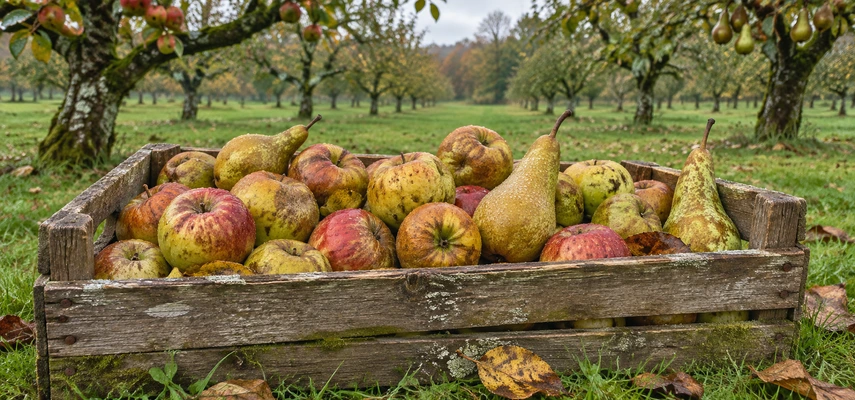

Calvados can begin with a blend long before anyone selects a cask. Sweet, sharp and more tannic apples provide different contributions to the cider destined for distillation, while pears play an important role in some traditions. The orchard therefore supplies production decisions as well as fruit. That makes a useful starting point for comparing several kinds of fruit spirit.
This lesson brings Normandy’s apple and pear spirits alongside South African grape brandy and a wider European fruit-spirit toolkit. The purpose is to compare material, fermentation, separation and final treatment. These are Learning Outcome 3 subjects, so the knowledge checks use MCQs and observe the specific examination exclusion for Calvados labeling terminology.
Calvados starts with appropriate cider and perry fruit
The Calvados trade body’s production account groups cider apples as sweet, sharp, bittersweet and bittersharp. These families offer different combinations of sugar, acidity and tannin. They are not simply alternative colors of the same fruit, nor do they establish identical suitability for eating and distilling.
Sugar provides fermentable material, while acidity and tannin shape the cider’s composition and fermentation environment. Combining fruit types gives the maker options before distillation. The comparison is similar to composing a wine base or selecting a grain recipe: suitability involves the whole material, rather than only the highest possible sugar concentration.
Perry pears provide another input. They should not be treated as a casual garnish added to an apple spirit after the main work is finished. In a pear-including cider or perry route, their sugars and other constituents enter fermentation and influence the mixture subsequently distilled. The proportion required depends on the appellation.
Fruit preparation and fermentation establish the cider
The fruit is prepared, milled or crushed and pressed to recover juice for fermentation. Handling affects the material delivered to the fermenting vessel. A clean, suitable juice is a production objective, but clean does not mean stripping the material of every contribution that might later support the desired spirit.
Yeast uses fermentable sugars to produce ethanol and other compounds. The resulting cider or perry therefore provides both alcohol and a composition that the distiller will select from. A pleasant dessert-apple aroma before fermentation is not a complete forecast of the finished spirit, because fermentation and distillation alter the relationship among constituents.
Domaine Dupont describes its own fully fermented cider and double distillation. It is a useful named example of the sequence from apple juice to matured Calvados. Its precise timing should remain attached to that producer’s account rather than becoming a rule imposed on every appellation and distillery.
The three appellations have different requirements
The official Calvados appellation guide distinguishes Calvados, Calvados Pays d’Auge and Calvados Domfrontais. The broad Calvados appellation permits pot or column distillation. Pays d’Auge requires the double-pot route, while Domfrontais uses a column and gives pears a specified place in the raw material.
These differences show why one national summary cannot substitute for the complete appellation name. A small column is not automatically evidence of lower quality or of a spirit outside the family. It can be the required equipment for a particular protected identity, with its own characteristic production arrangement and material.
For Calvados Domfrontais, INAO specifies at least 30% perry pears, exclusive column distillation and at least three years in oak. Calvados and Pays d’Auge have two-year oak minimums. The basic contrast concerns permitted material, equipment and maturation, rather than an assumption that every pear-containing bottle must taste the same.
Maturation adds another relationship to the fruit
Oak can add and transform contributions while the spirit develops under its storage conditions. A relatively young expression can emphasize fresh fruit; another can show more cooked-fruit, spice, nut or wood character. These are tendencies to investigate in the product, not an inevitable progression in which every additional year adds the same aroma.
Vessel history and activity matter alongside time. A powerful wood contribution can support a robust spirit or mask a subtler one. Blending different components gives another way to shape the finished profile. The producer must assess the relationship between orchard-derived character and maturation rather than treating age alone as a complete quality measure.
The specification excludes Calvados labeling terminology from examination. That does not exclude production, the three appellations or their legal distinctions. This lesson therefore tests those prescribed topics without asking the reader to memorize a ladder of age-related label acronyms for the MCQ examination.
South African brandy uses wine as the distilling base
South African brandy introduces a grape-based comparison. Chenin Blanc and Colombard, also called Colombar, are important examples for suitable base wine. Fruit condition and wine preparation establish the starting mixture; distillation then selects components that can express fruit while supplying an appropriate foundation for subsequent wood maturation.
The South African Brandy Foundation’s producer information illustrates those grape choices in actual brandies. A named grape can help explain a production approach, but it should not replace analysis of fermentation, distillation and maturation. Two producers using Colombard need not produce the same finished aroma or texture.
Potstill production characteristically uses double copper-pot distillation, selecting a spirit that can retain substantial wine-derived character. More highly rectified wine spirit provides another component for permitted blending routes. The two streams offer different functions; one does not become identical to the other merely because both started with wine.
Potstill, vintage and blended identify different compositions
The Foundation’s current category comparison distinguishes potstill, vintage and blended brandy. Potstill brandy uses 100% potstill material with at least three years’ maturation. Vintage uses a combination of 30–80% potstill brandy and matured wine spirit with an eight-year maturation framework. Blended brandy contains at least 30% matured potstill brandy alongside permitted spirit.
Vintage in this South African context should not automatically be read as a single harvest year. It is a category term with composition and maturation conditions. Likewise, blended does not mean there is no matured material: the potstill component has its required maturation even when the complete blend has another relationship of spirit contributions.
The Foundation’s updated table gives minimum strengths of 38% for potstill and vintage, and 40% for the ordinary blended category. Its older page retains a 43% blended figure, so dated summaries need care. Bezalel’s own production explanation also identifies the potstill category and its 38% minimum, while describing the producer’s own maturation choices.
Blending and casks influence the South African styles
A larger contribution from matured potstill material can give a different relationship of fruit, texture and wood from a formulation using a greater share of more restrained spirit. The finished effect still depends on the actual components. Percentage alone does not establish every aroma or guarantee that the most concentrated version is the best balanced.
Oak history, size and storage conditions introduce further differences. A producer may use the blending options to maintain a recognizable style as stocks develop. This is a practical composition task, not merely an exercise in satisfying the smallest permitted percentage. Legal identity and sensory success are related questions requiring different evidence.
European fruit spirits begin with diverse materials
Cherries, plums, pears, apricots and berries supply different amounts of fermentable sugar and different aromatic compositions. Ripe, sound fruit is important because the distiller is trying to express an appropriate material identity. A damaged or poorly stored input does not become a good foundation simply because a later still will separate some components.
Traditional names help organize examples: Kirsch is associated with cherries, Williams with the Williams pear, and Mirabelle with the small yellow plum. These are material identities rather than compulsory added flavors. A clear cherry spirit is not the same thing as a sweet red cherry liqueur, even if both smell recognizably of cherries.
Where the fruit supplies an appropriate fermentable medium, the producer can ferment it and distill the resulting material. Preparation may involve juice, crushed fruit or a more solid-rich mash. That physical difference affects handling at the still, so the fruit family does not imply one universal liquid-wash production setup.
Maceration offers another route to fruit character
For some aromatic materials, a producer instead macerates fruit in suitable alcohol and redistills the mixture. The fruit contributes extracted compounds, while the alcohol is already present as the extracting medium. This differs from deriving the entire alcohol content by fermenting that fruit. The distinction remains important even when both products appear clear.
Distillerie Metté describes raspberry maceration and distillation, followed by stainless-steel storage for its product. La Salamandre also describes macerating raspberries in eau-de-vie before redistillation. These examples establish actual routes without implying that every berry is incapable of fermentation or that every fruit aroma is an added essence.
The legal name needs to match the route in the relevant market. Fermented fruit spirit, a maceration-and-distillation product and a sweetened liqueur should not be treated as interchangeable solely because they feature the same fruit. Learn what the producer did, then read the identity claim in that context.
Separation and storage complete the comparison
Distillation selects a mixture whose composition depends on the fermented or extracted input and the collection decisions. An aroma resembling a fruit is not a complete record of which preparation method was used. The production account supplies information that a tasting note alone may not establish confidently.
Suitable non-wood storage can preserve a clear presentation while the spirit rests and develops. Wood maturation provides another expression, adding its own influence. Neither choice independently proves higher quality. The useful assessment considers recognizable fruit character, integration and the intended style, supported by the actual production history.
What to remember
Compare Calvados through cider fruit and appellation, South African brandy through wine spirit and category composition, and other fruit spirits through fermentation versus maceration. Then follow distillation and storage. The same broad word fruit can hide very different starting materials and production routes; keeping those routes clear is the most reliable revision strategy.
Knowledge check: 12 original practice questions
Independent TFE questions, not official WSET examination items. Choose one answer per question; explanations follow separately.
1. Which Calvados topic is explicitly excluded from examination?
2. Which Calvados appellation requires the double-pot route?
3. Which maturation minimum applies to Calvados Domfrontais?
4. Which grape pair is important in the South African brandy discussion?
5. What fruit is associated with Williams spirit?
6. What is the Domfrontais perry-pear minimum cited here?
7. Why are several cider-apple families useful in Calvados production?
8. Does clear appearance establish that a fruit spirit had no storage?
9. What is the most useful first distinction when comparing fruit-spirit examples?
10. Does South African vintage brandy automatically mean one harvest year?
11. What does potstill brandy composition require in the described South African comparison?
12. How does maceration before redistillation differ from fermenting the fruit?
Answers and explanations
- C — Labeling terminology. The exclusion is narrow and does not erase the production and law requirements. Mapping: LO3.
- C — Calvados Pays d’Auge. The complete appellation name matters when applying equipment requirements. Mapping: LO3.
- D — Three years in oak. Its oak minimum differs from the two-year minimums of the other two appellations. Mapping: LO3.
- B — Chenin Blanc and Colombard. Suitable base wine provides the starting material for grape-brandy distillation. Mapping: LO3.
- C — The Williams pear. The traditional name identifies the relevant fruit rather than a compulsory sweetening method. Mapping: LO3.
- B — 30%. The pear requirement is a specific part of that appellation identity. Mapping: LO3.
- C — They supply differing sugar acidity and tannin contributions. Fruit selection shapes the cider that enters the later production stages. Mapping: LO3.
- A — No. Storage development need not involve visible extraction from wood. Mapping: LO3.
- D — The material and whether it was fermented or macerated. The production route organizes the subsequent distillation and storage comparison. Mapping: LO3.
- B — No it is a category term with specific conditions. The national category meaning must not be replaced by a different everyday use of vintage. Mapping: LO3.
- B — 100% potstill material. The potstill category differs from vintage and blended composition pathways. Mapping: LO3.
- C — Alcohol is already present as the extracting medium. The source of alcohol and the route for fruit character differ. Mapping: LO3.
Continue exploring this series
3. Alcoholic Fermentation Explained: Yeast, Nutrients, and Flavor Compounds
4. Fermentation Methods Explained: Liquid, Solid-State, Sequential, and Parallel Fermentation
6. Pot Still Distillation Explained: Design, Heating, Cuts, and Flavor
7. Column and Hybrid Stills Explained: Plates, Reflux, and Continuous Distillation
9. Oak Maturation Explained: Barrels, Oxygen, Evaporation, and Flavor Development
10. Spirits Finishing Explained: Blending, Filtration, Sweetening, Coloring, and Packaging
16. How Fruit Spirits Are Made: Grapes, Wine, Pomace, and Fermentation
17. Cognac Explained: Grapes, Double Distillation, Oak, and Quality
19. Armagnac Explained: Grapes, Column Distillation, and Regional Styles
28. How Botanicals Flavor Spirits: Maceration, Percolation, and Redistillation
36. Pisco, Grappa, and Brandy de Jerez Explained: Three Grape-Spirit Traditions
38. Other Rum Traditions Explained: Haiti, Puerto Rico, Trinidad, Guyana, and Beyond
50. WSET Level 3 Spirits Exam: Complete Revision Guide and Practice Examinations












