











Two distillers can both say “we ferment grain” and be describing very different arrangements. One works with a free-flowing sugary liquid. Another manages a moist grain bed containing several microbial populations. Fermentation methods differ not only in ingredients, but in when sugars appear, where organisms live and how the process develops over time.
Start by separating two questions. Sequence asks whether carbohydrate conversion precedes alcoholic fermentation or overlaps with it. State asks whether the medium is liquid, semi-solid or solid-state. These are different dimensions. A process can involve parallel conversion in a liquid mash; “parallel” isn’t another word for “solid.”
Fermentation methods: sequence and state
In a sequential arrangement, conversion into usable sugars occurs mainly before alcoholic fermentation. A grain producer can prepare a sugary medium, then introduce yeast to use it. There may still be continuing reactions and some overlap in a real system, so the label describes the main organization rather than a claim that every enzyme stops on cue.
In a parallel arrangement, sugar-releasing activity and alcoholic fermentation operate together during a significant part of the process. Enzymes release sugars from the substrate while yeast uses available sugars. Different jobs occur at overlapping times. This doesn’t mean that yeast directly ferments intact starch, or that a single organism performs every transformation.
The physical medium is a separate consideration. Liquid fermentation has a substantial free-flowing liquid phase. Semi-solid systems contain appreciable solid and liquid components. Solid-state fermentation uses moist solid material with relatively little free liquid. None of these labels means water is absent. Microorganisms still need a suitable moist environment to function.
Sequential conversion creates a prepared starting medium
A familiar grain-processing sequence converts accessible starch into smaller carbohydrates before the main yeast fermentation. Preparation can include milling, suitable heat and water, and enzyme action. Once a suitable sugary medium is available, yeast begins the alcoholic stage. The division offers a useful way to organize equipment and control conditions for different tasks.
Conversion enzymes and yeast don’t necessarily share identical preferred conditions. Separating the stages lets a producer manage the conversion environment, then bring the medium to conditions suitable for the culture. This is a process advantage, rather than proof that the resulting spirit will be better than one made through an overlapping approach.
For an examination description, keep the verbs distinct. Enzymes hydrolyze suitable carbohydrate bonds; yeast metabolizes usable sugars and produces alcohol. A sequential process places those central activities mainly in order. Saying “the yeast converts grain starch into alcohol” skips the chemical and biological division of labor that the question is likely testing.
Parallel conversion supplies sugars during fermentation
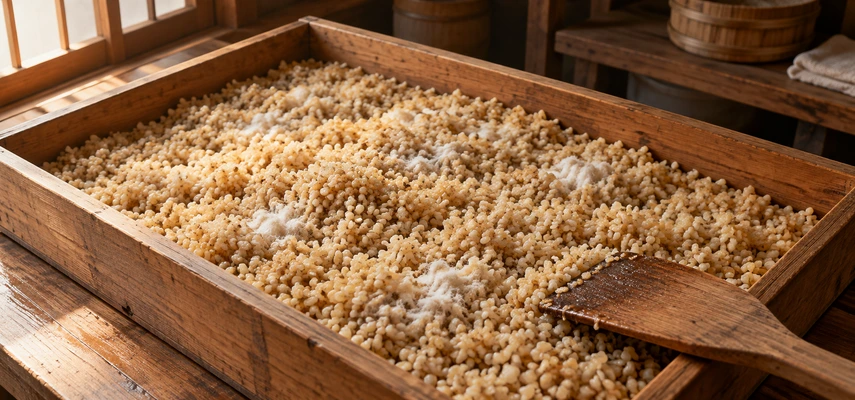
Parallel systems can release fermentable sugars while fermentation is underway. Kōji provides a useful example: grain is cultivated with selected mould, producing enzymes that help break down starch and other components. When the prepared culture contributes enzymes to a mash, sugar release can continue alongside yeast activity. The mould and the yeast have different roles.
The National Research Institute of Brewing explains kōji as mould cultured on steamed grain, supplying enzymes and other contributions. Kōji isn’t a synonym for yeast, and it isn’t simply another name for rice. Identify the cultivated material, the organisms and the enzyme functions separately before describing the larger fermentation.
The arrangement also changes the timing of sugar availability. Instead of treating all potential fermentable material as available at the start, the producer manages ongoing release and consumption. Actual concentrations depend on both processes. “Parallel” doesn’t guarantee a particular rate or alcohol yield; substrate accessibility, enzyme activity and yeast performance still need to work together.
Shōchū shows why stages and mechanisms differ
The Japan Sake and Shochu Makers Association describes an initial mash combining kōji and water with yeast, followed in common honkaku shōchū production by addition of the main raw material and more water. Saccharification and fermentation can then proceed in parallel. Having two mash stages doesn’t make the underlying starch conversion and fermentation purely sequential.
Awamori provides a useful comparison because its main fermentation uses an all-kōji rice arrangement rather than that same two-stage pattern. The distinction belongs to the specific production tradition. Don’t expand it into “every Japanese spirit uses exactly two fermentations,” or assume a shared use of kōji makes all recipes and sensory profiles equivalent.
Original research on shōchū kōji preparation examines changing grain structure and enzyme activity during culture development. That is a reminder that making the enzyme-bearing culture is itself a managed stage. The later mash doesn’t begin with an abstract word called kōji; it receives material whose preparation influences its capabilities.
Liquid fermentation still contains structure
Liquid systems can allow circulation of dissolved nutrients and contact between cells and substrate. The medium may contain suspended solids, and the presence of a few particles doesn’t automatically make it a solid-state fermentation. What matters is the overall working environment, including the amount and behavior of free liquid.
Heat removal, microbial distribution and sampling depend on vessel design and operating choices. A liquid tank isn’t perfectly uniform merely because it can be pumped. Temperature and composition can vary, particularly at scale. Good descriptions identify the actual system rather than assuming that every cell experiences exactly the same conditions throughout the process.
Likewise, don’t infer sensory neutrality from a liquid state. A liquid fermentation can generate a range of flavor-active compounds. The organism, raw material, nutrients, temperature and time all contribute. “Liquid” tells you something about the environment; it doesn’t replace the rest of the production explanation or dictate what the final spirit must smell like.
Solid-state fermentation changes the habitat
In a moist grain bed, organisms occupy surfaces, pores and local environments rather than simply existing in a uniform bath. Moisture, heat movement and access to substrates can vary through the mass. Material preparation and bed management therefore become important parts of creating a workable microbial habitat.
The word “solid” can mislead readers into imagining dry cereal that somehow ferments without water. Describe it instead as moist material with relatively little free liquid. That makes room for the biological reality while preserving the distinction from a liquid tank. A tray culture and a fermentation pit can also differ substantially despite both containing moist solids.
Many baijiu traditions use grain-based microbial starters known as qu, with communities that support conversion and flavor development. Qu and kōji shouldn’t be treated as interchangeable names for one universal culture. Their preparation, organisms and applications differ. The relevant lesson here is the division of microbial functions and the environment that allows those functions to operate.
Semi-solid systems challenge tidy labels
Rice-aroma baijiu offers a useful caution against describing all baijiu as one solid-state method. Original rice-flavor baijiu research follows starter preparation, saccharification and semi-solid fermentation, examining microbial change and flavor compounds. Its process includes both solid and liquid aspects rather than matching a simple dry-grain picture.
The study demonstrates a specific production arrangement, not every rice-aroma producer or all Chinese spirits. Use the example to test your categories. Can you describe the physical medium and identify when conversion and fermentation occur? A confident answer that forces every example into the same national template is less useful than a precise account of the process observed.
Terms can also vary between technical descriptions. If a source calls an arrangement semi-solid, explain what that means in context instead of silently changing the label. The underlying facts about water, material structure and sequence are more informative than a label detached from its process. This is especially important when comparing traditions across languages.
Microbial communities develop over time
A mixed community may include yeasts, filamentous fungi and bacteria with different activities. Enzyme production, sugar use, acid formation and other transformations can influence the environment experienced by the rest of the community. The organisms present at the beginning needn’t remain equally important throughout the fermentation.
Community succession means that the balance of organisms changes over time. Nutrient availability, acidity, alcohol and temperature can favor some populations while restricting others. This helps explain why a long fermentation isn’t simply a short one left running at the same biological setting. The system itself may change as time passes.
But observing two things together doesn’t establish that one directly causes the other. A research correlation between a microbial group and an aroma compound is evidence to investigate, not permission to assign every molecule to that group with certainty. In your own explanations, distinguish demonstrated function from association and avoid invented precision about a culture you haven’t identified.
Short and long fermentations create different opportunities
Duration affects the opportunities available for microbial growth and chemical change. A shorter process can limit some later activity; a longer one may permit additional bacterial contributions and changes in acids or aroma precursors. Whether those changes are desirable depends on the intended spirit and the way fermentation and later distillation are managed.
Imagine extending a fermentation without changing hygiene, temperature management or the intended collection strategy. More time could support useful development, or it could create unwanted activity. “Longer means more complex” therefore needs qualification. Complexity is also a sensory judgment; a greater number of compounds doesn’t automatically produce a more balanced or interesting drink.
What to remember
Describe sequence and state separately. Identify which agents release sugars, which make alcohol and how the environment supports them. Then consider microbial succession and duration without turning a tendency into a guarantee. Asian spirits provide several different arrangements, not one exception to a supposedly universal Western process. Accurate comparisons begin with the actual production choices in each case.
Written practice: original TFE exercises
These suggested marks and indicative points are independent teaching guidance, not official WSET marking schemes.
Exercise 1: 5 suggested marks
Describe sequential and parallel conversion in relation to alcoholic fermentation. Mapping: LO1 state/describe.
Indicative marking points:
- Sequential organization puts main sugar conversion before main alcoholic fermentation.
- Prepared usable sugars supply yeast in the sequential arrangement.
- Parallel organization overlaps sugar release with fermentation.
- Enzymes release sugars from suitable substrate.
- Yeast uses available sugars to produce alcohol.
Model answer: In a sequential arrangement, the main conversion to usable sugars precedes alcoholic fermentation, giving yeast a prepared sugar-containing medium. In a parallel arrangement, enzymes continue releasing usable sugars while yeast ferments available sugars. The two jobs overlap but remain different biochemical functions.
Why it works: It describes timing and division of work without equating parallel fermentation with direct yeast use of intact starch.
Common mistake: Calling every two-stage mash sequential confuses the number of additions with the timing of biochemical activities.
Exercise 2: 5 suggested marks
Describe liquid, semi-solid and solid-state fermentation and identify two cautions when comparing them. Mapping: LO1 state/describe.
Indicative marking points:
- Liquid systems have substantial free-flowing liquid.
- Semi-solid systems contain appreciable solid and liquid components.
- Solid-state systems contain moist solids with relatively little free liquid.
- Solid-state does not mean water-free.
- Physical state does not by itself define fermentation sequence.
Model answer: Liquid fermentation has a substantial free-flowing liquid phase. Semi-solid systems combine appreciable liquid and solid components. Solid-state fermentation uses moist solids with relatively little free liquid, so it is not water-free. These physical categories do not establish whether sugar conversion and alcoholic fermentation are sequential or parallel.
Why it works: The answer defines the physical arrangements and supplies two distinct safeguards against category confusion.
Common mistake: Assuming solid-state means dry material removes the moisture needed for microbial activity.
Knowledge check: 10 original practice questions
Independent TFE questions, not official WSET examination items. Choose one answer per question; explanations follow separately.
1. How should a microbial correlation in research be treated?
2. What distinguishes parallel conversion and fermentation?
3. Which pair describes independent dimensions?
4. What does solid-state fermentation require?
5. Why does long fermentation not guarantee quality?
6. What is microbial succession?
7. What is a central function of kōji enzymes?
8. What does liquid state alone establish about aroma?
9. Why can a two-stage mash still use parallel conversion?
10. Which statement about baijiu methods is appropriate?
Answers and explanations
- A — As an association requiring appropriate causal interpretation. Finding a population alongside a compound does not alone demonstrate that the organism directly produced every observed molecule. Mapping: LO1.
- A — Sugar release and alcoholic fermentation overlap.. Parallel describes overlapping activities, not a physical state or a fixed distillation method. Mapping: LO1.
- A — Fermentation sequence and fermentation state. Sequence concerns timing of conversion and fermentation; state concerns the physical character of the medium. Mapping: LO1.
- D — A suitably moist solid substrate with little free liquid. Solid-state systems remain biological moist environments even though they differ from free-flowing liquid tanks. Mapping: LO1.
- C — Additional activity may be useful or undesirable for the target.. Duration creates opportunities, but organisms, conditions, sensory consequences and later processing determine whether they help. Mapping: LO1.
- D — A changing balance of organisms over time. As conditions and resources change, the relative importance of microbial populations can change during fermentation. Mapping: LO1.
- B — Helping break down starch into smaller sugars. Kōji supplies enzyme activities; yeast performs a different central role in alcoholic fermentation. Mapping: LO1.
- B — It does not prescribe a fixed aromatic intensity.. Liquid fermentations can produce varied compounds depending on substrate, microorganisms and operating conditions. Mapping: LO1.
- D — Mash additions and biochemical overlap describe different things.. Counting material additions does not establish whether sugar release and yeast fermentation overlap within a stage. Mapping: LO1.
- B — Different traditions include different physical and microbial arrangements.. Rice-aroma examples and other traditions should be described specifically rather than forced into one universal national recipe. Mapping: LO1.
Continue exploring this series
2. Carbohydrates Explained: How Sugar, Starch, and Fructans Become Fermentable
3. Alcoholic Fermentation Explained: Yeast, Nutrients, and Flavor Compounds
21. Sugar Cane Spirits Explained: Juice, Syrup, Molasses, and Fermentation
32. Shōchū Explained: Honkaku Shōchū, Awamori, and Japanese Distillation
33. Baijiu Explained: Qu, Solid-State Fermentation, and China’s Major Styles
34. Soju Explained: Korean Distilled and Diluted Spirits
5. Distillation Science Explained: Volatility, Congeners, Reflux, and Rectification
50. WSET Level 3 Spirits Exam: Complete Revision Guide and Practice Examinations











