










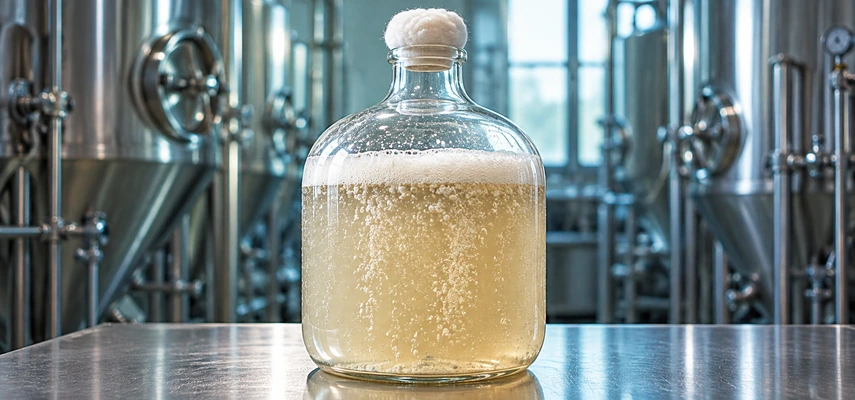

A fermentation tank can look wonderfully busy while telling you very little about the spirit it will eventually produce. Bubbles show gas escaping. They don’t reveal whether yeast has the nutrients it needs, whether unwanted microbes are active, or whether the resulting aroma profile suits the distiller’s aim. Alcoholic fermentation is a biological process with several outputs and several ways to go off course.
The useful study question isn’t simply “how does yeast make alcohol?” Ask what the organism needs, which conditions change its behavior, and how its products might influence the finished spirit. That sequence connects cell biology with practical production. It also prevents the common mistake of treating maximum fermentation speed as the definition of quality.
Alcoholic fermentation begins with a living organism
Yeast are single-celled fungi. Saccharomyces cerevisiae is important in spirits production, although strains differ and other microorganisms can play roles in particular traditions. A yeast strain is a selected genetic lineage with its own useful characteristics. Naming the species doesn’t establish one fixed operating temperature, sugar preference or aroma signature for every example.
Cells need a suitable environment to remain viable and metabolically active. Viability means being alive; vitality concerns how effectively cells can perform their work. A culture may contain living cells yet struggle under difficult conditions. For a distiller, useful yeast management considers both the number of cells introduced and their condition.
The raw material must also offer sugars the selected organism can use. Grain starch usually needs prior conversion, while fruit juice offers a different carbohydrate starting point. Preparation and fermentation therefore belong to the same causal chain, but they aren’t interchangeable stages. Yeast cannot correct an inaccessible substrate merely by trying harder.
Sugar metabolism produces ethanol, gas and heat
During alcoholic fermentation, yeast metabolizes sugar and produces ethanol and carbon dioxide. Energy released through metabolism supports cellular activity, and heat enters the surrounding medium. At the level needed here, distinguish the substrate from the outputs: sugar supplies the starting carbon, while ethanol and carbon dioxide are principal products of the fermentation pathway.
A useful chain runs like this: active sugar metabolism generates heat; the medium can become warmer; rising temperature changes the environment experienced by the cells. That feedback explains why temperature management matters in a large vessel. The liquid doesn’t politely stay at the temperature recorded before yeast was added.
Carbon dioxide bubbling is useful evidence of activity, but bubble rate alone isn’t a complete measurement. Dissolved gas, vessel design and gas release affect what is visible. Producers assess fermentation through appropriate measurements and observation, including sugar use, temperature and alcohol development. A quiet surface can mean several things; it isn’t a diagnosis by itself.
Nitrogen supplies building material
Sugar provides carbon and energy, but cells also need nitrogen to build important cellular components. Yeast-assimilable nitrogen refers to forms the organism can take up and use. Depending on conditions and strain, these include suitable amino acids, small peptides and ammonium. Total nitrogen in a raw material isn’t necessarily the same as available nitrogen.
The distinction is practical. A medium may contain protein without providing enough readily assimilable nitrogen at the right time. Preparation can affect accessibility, while permitted nutrient additions can address identified needs. The Lallemand yeast-nutrition paper describes these relationships and the different nutritional situations created by feedstocks.
Deficiency can restrict growth and fermentation performance. Excess is not automatically beneficial either. The reasonable objective is a suitable balance for the substrate, strain and process, rather than the largest possible addition. Keep legal permissions separate from biological usefulness: a technically useful intervention still needs to comply with the product’s production rules.
Minerals and vitamins support cellular work
Minerals and vitamins help support the biochemical machinery that cells use. Some mineral ions act as enzyme cofactors, assisting enzyme function. Vitamins participate in essential metabolic processes. These materials needn’t be present in large quantities to matter. A small missing component can limit a system supplied with plenty of sugar.
Different feedstocks offer different nutritional packages. A highly refined sugar source should not be assumed to provide everything found in a complex grain or fruit medium. Conversely, a traditional raw material doesn’t guarantee ideal composition in every batch. Producers may assess their actual substrate rather than relying on an ingredient name as a complete nutritional analysis.
For an examination answer, identify the nutritional limitation and connect it to cell function. “Nutrients improve fermentation” is too broad. “Insufficient usable nitrogen can restrict yeast growth and contribute to sluggish fermentation” supplies the missing relationship. Avoid invented dosage rules: the best amount depends on conditions, and more can create different problems.
Temperature and pH shape the working environment
Temperature influences the rates of biochemical reactions and the stress experienced by yeast. A strain has a useful operating range, but that doesn’t produce one universal optimum for all goals. A distiller seeking particular aroma development may balance speed, cell health and flavor rather than selecting the hottest condition the organism can survive.
pH describes acidity on a logarithmic scale. It affects yeast activity and microbial competition, among other interactions. A suitable acidic environment can help favor a desired process, but extreme acidity can also impose stress. Don’t reduce pH management to “lower is cleaner.” Organisms and substrates respond differently, and the production target matters.
Ethanol itself becomes another environmental pressure as it accumulates. High initial sugar concentration can also impose osmotic stress, affecting the movement of water across cell membranes. These factors interact with temperature and nutrition. When a fermentation slows, identify plausible causes from measurements instead of assigning every problem to a single favorite variable.
Congeners turn metabolism into sensory potential
Fermentation produces compounds besides ethanol. In spirits study, congeners include compounds that contribute to aroma, flavor and other aspects of character alongside the principal ethanol and water components. Relevant groups include esters, higher alcohols, acids, aldehydes and sulfur-containing compounds. Their sensory effects depend on identity, concentration and the surrounding mixture.
Esters often contribute fruit-associated aromas. Higher alcohols can contribute desirable complexity at suitable concentrations, while excessive or poorly integrated impressions may be unwelcome. Sulfur compounds are also diverse: a broad chemical family isn’t a single tasting note. Avoid treating every congener as an impurity that a good distiller must eliminate.
Strain and environment influence what is formed. Lallemand’s discussion of fermentation control illustrates how these variables affect flavor expression. Its examples concern brewing, so transfer the biological principle carefully. A tendency observed in one fermentation doesn’t establish the size or direction of an effect in every spirits substrate and process.
Choose a strain for the actual job
Strain selection can consider sugar use, tolerance of the working environment, fermentation performance and aroma production. For example, Lallemand’s DistilaMax LS description identifies a yeast intended for fruit and fructose-rich substrates. That is an example of matching biological characteristics to a production problem, rather than choosing yeast by its species name alone.
A distiller also needs consistent handling and an appropriate population of healthy cells. Pitching means introducing yeast into the fermentation medium. The amount and condition of the culture influence how fermentation begins. Product-specific instructions can matter, particularly with dried cultures. A study answer should explain the principle without turning one supplier’s procedure into a universal production law.
Selection doesn’t guarantee a sensory outcome. The same strain can behave differently when substrate, nutrients, temperature or competition change. Think of it as choosing a capable worker for a particular job. The workplace still needs to function; even an excellent strain cannot replace missing fermentable sugar or make every hostile condition irrelevant.
Competition can change both yield and flavor
Other microorganisms can consume nutrients or sugars and produce their own metabolites. Unwanted activity may reduce fermentation performance or create undesirable aromas and acidity. Hygiene, sound raw materials and process control help manage that risk. Distillation should not be treated as an automatic reset button for everything that happened in the tank.
Yet bacteria are not universally unwelcome. Some spirits traditions deliberately accommodate microbial activity that contributes useful compounds and precursors. Distinguish controlled or characteristic activity from spoilage relative to the intended product. “Microbe present” isn’t enough information to judge the result; identity, timing, conditions and sensory consequences all matter.
The next lesson compares liquid, semi-solid and solid-state approaches, including traditions with different microbial communities. Keep that broader perspective in mind here. A management choice appropriate for a neutral-spirit fermentation isn’t automatically the target for a characterful rum or a complex mixed-culture process. Production success is measured against the intended result.
Follow a fermentation decision into the still
Imagine two otherwise comparable fermentations whose conditions produce different congener balances. Their distillation feedstocks now differ chemically. The still’s operation can select, concentrate, reduce or transform aspects of that starting material. The final aroma therefore reflects interacting stages, rather than fermentation acting alone or distillation creating every flavor from nothing.
A named example makes the point concrete. The Glasgow Distillery describes its fermentation and distillation choices as parts of its overall approach to new-make character. Its timing is an operating example, not a universal recipe. In a written explanation, connect the chosen condition to the relevant microbial or chemical mechanism before predicting a qualified sensory consequence.
What to remember
Describe yeast as a living system supplied with usable sugars, suitable nutrients and a workable environment. Its outputs include ethanol, carbon dioxide, heat and flavor-active compounds. Explain differences through strain, conditions and competition, then follow those differences into distillation. A successful fermentation delivers the right starting material for the intended spirit, rather than merely an impressive display of bubbles.
Written practice: original TFE exercises
These suggested marks and indicative points are independent teaching guidance, not official WSET marking schemes.
Exercise 1: 5 suggested marks
State five resources or conditions relevant to healthy alcoholic fermentation. Mapping: LO1 state/describe.
Indicative marking points:
- Usable fermentable sugars.
- Suitable assimilable nitrogen.
- Appropriate minerals and vitamins.
- A workable temperature for the strain and purpose.
- A suitable pH environment.
Model answer: Healthy fermentation needs sugars the yeast can use, suitable assimilable nitrogen, appropriate minerals and vitamins, a workable temperature and suitable pH conditions. These are different needs. Supplying sugar does not automatically supply the nutrition or environment needed for the selected strain to perform.
Why it works: The response gives five distinct resources or conditions without assuming one numeric target fits every strain and substrate.
Common mistake: Repeating five sugar names overlooks the separate nutritional and environmental needs in the question.
Exercise 2: 5 suggested marks
Describe the principal fermentation outputs and distinguish them from a single aroma compound. Mapping: LO1 state/describe.
Indicative marking points:
- Yeast produces ethanol.
- Carbon dioxide is produced.
- Metabolism releases heat.
- Additional compounds include higher alcohols.
- Esters are another relevant class rather than the whole output.
Model answer: Yeast fermentation produces ethanol and carbon dioxide, releasing heat during metabolism. It also forms additional compounds, including higher alcohols and esters. These groups contain different molecules with different possible sensory effects. Fermentation cannot be described adequately by naming one fruity ester alone.
Why it works: It distinguishes bulk fermentation products, thermal output and chemical families rather than presenting all flavor as one substance.
Common mistake: Describing all additional compounds as faults confuses their existence with an assessment of the finished spirit.
Knowledge check: 10 original practice questions
Independent TFE questions, not official WSET examination items. Choose one answer per question; explanations follow separately.
1. Why select a strain for a fructose-rich substrate?
2. What does yeast-assimilable nitrogen describe?
3. Why is bubble rate an incomplete fermentation diagnosis?
4. What follows when fermentation changes the congener balance?
5. Which statement about congeners is sound?
6. Which statement about bacteria is most accurate?
7. What is pitching?
8. Which pair comprises principal products of alcoholic fermentation?
9. Which situation can make a sugar-rich fermentation sluggish?
10. Why may fermentation temperature rise without extra heating?
Answers and explanations
- B — Strains can differ in sugar use and stress tolerance. Matching strain capabilities to substrate and operating conditions is part of fermentation management. Mapping: LO1.
- B — Nitrogen forms the yeast can take up and use. Availability matters: total substrate nitrogen and the fraction usable by yeast need not be identical. Mapping: LO1.
- C — Gas behavior and vessel conditions affect visible bubbling. Visible gas release is one observation, so producers combine it with measurements of fermentation progress and conditions. Mapping: LO1.
- B — Distillation begins with a chemically different feedstock. The changed starting mixture interacts with later selection and maturation decisions rather than guaranteeing a fixed final aroma. Mapping: LO1.
- A — Their sensory importance depends on identity and concentration. Congeners include diverse compounds; desirable character and undesirable effects depend on the compound and its context. Mapping: LO1.
- A — Their contribution depends on organism, conditions and production target. Some processes accommodate useful bacterial contributions, while unwanted activity can damage other fermentations. Mapping: LO1.
- A — Introducing yeast into the fermentation medium. Pitching starts a culture in the prepared medium; culture condition and population influence the subsequent fermentation. Mapping: LO1.
- A — Ethanol and carbon dioxide. Yeast metabolism converts suitable sugars into ethanol and carbon dioxide while releasing heat and forming other compounds. Mapping: LO1.
- C — Insufficient usable nitrogen. Sugar alone does not supply every cellular need; nutritional limitations can restrict growth and performance. Mapping: LO1.
- C — Metabolic activity releases heat. Heat generated by active fermentation can warm the medium and change the cells working environment. Mapping: LO1.
Continue exploring this series
2. Carbohydrates Explained: How Sugar, Starch, and Fructans Become Fermentable
4. Fermentation Methods Explained: Liquid, Solid-State, Sequential, and Parallel Fermentation
8. How Distillers Manage Flavor: Sulfur, Esterification, Pressure, and Distillation Choices
11. How Grains Become Whisky: Malting, Mashing, Enzymes, and Starch Conversion
16. How Fruit Spirits Are Made: Grapes, Wine, Pomace, and Fermentation
21. Sugar Cane Spirits Explained: Juice, Syrup, Molasses, and Fermentation
23. Agave Spirits Explained: Growing, Cooking, Crushing, and Fructan Conversion
26. Vodka Explained: Neutral Spirits, Raw Materials, and Production Choices
30. How to Explain Spirits Production: Advanced Cause-and-Effect Case Studies
50. WSET Level 3 Spirits Exam: Complete Revision Guide and Practice Examinations











