










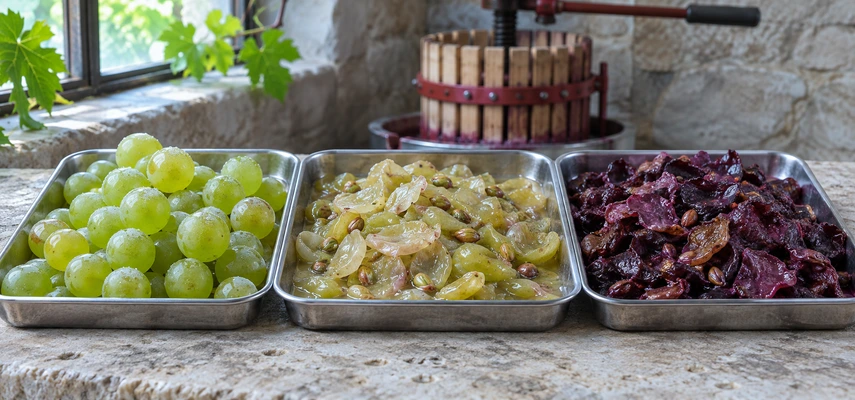

Fruit spirits begin with an advantage over grain spirits: fresh fruit already contains sugars that yeast can use. There is no general need to convert a large starch reserve before fermentation. That apparent simplicity hides several choices. Is the producer fermenting juice, working with a fruit mash, distilling grape pomace or extracting aromas into alcohol that already exists?
Those routes put different material in front of the distiller. Understanding them makes the later comparisons among Cognac, Armagnac, grappa and other fruit-based spirits much more useful. Start before the still, with the fruit’s condition and the sequence of operations. A recognizable aroma at the end has a production history, rather than simply being a souvenir of the orchard.
Fruit spirits need suitable fruit, not just fruit sugar
Ripeness affects the useful starting balance of sugar, acidity and aroma-related material. Variety and condition matter too. Fruit intended for a distinctive aromatic spirit may be selected differently from grapes intended to make a relatively restrained wine for long maturation. One ideal raw material cannot be assumed to suit every spirit style.
Damaged fruit presents a different microbial and handling situation from sound fruit. Unwanted changes can begin during transport or storage, before a deliberate fermentation has been established. A still is a separation device, not permission to neglect raw-material quality. Some unwanted volatile compounds can travel into the distillate rather than conveniently remaining behind.
The practical objective is to preserve useful material until the intended process can control its transformation. Time, temperature, cleanliness and protection during handling all contribute. More intense fruit aroma at intake is only helpful if the producer can carry an appropriate part of it through fermentation and distillation without losing balance or introducing faults.
Crush, press and ferment are different operations
Crushing breaks fruit structures and releases juice. Pressing separates liquid from a proportion of the solid material. Fermentation is the biological conversion of usable sugars into alcohol and other products. These verbs describe different jobs, and their order determines whether skins and other solids remain present while the sugars ferment.
For a juice route, fruit can be crushed or otherwise prepared, pressed and then fermented as a liquid medium. That is a useful simplified sequence for understanding wine destined for distillation. It does not mean every press must crush grapes in exactly the same way, or that the resulting juice contains no solids whatsoever.
For a fruit-mash route, prepared fruit can ferment with much more of its original solid material. Rochelt describes such a route for its fruit brandies. The producer’s preference for spontaneous fermentation is its own method; selected yeast is another possible production choice, and the word natural does not establish a universal quality ranking.
The alcohol comes from fermentation
Yeast metabolises usable fruit sugars, producing ethanol, carbon dioxide and other compounds. The latter can contribute fruit-like or other aromas, so the eventual spirit does not merely preserve a complete inventory of the fresh fruit’s smell. It combines retained raw-material character with products and changes from subsequent processing.
Temperature, nutrition, yeast population and the condition of the medium influence fermentation performance. A high-sugar starting fruit does not guarantee a trouble-free fermentation, and an aromatic variety does not guarantee a balanced distillate. Follow what the organisms can use and how the process is managed, rather than stopping at a variety name.
Fermenting thoroughly also has practical significance. Sugar left unused has not yet supplied ethanol for recovery, while poorly controlled storage of a fermented medium creates opportunities for unwanted change. The producer needs an appropriate fermentation result and a suitable plan for holding and distilling it. Harvest, fermentation and still capacity therefore have to fit together.
Wine for a still has a particular purpose
An excellent drinking wine and an excellent distilling wine need not share the same target profile. The latter is feed for another separation and development process. Acidity, alcohol level, condition and aroma precursors are considered in relation to that purpose. Calling it thin as a table wine does not establish that it is poor raw material for spirit.
As an example, the BNIC production account describes Cognac’s relatively low-potential-alcohol, acidic wine and careful pressing. It also states that adding sugar and sulphites during fermentation is prohibited there. Those are features of this specific production framework, not a universal ban applied to every wine and fruit spirit in every jurisdiction.
The broader lesson is to distinguish the desired feed from the desired finished drink. A producer making spirit for extended oak maturation may seek a different starting relationship than one bottling an unaged aromatic fruit distillate. Quality depends on suitability and execution along that route, rather than whether the base wine would win a table-wine tasting.
Macerate and distil is another route
Some fruit-based spirits obtain aroma by soaking fruit or other suitable material in existing alcohol before redistillation. Maceration extracts compounds into that alcoholic medium. The alcohol is already there; the fruit does not have to supply it all through fermentation. That makes this route fundamentally different from simply fermenting fruit sugars and recovering the resulting ethanol.
The distinction is especially useful with aromatic materials that offer limited practical fermentable yield. Their value may lie in aroma rather than the quantity of alcohol they can generate. In an extraction route, the producer manages the material, alcohol environment and contact, then uses distillation to select the resulting volatile character.
A Geist is a useful example of this principle. The EU spirit-drinks framework distinguishes this sort of identity from fruit spirit made through fermentation. Learn the production difference without treating every fruit-flavored drink as legally interchangeable. A liqueur made by infusion and sweetening is not automatically the same thing as a redistilled fruit macerate.
Pomace is the grape material left after separation
Grape pomace consists principally of the solid grape material remaining after juice or wine is separated, including skins and seeds and, depending on handling, other grape matter. It is not the same as finished wine. It can nevertheless contain retained liquid and useful material for making a distinct spirit through appropriate fermentation and distillation.
That description does not establish whether the pomace has already fermented. To answer that, ask when separation occurred in the winemaking sequence. The difference between pressing grapes before fermentation and pressing material after fermentation is central. Pomace is a material description; its processing history provides the information needed to plan the next step.
Nor should it be described as worthless waste rescued by a still. Condition, variety, retained material and handling all influence suitability. A producer can select and manage pomace deliberately. Its identity as a co-product of winemaking does not decide the quality of the resulting spirit before the distiller has begun work.
White-wine pomace commonly needs fermentation
In a conventional white-wine sequence, grapes are pressed before the juice undergoes alcoholic fermentation. The separated pale pomace can retain sugars but has not necessarily developed the alcohol needed for a pomace spirit. It must therefore receive suitable fermentation management before distillation. Do not assume the finished white wine’s fermentation occurred inside the discarded skins.
This creates a logistical challenge. Fresh pomace needs prompt protection and appropriate conditions rather than an indefinite wait in an open heap. Temperature, air exposure, cleanliness and available fermentable material affect the process. The intended result is a suitable fermented solid-containing feed, not simply a pile that happens to smell alcoholic.
Nonino’s method account illustrates attention to fresh pomace, prompt transport and controlled storage or fermentation. Use it as a producer example. It supports the importance of handling, without proving that every maker uses identical equipment or that one claimed commercial method is the only possible route to good quality.
Red-wine pomace commonly arrives after fermentation
In conventional red winemaking, fermentation takes place with skins present to extract color and other material. The pomace separated afterward has therefore had a different history from freshly pressed unfermented white-grape pomace. It can already contain retained alcoholic liquid from that fermentation, changing what further preparation is needed before distillation.
This is a comparison of usual sequences, not a rule that every pale skin is unfermented or every dark skin is ready for a still. Actual winemaking varies. Determine the material’s processing history and condition rather than relying only on its color. A visual distinction can start a question, but it cannot replace the production record.
Even fermented pomace remains vulnerable to unwanted change. Protection and timely handling still matter, and the equipment must cope with its physical form. A solid-containing feed behaves differently from a relatively clear wine during heating and vapor contact. That difference helps explain why pomace and wine distillation may require different practical arrangements.
Freshness connects the vineyard with the still
Consider a delayed delivery of wet pomace. Its original grape identity has not changed, but its condition may have. Additional microbial activity, oxidation or heating within stored material can alter the compounds available for recovery. The distiller is working with the material that actually arrives, not the healthy grapes described on the vineyard’s harvest sheet.
Preservation is therefore part of production quality. Appropriate storage limits unwanted changes while retaining useful character and allowing any necessary fermentation to proceed as intended. It should be assessed as a system with processing capacity, rather than an isolated instruction to transport everything faster regardless of the conditions at the destination.
What to remember
For every fruit spirit, identify the source of the alcohol, the source of the aroma and the physical material entering the still. Distinguish fermenting juice or mash from macerating fruit in existing alcohol. For pomace, establish whether pressing occurred before or after fermentation. Those questions give you a reliable starting map for the named spirits that follow.
Written practice: original TFE exercises
These suggested marks and indicative points are independent teaching guidance, not official WSET marking schemes.
Exercise 1: 5 suggested marks
Describe five features of the usual white-wine pomace route before distillation. Mapping: LO2 state/describe: processing fruit.
Indicative marking points:
- Grapes are prepared for pressing.
- Juice is separated before its usual white-wine fermentation.
- Pomace remains as solid grape material with retained material.
- It is not necessarily already alcoholic.
- Suitable protected fermentation and handling prepare it for distillation.
Model answer: Prepared grapes are pressed and the juice is separated before its usual white-wine fermentation. The remaining pomace contains grape solids and retained material, but is not necessarily already alcoholic. Suitable protected fermentation and handling are needed to prepare that material for distillation.
Why it works: It describes the sequence and the state of the separated material without turning the task into an explain-type question.
Common mistake: Assuming the pomace automatically underwent the later fermentation of the separated juice gives it the wrong history.
Exercise 2: 5 suggested marks
Describe the macerate-and-distil route using five distinct points. Mapping: LO2 state/describe: maceration route.
Indicative marking points:
- Suitable fruit or other aromatic material is selected.
- Existing alcohol is provided.
- The material is held in that alcohol for maceration.
- Aroma-related compounds are extracted into the medium.
- The resulting preparation is distilled to produce the intended spirit.
Model answer: Suitable aromatic material is selected and combined with existing alcohol. It is held in the alcohol during maceration, allowing aroma-related compounds to enter the medium. The resulting preparation is distilled to obtain the intended spirit. This sequence does not require all its alcohol to originate from fermentation of the macerated fruit.
Why it works: The description identifies material, existing alcohol, contact, extraction and the subsequent distillation as separate points.
Common mistake: Calling maceration yeast fermentation confuses extraction with the biological production of alcohol.
Knowledge check: 10 original practice questions
Independent TFE questions, not official WSET examination items. Choose one answer per question; explanations follow separately.
1. What should be separated when tracing a fruit spirit?
2. What is grape pomace?
3. Which question best establishes a pomace batch’s preparation needs?
4. What supplies ethanol in a fermented-fruit route?
5. Why does prompt pomace handling matter?
6. Which operation separates juice from much of the solid fruit material?
7. What commonly distinguishes conventional red-wine pomace?
8. What does maceration in existing alcohol do?
9. Why can conventional white-wine pomace need fermentation?
10. Does poor table-wine appeal necessarily mean unsuitable distilling wine?
Answers and explanations
- D — Sources of alcohol and aroma. A fermented fruit route and a maceration route can obtain those contributions differently. Mapping: LO2.
- B — Grape material remaining after juice or wine separation. Pomace has a physical identity and can have different fermentation histories. Mapping: LO2.
- B — What is its actual processing history and condition?. Color or reputation cannot replace knowing whether fermentation occurred and how the material was handled. Mapping: LO2.
- C — Yeast metabolism of usable sugars. Fruit sugars can support yeast fermentation without the general starch-conversion requirement of cereals. Mapping: LO2.
- B — Condition can change during uncontrolled storage. Wet material can undergo unwanted microbial and oxidative changes before distillation. Mapping: LO2.
- C — Pressing. Pressing is physical separation; fermentation is a biological transformation of sugar. Mapping: LO2.
- D — Skins have been present during fermentation. Separation after fermentation gives retained material a different history from unfermented pressed pomace. Mapping: LO2.
- C — Extracts compounds into an alcoholic medium. Extraction and alcoholic fermentation are different processes and can supply aroma and alcohol in different ways. Mapping: LO2.
- C — Pressing usually precedes juice fermentation. The separated pomace has not necessarily undergone the alcoholic fermentation that later occurs in the juice. Mapping: LO2.
- A — No, the intended production purpose differs. Suitability is assessed for the intended distillation and development route. Mapping: LO2.
Continue exploring this series
2. Carbohydrates Explained: How Sugar, Starch, and Fructans Become Fermentable
3. Alcoholic Fermentation Explained: Yeast, Nutrients, and Flavor Compounds
5. Distillation Science Explained: Volatility, Congeners, Reflux, and Rectification
6. Pot Still Distillation Explained: Design, Heating, Cuts, and Flavor
17. Cognac Explained: Grapes, Double Distillation, Oak, and Quality
19. Armagnac Explained: Grapes, Column Distillation, and Regional Styles
27. Gin Explained: Juniper, Botanicals, Distillation, and Quality
28. How Botanicals Flavor Spirits: Maceration, Percolation, and Redistillation
15. Rye and Tennessee Whiskey Explained: Production Rules and Flavor Differences
50. WSET Level 3 Spirits Exam: Complete Revision Guide and Practice Examinations












