










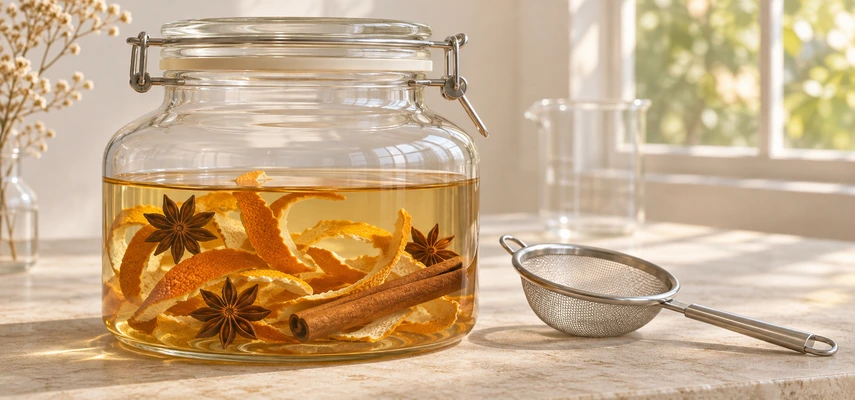

A botanical recipe is only half a production story. Orange peel soaked in spirit, exposed to moving solvent or included in a distillation does not contribute in exactly the same way. The material may be familiar, but its treatment changes which parts of it reach the bottle. That is why a list of ingredients cannot fully explain a flavored spirit.
This lesson follows those routes carefully. Maceration, percolation and redistillation are useful production choices to explain. Other flavorings, animal ingredients and coloring materials belong in the wider picture too, although their place in the syllabus does not make every detail an explain-type written topic. Keep the process and its intended sensory contribution together.
Botanicals offer several kinds of flavor
Botanicals are plant materials used for their contribution to flavor. Fruits and peels, flowers, leaves, seeds, bark and roots offer different starting compositions. Citrus peel can contribute aromatic oils; seeds may provide spice notes; roots and bark can bring earthy or bitter character. The relevant part of the plant matters as much as its name.
Think about an orange. Peel, juice and the white pith are related materials, but a recipe using one does not automatically reproduce another. Likewise, fresh and dried material can behave differently. Drying changes water content and can change aromatic composition, while storage and preparation affect the condition of the ingredient before extraction even begins.
The producer therefore specifies more than a botanical weight. Identity, plant part, condition and preparation all help define the actual input. A substitution that looks tidy in a purchasing spreadsheet may require a new extraction trial. Sensory consistency begins with knowing what went into the vessel, rather than hoping the final blend will hide every difference.
Maceration gives liquid time with the material
Maceration means keeping the material in contact with a liquid, commonly an alcohol-water mixture, so soluble constituents can move into that liquid. The producer selects the solvent, botanical preparation and contact conditions. The resulting macerate can contain aromatic components as well as substances contributing color, bitterness or texture.
Alcohol strength matters because changing the alcohol-water balance changes the solvent environment. Different components have different affinities for that environment. A stronger liquid is therefore not simply a faster version of a weaker one: it may produce a different balance of extracted constituents. The useful question is which composition suits the recipe.
Contact time also needs a target. An early sample may show a bright aromatic contribution; a later one may contain more of another soluble component. Extending extraction can increase unwanted bitterness or alter the balance without improving the desired aroma. More time is a production variable, not an automatic quality certificate.
Preparation changes physical access. Breaking a material into smaller pieces exposes more surface, which can make extraction quicker, but fine particles may complicate separation later. Stirring or circulation can alter contact as well. These choices connect extraction rate, composition and the practical task of obtaining a clear, usable liquid afterward.
A gin example makes the timing concrete
Beefeater describes a 24-hour botanical steep before distillation. That gives a useful named example of maceration as part of a larger process. It does not establish a compulsory steep for all gin, or show that every botanical reaches a desirable endpoint at the same moment.
Suppose a maker changes a dried peel supplier while keeping the old time and weight. The incoming material may differ in oil content, thickness or condition. Sampling can reveal that the familiar procedure now gives a different result. Controlling a process means checking the relationship between the material and the treatment, rather than defending the old timetable.
Percolation uses a moving liquid
In liquid percolation, solvent passes through a bed of prepared botanical material and carries dissolved constituents onward. Unlike a static soak, flowing liquid continually changes the contact environment. The producer must consider flow, bed preparation and the condition of the liquid reaching different parts of the material.
If flow favors a few easy channels, much of the botanical bed may receive less effective contact. Very fine material can impede flow, while loosely arranged material may allow uneven passage. The result depends on the actual movement through the bed, so a diagram showing a downward arrow is only the beginning of the explanation.
The liqueur maker M. J. Horn distinguishes percolation from maceration by the flowing extraction medium. Use that distinction precisely. A percolator is not inherently a still, and an extract obtained this way has not automatically undergone the selective separation associated with redistillation.
Vapor infusion involves another contact environment
In vapor infusion, botanicals are placed in the vapor path during distillation. Vapor contacts the material and the recovered condensate carries a selected aromatic contribution. This differs from simply soaking the same ingredients in the charge liquid. Recipes may combine different treatments, depending on the equipment and intended style.
Terminology can become slippery here because some discussions use percolation more broadly for contact through a botanical basket. State what is moving and where the material sits: liquid solvent flowing through a bed, or vapor contacting botanicals in a still. That makes an answer intelligible even when two producers use slightly different shorthand.
Neither route guarantees a delicate or powerful result by itself. Botanical loading, condition and the rest of the distillation arrangement still matter. A useful comparison describes the changed contact environment and the resulting opportunity for a different composition, without turning one equipment choice into a universal tasting prediction.
Redistillation selects from the extracted mixture
A macerate can be redistilled so that components transferring with the vapor are collected in a new distillate. This is another selection step. It changes the relationship among compounds rather than transferring the entire contents of the extraction vessel into a fresh container. Distillation and filtration therefore perform different jobs.
A visibly colored macerate may yield a clear distillate because many extracted pigments do not transfer in the same way as volatile aromatic components. Likewise, an extract’s bitterness need not appear unchanged in the distillate. Avoid the sweeping claim that every flavor or color always stays behind: behavior depends on the substances and process.
Collection decisions shape the retained composition. A distiller selects material for its contribution to the target profile, then may combine distillates or adjust strength. Heidolph’s equipment application note describes a producer treating botanicals separately and blending their distillates with a traditionally distilled gin. That illustrates control over components, rather than a requirement to process every recipe separately.
One recipe can use more than one route
Consider an original teaching example: a producer wants citrus aroma, a gentle bitter edge and a clear final appearance. A peel macerate may supply aroma and bitterness together, while redistillation can change their relative contribution. Adding an undistilled extract afterward introduces another composition and may change appearance as well as flavor.
The maker must reconcile those choices with the intended legal category. A technique available to flavored spirits in general may be restricted for a particular defined product. Being able to dissolve an extract in alcohol does not prove that the resulting drink meets a named spirit’s production rules. Learn the general toolkit, then apply the category constraints.
Flavorings extend beyond pieces of plants
Producers may use prepared extracts or other permitted flavorings instead of putting the original botanical directly into every production batch. Such materials can make dosing and blending practical, but their concentration and composition still need control. A small addition can have a substantial sensory effect, so precision matters at the blending stage.
Flavoring and sweetening are different operations even when they interact in perception. A fruit extract may contribute aroma without supplying the sweetness expected from the fruit. Sugar can alter the perceived balance of bitterness and alcohol without recreating the fruit’s aromatic identity. Describe the contribution of each addition rather than treating flavor as a single dial.
Animal ingredients have different functions
Animal-derived materials belong to this wider production vocabulary. Cream can contribute dairy character and texture in a liqueur: Baileys describes its Original Irish Cream as combining dairy cream with whiskey, spirits and other flavors. This is a formulated finished drink, not an example of distilling every ingredient together.
Pechuga offers a different route. Montelobos identifies a third distillation with turkey for its Pechuga. That establishes a specific animal ingredient and stage; it does not prove all pechuga recipes use turkey. Honey, eggs and other animal materials also require accurate identification rather than being grouped into one imagined universal process.
Color is an addition with its own purpose
Natural coloring materials and artificial coloring materials can alter appearance independently of the main flavor route, where permitted. Plant-derived colors, caramel and other allowed preparations have different compositions and stability. Natural describes a source or regulatory classification; it does not guarantee that the color will remain unchanged under every storage condition.
Artificial colors can also be used in appropriate products under the relevant rules. An intense hue does not independently establish botanical loading, flavor concentration, age or quality. A red liqueur and a clear botanical distillate may each achieve their intended style through very different decisions about extraction, separation and permitted additions.
What to remember
Follow the material through the process: what contacts it, what dissolves, what is separated, and what finally enters the blend. Maceration uses sustained liquid contact; liquid percolation uses flow through material; redistillation selects a new volatile mixture. Supporting flavorings and colors then need their own descriptions. The ingredient list starts the story, but the route explains the drink.
Written practice: original TFE exercises
These suggested marks and indicative points are independent teaching guidance, not official WSET marking schemes.
Exercise 1: 5 suggested marks
Explain why reducing botanical particle size can affect maceration and subsequent separation. Mapping: LO2 explain: botanical maceration.
Indicative marking points:
- Smaller pieces expose more surface.
- The solvent gains access to more material.
- Extraction can proceed more quickly.
- Fine particles can remain suspended in the liquid.
- Separating those particles can become more demanding.
Model answer: Reducing particle size exposes more surface to solvent, allowing extraction to proceed more quickly. Fine particles can also remain suspended in the liquid, making subsequent separation more demanding. The maker therefore balances extraction access against the practical requirements for a usable extract.
Why it works: It follows the physical change through extraction and a subsequent production consequence.
Common mistake: Claiming finer material is always better ignores separation and the intended extraction endpoint.
Exercise 2: 5 suggested marks
Explain why redistilling a botanical macerate can change its flavor and appearance. Mapping: LO2 explain: redistillation.
Indicative marking points:
- Maceration extracts several kinds of constituents.
- Those constituents do not all have the same volatile behavior.
- Redistillation collects a selected vapor-derived mixture.
- Many pigments transfer less readily than volatile aromatics.
- The retained flavor balance and visible color can therefore differ from the macerate.
Model answer: A macerate contains constituents with different volatile behavior. Redistillation collects a selected vapor-derived mixture, so many pigments do not transfer as readily as aromatic components. The new distillate can therefore have a different flavor balance and less color than the original macerate.
Why it works: It connects selective separation to both sensory and visible consequences.
Common mistake: Treating distillation as an unchanged transfer overlooks the behavior of individual components.
Knowledge check: 10 original practice questions
Independent TFE questions, not official WSET examination items. Choose one answer per question; explanations follow separately.
1. What is a sound approach to extraction time?
2. Why can channeling matter?
3. What does a vivid spirit color prove by itself?
4. What distinguishes liquid percolation?
5. What does redistillation do to a macerate?
6. Why can a colored extract yield a clear distillate?
7. What should an answer clarify when percolation terminology varies?
8. What defines maceration here?
9. Which example adds an animal ingredient during another distillation?
10. Why can changing alcohol strength change an extract?
Answers and explanations
- B — Choose it for the target composition. Longer contact can change unwanted as well as desired components. Mapping: LO2.
- B — Some material receives less effective solvent contact. Uneven flow can create uneven extraction. Mapping: LO2.
- B — Neither age nor quality. Appearance needs separate evidence about production and additions. Mapping: LO2.
- A — Solvent flows through a botanical bed. Flow creates a different contact arrangement from a static soak. Mapping: LO2.
- D — Selects components transferring into collected vapor and condensate. Volatile separation changes the retained composition. Mapping: LO2.
- B — Many pigments do not transfer like volatile aromatics. Appearance and aroma components can behave differently during distillation. Mapping: LO2.
- C — Whether liquid or vapor contacts the botanicals. The actual contact arrangement matters more than ambiguous shorthand. Mapping: LO2.
- A — Sustained contact between botanical material and extracting liquid. Liquid contact allows soluble components to enter the solvent. Mapping: LO2.
- D — The cited Montelobos turkey pechuga. The brand identifies a specific third distillation with turkey. Mapping: LO2.
- D — It changes the solvent environment. Different constituents respond differently to alcohol-water balance. Mapping: LO2.
Continue exploring this series
5. Distillation Science Explained: Volatility, Congeners, Reflux, and Rectification
9. Oak Maturation Explained: Barrels, Oxygen, Evaporation, and Flavor Development
27. Gin Explained: Juniper, Botanicals, Distillation, and Quality
41. Flavored Vodka, Spiced Rum, and Flavored Whiskey Explained
42. Aniseed Spirits and Aquavit Explained: Botanicals, Production, and Styles
43. Genever, Amaro, and Cocktail Bitters Explained: Production, Styles, and Laws
44. Liqueurs and Non-Alcoholic Spirits Explained: Sweetness, Flavoring, and Production
29. Spirits Quality Explained: How Production Decisions Affect Balance and Complexity
50. WSET Level 3 Spirits Exam: Complete Revision Guide and Practice Examinations











