










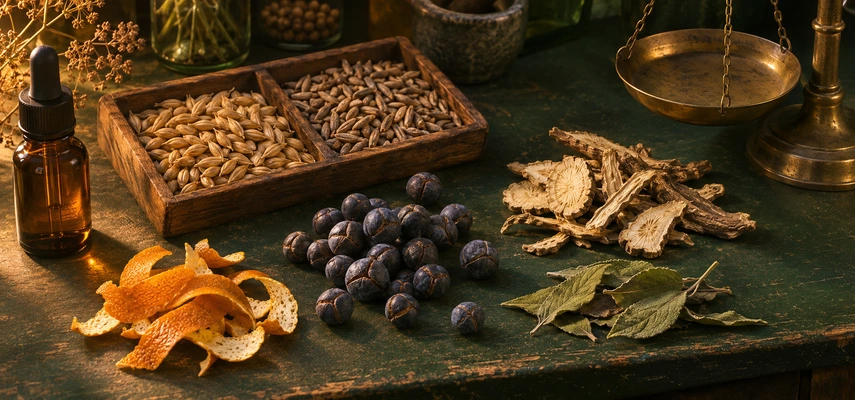

Genever can carry grain character as well as juniper. Amaro can balance assertive bitterness with sweetness and other botanical flavors. Cocktail bitters can concentrate an aromatic contribution into a few dashes. They share some flavor-building tools, but their bases, proportions and intended uses make the finished products very different.
This lesson follows those differences through malt wine, botanical extraction and blending. It also separates recipe-style names from age statements and a bitter flavor from a single universal legal category. These are Learning Outcome 3 subjects, so the original practice questions use the MCQ format rather than suggesting eligibility for written examination answers.
Genever gives grain distillate a role in the blend
Moutwijn, often translated as malt wine, is a grain distillate rather than an ordinary fermented table wine. Grain preparation, starch conversion and fermentation precede distillation. The distillate retains material character that can contribute to genever’s aroma and texture, alongside the influence of juniper and other botanicals.
A Bols production comparison describes malt wine combined with lighter spirit and botanical distillate. The useful point is the division of roles. A relatively characterful grain component can give the blend a different foundation from a highly rectified neutral base whose main role is to carry the botanical recipe.
Malt wine is not made from malt alone in every recipe
The word malt can tempt learners to imagine a compulsory single-malt-whisky recipe. In genever production, the permitted grain-distillate framework and individual recipes allow a wider cereal discussion. The important distinction is the retained character of the distillate, not an assumption that every maker uses exactly the same grain proportions or distillation arrangement.
Starch must still reach a usable sugar form before yeast can supply ethanol. Distillation then concentrates and selects from that fermented mixture. Keeping these stages in order prevents two common errors: treating dry grain as immediately fermentable without preparation, and treating the term malt wine as though it referred only to an undistilled beer-like wash.
Juniper belongs alongside the grain contribution
Juniper supplies a defining botanical relationship, with other ingredients able to support the intended profile. Its role need not look identical to the juniper dominance expected in gin. A malt-wine contribution can remain apparent, creating a balance between cereal-derived and botanical character rather than requiring the base to disappear completely.
The Dutch government’s current protected-name overview lists genever and related identities separately. General jenever has a 30% ABV minimum and at least 1.5% of its alcohol from moutwijn. Its protected geography extends beyond the Netherlands to Belgium and specified French and German areas. More specific names have narrower conditions.
Jonge and oude refer to recipe styles
Jonge means young and oude means old, but the names do not operate as ordinary minimum-age statements. Their important distinction concerns composition and style. A jonge expression is associated with a smaller malt-wine contribution, while oude gives that component a more substantial role. Actual wood maturation is a separate production decision that should be identified independently.
Imagine an oude genever with no claimed cask age and a separate barrel-aged bottling. The word oude alone does not tell you that the first must be older than the second. The sensible reading separates the protected recipe name from any additional maturation statement, then asks what each one actually establishes.
Read the malt-wine percentages on the correct basis
The official jonge product file specifies at least 1.5% but less than 15% moutwijn in the final product’s pure-alcohol volume, with a 35% ABV minimum. That is more precise than the casual phrase up to fifteen percent. The boundary is strictly below fifteen in that specification.
The oude file specifies at least 15% on the corresponding alcohol basis, also with a 35% ABV minimum. Do not quietly change an alcohol-contribution percentage into the same percentage of liquid volume when components have different strengths. The measurement basis is part of the rule, not an optional footnote.
Korenwijn offers a more grain-focused comparison
Korenwijn, also appearing as corenwyn, points toward a substantial grain-distillate contribution. Bols describes its two-year Corenwyn bottling as containing more than 51% malt wine and undergoing French-oak maturation. The producer example makes the contribution of grain and wood explicit rather than asking the word old to carry every part of the story.
Keep that named product’s two-year maturation attached to the expression. It illustrates a choice, not a compulsory age for every genever. A richer grain profile also does not automatically outrank a lighter jonge style. A quality judgment should assess how successfully the selected components form the intended finished spirit.
Bitter spirits begin with a controlled botanical selection
Bitter roots, bark, citrus and other plant materials can supply different contributions. An amaro recipe may combine bitterness with herbal, floral, spice or citrus associations and a sweetening component. The Italian word amaro means bitter, with amari as the plural, but that linguistic connection does not identify one universal recipe or strength.
Selection matters because several intense ingredients can compete as easily as complement one another. A successful formula considers the base, the desired bitter structure and supporting aromas together. Listing more botanicals is not the same as demonstrating more complexity, especially if one forceful contribution obscures everything else in the glass.
Extraction conditions change the bitter contribution
Maceration, percolation and distillation offer different ways to recover botanical material. M. J. Horn distinguishes these production routes, providing a practical reminder that a botanical list alone cannot specify the resulting liquid. Contact time, preparation and solvent conditions affect what is extracted before blending even begins.
Some bitter constituents do not transfer through distillation in the same way as volatile aroma compounds. An extract can therefore contribute a different combination of color, bitterness and aroma from a corresponding distillate. The producer can process materials separately, then combine the results, rather than requiring every ingredient to share one extraction treatment.
Amaro styles occupy several positions on the sensory map
One example may emphasize citrus and a relatively rounded sweet-bitter relationship, while another is intensely herbal with menthol-like associations. These are sensory directions, not rigid subcategories covering every brand. Strength, sweetness, concentration and texture can vary alongside the botanical recipe, so compare several dimensions rather than ranking bitterness alone.
Fernet-Branca identifies a 27-botanical recipe and a 39% ABV product, with an intense bitter and herbal identity. That named account supports an example rather than permission to invent a complete proprietary formula. Historical digestive associations should likewise remain historical context, not be promoted as a demonstrated medical benefit of drinking the spirit.
Blending can connect bitter components with a new base
Amaro di Angostura is described as combining aromatic bitters, neutral spirit and additional spices. This is a useful example of a concentrated component being incorporated into a broader finished formulation. The eventual amaro is not simply the original cocktail bitters poured into a larger bottle.
Sweetening can alter perceived balance without eliminating bitterness. Likewise, changing strength can alter texture and the way aromas are expressed. A thoughtful production account connects those adjustments to the target drink. It doesn’t assume that the strongest, darkest or most bitter version must be the best expression of every botanical combination.
Cocktail bitters are concentrated seasoning ingredients
Angostura describes its aromatic bitters as a flavoring for drinks and food. Small amounts can change the aromatic balance of a larger mixture, rather like seasoning in a dish. This use distinguishes cocktail bitters from an amaro commonly served in a larger measure as a finished drink.
The analogy has limits. A few dashes do not make an alcoholic ingredient alcohol-free, and serving size is not the same as the strength printed on the bottle. Nor should every cocktail bitters brand be assumed to have the same recipe, sweetness or botanical concentration. Learn the production idea without treating one market leader as the entire category.
Bitter taste and legal category are separate questions
The EU spirits framework defines a bitter-tasting spirit-drink category with a predominantly bitter taste and a 15% ABV minimum. It also allows bitter terminology in relation to bitter-tasting liqueurs. A bitter flavor alone therefore does not settle every part of the final legal designation.
For an individual product, check its actual composition and market description. Amaro, herbal liqueur and cocktail bitters are useful terms in discussion, but they should not be forced into one identical strength or sugar rule. This is the same discipline used elsewhere in the series: describe the sensory observation, then establish the identity through the applicable requirements.
When comparing products, note the measure and dilution used. A concentrated bitters sample tasted neat and an amaro served over melting ice are being presented under different conditions, which can obscure the compositional differences you intended to study.
What to remember
Genever combines a grain-distillate relationship with juniper, while jonge and oude identify composition styles rather than ordinary age statements. Amaro uses bitter botanicals within a balanced formulation; cocktail bitters provide a concentrated seasoning role. Across all three, learn what the base contributes, how the botanicals are treated and how the final blend is organized. Those relationships explain more than a long ingredient list.
Knowledge check: 12 original practice questions
Independent TFE questions, not official WSET examination items. Choose one answer per question; explanations follow separately.
1. What do jonge and oude principally distinguish here?
2. What is a sound quality comparison for bitter spirits?
3. What does amari mean?
4. What is a characteristic role for cocktail bitters?
5. What minimum moutwijn alcohol contribution applies to oude in the cited file?
6. What distinguishes an extract from a distillate in the botanical comparison?
7. What minimum moutwijn alcohol contribution does the cited jonge file require?
8. What is moutwijn in the genever discussion?
9. What minimum strength do the cited jonge and oude files share?
10. What minimum applies to the cited EU bitter-tasting spirit category?
11. What is the upper malt-wine boundary in that jonge file?
12. Why should an alcohol-contribution percentage not be silently treated as liquid volume?
Answers and explanations
- D — Recipe styles and malt-wine relationships. The names must be separated from additional actual maturation statements. Mapping: LO3.
- A — Assess integration of bitterness, sweetness, alcohol and other aromas. Balance and the successful whole matter more than maximizing one intense contribution. Mapping: LO3.
- A — The plural of amaro. The word groups bitter drinks linguistically without establishing one universal recipe. Mapping: LO3.
- A — Concentrated seasoning in small amounts. Small additions can influence a larger mixture without defining the whole drink composition. Mapping: LO3.
- A — 15%. The larger required contribution distinguishes the protected composition relationship. Mapping: LO3.
- B — They can retain different combinations of volatile and less volatile constituents. Different recovery operations need not deliver the same bitterness, color and aroma contribution. Mapping: LO3.
- B — At least 1.5%. The protected specification includes a lower contribution threshold as well as an upper boundary. Mapping: LO3.
- C — A characterful grain distillate. The term describes a distilled grain component rather than an ordinary undistilled wine. Mapping: LO3.
- B — 35% ABV. Their minimum must not be confused with the lower general jenever minimum. Mapping: LO3.
- B — 15% ABV. This specific category must be kept distinct from other bitter-tasting liqueur identities. Mapping: LO3.
- A — Less than 15% on the specified pure-alcohol basis. The official wording is stricter than a casual inclusive up-to-fifteen shorthand. Mapping: LO3.
- A — Components can have different strengths. The specified measurement basis is essential when interpreting a formulation rule accurately. Mapping: LO3.
Continue exploring this series
3. Alcoholic Fermentation Explained: Yeast, Nutrients, and Flavor Compounds
4. Fermentation Methods Explained: Liquid, Solid-State, Sequential, and Parallel Fermentation
6. Pot Still Distillation Explained: Design, Heating, Cuts, and Flavor
9. Oak Maturation Explained: Barrels, Oxygen, Evaporation, and Flavor Development
10. Spirits Finishing Explained: Blending, Filtration, Sweetening, Coloring, and Packaging
27. Gin Explained: Juniper, Botanicals, Distillation, and Quality
28. How Botanicals Flavor Spirits: Maceration, Percolation, and Redistillation
41. Flavored Vodka, Spiced Rum, and Flavored Whiskey Explained
42. Aniseed Spirits and Aquavit Explained: Botanicals, Production, and Styles
44. Liqueurs and Non-Alcoholic Spirits Explained: Sweetness, Flavoring, and Production
50. WSET Level 3 Spirits Exam: Complete Revision Guide and Practice Examinations












