










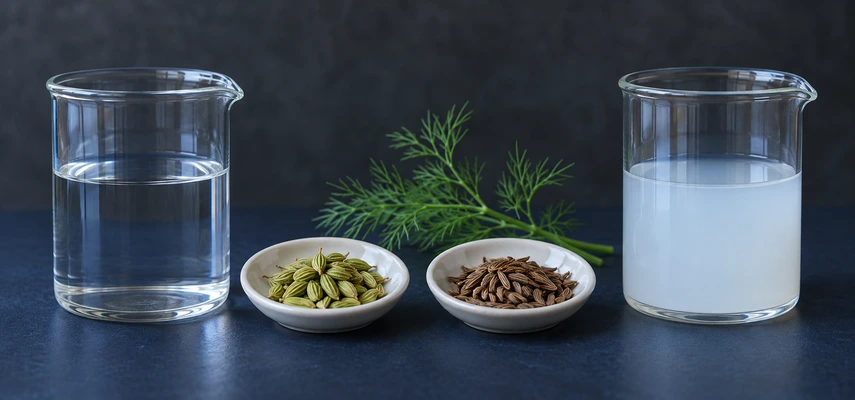

Aniseed spirits can announce themselves before the glass reaches your nose. Their distinctive aromatic family appears in drinks as different as ouzo, pastis and rakı, yet those names do not describe one universal recipe. Aquavit brings another set of botanical anchors, principally caraway and dill, with styles that can be clear and direct or influenced by wood.
The production questions are familiar: which alcohol provides the base, how is botanical character extracted, what is distilled, and how is the final liquid adjusted? Following those choices explains more than a list of national drinking customs. It also makes the famous clouding of an anise spirit a useful lesson in solubility rather than a mysterious change of substance.
Similar aromas can come from different plants
Anise, star anise and fennel are different botanical materials that share an important aromatic association. Anethole contributes much of the familiar anise-like character. The presence of a shared constituent helps explain the family resemblance, but it does not make the plants identical or require producers to use them in equal proportions.
Other botanicals can contribute supporting notes, while extraction conditions influence the resulting balance. A recipe containing several ingredients is therefore more than a contest to choose the most aromatic seed. The maker must decide how much of each contribution belongs in the intended whole, and how those materials should be processed.
Extracting flavor and distilling flavor are different operations
Maceration exposes material to a liquid that dissolves selected constituents. Redistillation then transfers volatile components into a collected distillate while leaving much less volatile material behind. Producers can use one route or combine appropriate methods. A final spirit’s color and aroma consequently depend on the treatment sequence, not merely on the presence of herbs.
This distinction is useful when comparing a colored infusion with a clear aromatic distillate. The latter can smell strongly of the botanicals without retaining the same pigment contribution. The still has selected from the mixture rather than carrying the entire original liquid unchanged into the receiving vessel.
Why water can turn an anise spirit cloudy
The Ouzo technical file explains the characteristic haze through aromatic compounds, especially anethole, becoming less soluble as alcohol concentration or temperature falls. Adding water changes the solvent mixture. Tiny dispersed droplets scatter light, producing the familiar opalescent appearance often called the louche or ouzo effect.
That observation is different from adding milk, creating carbon dioxide or restarting fermentation. Nor does the haze mean every aroma compound has disappeared. The liquid’s physical organization has changed. A neat clear sample and its diluted cloudy version can therefore belong to the same spirit, viewed under different composition and temperature conditions.
Ouzo: a protected identity with several production proportions
Ouzo is associated with the protected production territories of Greece and Cyprus. Its technical framework requires at least 20% of the finished product’s alcoholic strength to come from the qualifying flavored distillate; minimum marketed strength is 37.5% ABV. The rest of the formulation is still controlled by the relevant identity requirements, rather than being an unrestricted mixture.
Samara describes an ouzo made entirely through distillation. That is a useful contrast between a category’s minimum distilled share and a producer choosing a higher share. The phrase 100% from distillation therefore tells you something specific about the example, not what every bottle named ouzo must necessarily contain.
Pastis combines anise with a liquorice relationship
The EU category framework defines pastis as an aniseed-flavored spirit drink containing natural liquorice-root extracts. Its minimum strength is 40% ABV. Pastis de Marseille has a more specifically prescribed anise character and a 45% ABV minimum. Those distinctions concern the category, rather than simply the location of a serving terrace.
The broader aniseed-flavored spirit-drink category has a 15% ABV minimum, while anis has a 35% minimum. Learn the names with their applicable numbers. Using the lowest family-wide minimum for every named subcategory would erase requirements that the more specific identities retain. Likewise, not every anise-tasting drink is automatically pastis.
Rakı: consider the base as well as the anise
Yeni Rakı describes fresh and dried grapes supplying suma, with aniseed contributing the characteristic flavor. This gives a named example in which the grape-derived distillate is part of the production story. It is more informative than treating anise as if it were the sole ingredient that mattered.
Keep Turkish rakı distinct from fruit-spirit names that look or sound similar in other languages. A familiar-looking spelling does not establish identical raw materials or legal requirements. When revising, write the country and production relationship beside the name, then use the actual product information rather than transferring a neighboring tradition’s recipe.
Absinthe shows how distillation and coloring can be separated
Wormwood, anise and fennel are central botanical references for absinthe, with other herbs varying by recipe. Combier’s L’Entêté technical sheet describes distillation followed by a fresh-leaf infusion that contributes natural green color. The aroma-building and coloring stages can therefore be related while remaining separate operations.
The same distillery’s Blanchette sheet describes a white absinthe, showing why green appearance is not compulsory across all traditional styles. Neither color alone nor an elaborate serving ritual establishes quality. Compare the actual integration of botanical aromas, alcohol, texture and finish rather than relying on a dramatic visual cue.
Sambuca belongs in the sweetened part of the comparison
Molinari’s recipe account identifies anise, alcohol and sugar. Sambuca provides a useful comparison with drier anise-focused spirits because its liqueur relationship gives sweetness a more obvious structural role. A shared aromatic family does not mean ouzo, absinthe and sambuca must have the same palate weight or level of sweetness.
When tasting, distinguish a sweet-smelling anise association from the actual impression of sweetness on the palate. Record each separately. That prevents a strong aroma from becoming an assumed sugar concentration, and it makes comparisons clearer when one spirit combines substantial sweetness with botanical intensity while another emphasizes a more restrained, dry-seeming profile.
Aquavit changes the principal botanical anchors
Aquavit, also spelled akvavit, centers on caraway or dill seed or both. Under the EU definition, its flavor is largely attributable to their distillates, with a 37.5% ABV minimum; essential oils are prohibited as the means of supplying that defining contribution. The category should not be reduced to any neutral spirit with a savory herb added.
Caraway and dill are alternatives as well as potential partners. This point matters because a learner who remembers only caraway will misclassify a legitimate dill-led example. Supporting botanicals can add further detail, but the principal relationship remains more specific than a general impression of spice or a Scandinavian name on the label.
Clear Danish examples demonstrate botanical differences
Aalborg Taffel is described by its producer as clear and caraway-led, with a more subtle orange association. This is a useful example of a direct botanical profile whose appearance does not depend on a pronounced maturation color. It need not be treated as an unfinished version of a darker aquavit.
Aalborg Jubilæums instead emphasizes dill and coriander distillates and explicitly describes an absence of caraway, alongside an American white-oak extract contribution. That last detail matters: an extract statement is not the same as a claim that the whole spirit spent a specified period aging in a cask. Read the production description literally.
Wood-matured aquavit offers another style
Linie describes a potato-based spirit redistilled with botanicals and matured in former Oloroso sherry casks, including its sea journey across the equator. The example brings botanical and wood-derived contributions together. Cask history adds a further variable beyond the selection and distillation of the herbs and seeds.
The voyage is a specific house practice, not a universal requirement for every aquavit. Nor is potato a compulsory raw material for every expression. Keep the base, botanical profile and maturation method on separate lines in your notes, then connect them for the named example. That structure makes variation easier to remember without inventing national absolutes.
Compare botanical strength with balance
A powerful aroma can be appropriate, but intensity alone does not establish quality. Ask whether the defining botanical contribution sits coherently with alcohol, sweetness, texture and any wood influence. An aggressive bitterness or disconnected alcohol impression may undermine the whole even when the main botanical is unmistakable.
For a practical exercise, compare a clear caraway-led aquavit with a matured example, or two anise spirits with different sweetness and dilution behavior. Write observations before studying the production notes. Then explain plausible connections while preserving uncertainty: a particular aroma does not uniquely reveal a still design, a seed proportion or the precise duration of an extraction.
Keep tasting conditions consistent during that comparison. Different serving temperatures or dilution levels can alter what seems most prominent, so a comparison of production choices becomes less useful if every sample is evaluated under a different set of conditions.
What to remember
Follow the botanical route from extraction to distillation and final adjustment. Learn anise, star anise and fennel as distinct materials; explain clouding through solubility; keep ouzo, pastis, rakı, absinthe and sambuca separate. For aquavit, remember caraway or dill and distinguish clear, extract-adjusted and cask-matured examples. Shared aroma families can connect traditions without making their identities interchangeable.
Knowledge check: 12 original practice questions
Independent TFE questions, not official WSET examination items. Choose one answer per question; explanations follow separately.
1. What does the Yeni Rakı example connect with aniseed?
2. What minimum strength applies to pastis de Marseille?
3. What EU minimum applies to aquavit?
4. Which practice is attached to the Linie example rather than all aquavit?
5. Which compound is central to the anise-spirit clouding discussion?
6. What does an oak-extract statement establish?
7. What minimum qualifying distillate contribution does the cited ouzo framework require?
8. Why can adding water produce an opalescent appearance?
9. Which root extract is part of the pastis definition?
10. What does a white absinthe example show?
11. Which botanical alternatives define the central EU aquavit relationship?
12. Which pair forms the protected ouzo production territories?
Answers and explanations
- C — Grape-derived suma. The named producer describes a grape-based production relationship before anise flavoring. Mapping: LO3.
- A — 45% ABV. The specific category has a higher minimum than broad aniseed-flavored spirit drink. Mapping: LO3.
- C — 37.5% ABV. The category minimum is separate from broad aniseed-spirit and other botanical-drink minima. Mapping: LO3.
- B — Maturation in sherry casks including an equator-crossing voyage. A named house maturation method must not be converted into a universal category rule. Mapping: LO3.
- C — Anethole. Reduced solubility of aromatic oil helps explain the dispersed droplets and resulting haze. Mapping: LO3.
- B — An extract contribution rather than proof of a specified cask age. Adding an extract and holding the whole spirit in a cask are distinct production operations. Mapping: LO3.
- B — 20% of the finished alcoholic strength. A producer making 100% distilled ouzo exceeds rather than defines the category minimum. Mapping: LO3.
- D — Changing alcohol concentration reduces solubility of some aromatic constituents. The solvent composition changes, allowing tiny droplets to scatter light through the liquid. Mapping: LO3.
- D — Liquorice. Liquorice-root extract distinguishes the category relationship from a generic anise flavor. Mapping: LO3.
- B — Green color is not compulsory across all absinthe styles. Coloring and botanical distillation can be separate decisions in the production sequence. Mapping: LO3.
- D — Caraway or dill seed or both. Dill-led examples prevent reducing the entire category to mandatory caraway alone. Mapping: LO3.
- C — Greece and Cyprus. The protected identity has a specific geographical relationship rather than covering every anise spirit. Mapping: LO3.
Continue exploring this series
5. Distillation Science Explained: Volatility, Congeners, Reflux, and Rectification
9. Oak Maturation Explained: Barrels, Oxygen, Evaporation, and Flavor Development
26. Vodka Explained: Neutral Spirits, Raw Materials, and Production Choices
28. How Botanicals Flavor Spirits: Maceration, Percolation, and Redistillation
41. Flavored Vodka, Spiced Rum, and Flavored Whiskey Explained
44. Liqueurs and Non-Alcoholic Spirits Explained: Sweetness, Flavoring, and Production
43. Genever, Amaro, and Cocktail Bitters Explained: Production, Styles, and Laws
50. WSET Level 3 Spirits Exam: Complete Revision Guide and Practice Examinations












