











Vodka looks simple because much of the production work is aimed at restraint. The producer starts with an agricultural material, makes alcohol through fermentation, then separates it extensively and prepares a controlled final liquid. That process can reduce source character dramatically without making every bottle identical in aroma, texture or balance.
The useful question is not whether vodka has flavor in the abstract. It is which compounds and sensations remain after the chosen preparation, separation and treatment. Wheat, rye, potatoes and sugar-bearing materials create different upstream problems. Distillation, filtration and water then determine how much of those differences matters in the glass.
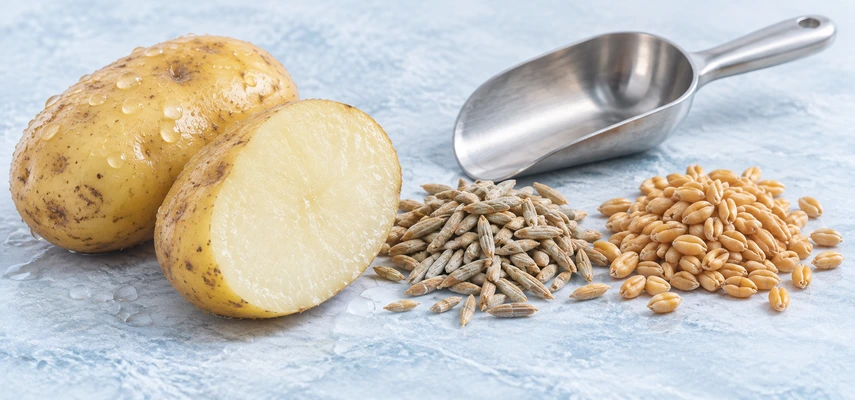
Vodka has several possible starting materials
Cereals and potatoes are important traditional sources, but vodka need not always begin with either. Other suitable agricultural raw materials can supply fermentable sugar or carbohydrate for conversion under the applicable framework. A raw-material name tells you where to begin tracing the process, not the complete sensory profile of the finished spirit.
For example, Absolut describes its winter-wheat route and continuous distillation. Chopin describes potatoes as one of its deliberately selected materials. These are real producer examples, rather than proof that every wheat vodka is light or every potato vodka must be creamy.
The producer first needs a reliable source of usable sugar and an appropriate medium. Cost, supply, handling, yield and target style can influence the choice. Highly rectified production still needs sound material and control; extensive separation is not an unlimited repair service for every upstream problem.
Grain needs access and starch conversion
Grain stores much of its useful carbohydrate as starch. Milling improves physical access, and suitable preparation makes that starch available for enzyme action. Depending on the material and process, heat and water help gelatinise it. Suitable enzymes then break appropriate links to produce smaller carbohydrates, including sugars the selected yeast can use.
Vodka is not constrained to the malt-only route of a particular whisky category. Suitable commercial enzymes can perform conversion functions within the applicable process. The important principle is substrate compatibility: the preparation and enzymes must work on the material present, under conditions that preserve useful activity.
Concentrate on the sequence. Grinding changes particle size, hydrolysis changes chemical bonds and yeast makes alcohol from usable sugars. Confusing those jobs leads to explanations in which a mill makes ethanol or a still somehow ferments starch. Even when the intended spirit is neutral, the underlying biology remains essential.
Potatoes require their own preparation
Potatoes contain starch within a moist tuber structure rather than the relatively dry organization of cereal grain. Washing removes soil, and suitable preparation and cooking disrupt the material and make starch accessible. Chopin’s account describes washing and steam cooking in its own potato-vodka route. That is a practical example of adapting preparation to the raw material.
Cooking alone should not be described as automatically converting every starch molecule into fermentable sugar. Gelatinisation and hydrolysis are different transformations. Appropriate enzyme activity is still needed to release usable smaller carbohydrates from the accessible starch. A potato mash can be physically soft while its carbohydrate preparation remains incomplete.
The producer also has to manage water content, concentration and handling. A wet tuber feed and a dry milled cereal do not begin with identical proportions or physical behavior. Simply copying the weight of material from one recipe into the other does not establish the same usable extract. Preparation must suit both the ingredient and the working equipment.
This gives a clear diagnostic chain: inspect material condition, establish physical access, check conversion and then assess the fermentation environment. Low alcohol yield could begin with poor conversion rather than weak yeast. The remedy depends on identifying the limiting stage, not merely adding more of whichever ingredient has the most memorable name.
Sugar-bearing feeds have a different problem
A feed already containing suitable simple sugars can avoid the general starch-conversion requirement. It still needs preparation into an appropriate liquid. Dilution, acidity, temperature and nutrition matter because the yeast is an organism with working limits, not a pump that turns every sweet liquid into alcohol at the same rate.
The Lallemand nutrition guidance explains why nutrient management differs across substrates. Abundant sugar does not establish sufficient nitrogen, vitamins or minerals. Fermentation reliability depends on the whole medium, while an inappropriate environment can create unwanted products that increase the later separation burden.
The difference from grain and potatoes is therefore specific. The producer may avoid one carbohydrate-conversion stage, but not the need for a suitable fermentation. It is more accurate to identify which preparation job disappears than to call the whole process simpler and leave the biological requirements unexplained.
Fermentation supplies alcohol and congeners
Yeast creates ethanol, carbon dioxide and other products from usable sugars. Strain and conditions influence yield and the additional compounds formed. Even a producer seeking a restrained final spirit benefits from controlling the wash’s composition, because rectification receives that actual mixture rather than a theoretical solution containing only ethanol and water.
Two fermentations with similar ethanol concentration can carry different amounts and balances of other volatile material. That can affect the work needed downstream and the character retained. A neutral target does not make fermentation irrelevant; it changes how the producer evaluates its contribution alongside the intended separation.
This is also why an aromatic raw material does not guarantee a strongly aromatic vodka. Extensive rectification and later treatment can reduce many of the compounds that might otherwise announce its origin. The relationship between ingredient and final style is mediated by the process, rather than a direct transfer from farm to tasting note.
Rectification creates a highly concentrated spirit
Continuous multi-stage systems can provide extensive contact between vapor and liquid. Working stages, reflux, heat and withdrawals influence separation, concentrating ethanol while reducing or redirecting other components. The high-strength spirit reflects repeated phase exchange, not an imaginary point where ethanol boils alone and all water waits quietly in another corner.
Different arrangements can perform different tasks, including stripping alcohol from fermented feed and refining the recovered spirit further. A producer coordinates those stages to meet compositional and sensory targets. More equipment or a greater advertised number of distillations does not independently establish better quality; the relevant question is what separation has actually achieved.
Repeated distillation claims also need interpretation. A continuous column cannot always be meaningfully compared with the count of separately charged pot runs. Read the process rather than turning a marketing number into a universal scale. Appropriate removal, retention and consistency matter more than the largest integer printed on the bottle.
Filtration is a separate control
Activated charcoal can adsorb selected compounds, changing the liquid after distillation. Its effect depends on the spirit, contact conditions, material and treatment intensity. It is not the same operation as mechanical screening, and it does not automatically remove every possible aroma compound or make all treated spirits identical.
Other treatment or filtration arrangements can serve particular purposes. The producer assesses whether the result meets the target in clarity, aroma and texture. Charcoal treatment should not be assumed compulsory for every vodka merely because it is prominent in some brand stories. A particular method requires evidence about that product and its governing framework.
The useful comparison is between the composition entering treatment and what leaves it. Distillation establishes one set of changes; adsorption and filtration establish another. Calling them all purification hides the controls the producer actually has and the different consequences each can create.
Water and final preparation influence presentation
High-strength spirit is reduced with suitable water for bottling. Water quality, composition and treatment matter to consistency, clarity and final presentation. The producer also manages the adjustment itself, then assesses the finished liquid at its intended strength. A source’s romantic description does not replace evidence about its suitability.
Strength changes affect the alcohol-water environment and the release of aroma compounds, as well as perceived warmth and texture. A stronger vodka is not automatically more detailed or higher quality. Judge the relationship among intensity, alcohol and texture in the actual sample, rather than treating strength as an independent score.
Texture descriptions need similar care. Creamy does not mean potato starch has simply survived intact through rectification into the glass. A sensory impression is a result to investigate, not permission to invent its cause. Retained compounds, final strength and permitted preparation can all contribute to the experience.
USA and EU rules need separate reading
Under the current US standard, vodka belongs to neutral spirits, distilled at or above 95% ABV and bottled at no less than 40% ABV. The current wording does not repeat the old absolute requirement for an absence of distinctive character, aroma or taste. Charcoal treatment is not universally compulsory.
The EU framework uses agricultural ethyl alcohol with its 96% minimum-strength standard and a vodka bottling minimum of 37.5% ABV. It also requires prominent raw-material information when vodka is not produced exclusively from potatoes or cereals. Do not exchange the two markets’ bottling minimums or their exact wording.
These are core distinctions, not a complete labeling manual. Permitted preparation, flavored identities and geographical indications can add further conditions. Establish the market and product identity before applying a rule. The same ordinary word on two shelves does not guarantee that every regulatory detail is identical.
What to remember
Trace the source material into usable sugars, fermentation and extensive separation, then assess treatment, water and final strength. Know why potatoes and grain need conversion while a suitable sugar feed may not. For quality, examine precision, balance, texture and appropriate persistence using the actual vodka. Neutrality is a controlled production outcome, with plenty of decisions behind its quiet appearance.
Written practice: original TFE exercises
These suggested marks and indicative points are independent teaching guidance, not official WSET marking schemes.
Exercise 1: 5 suggested marks
Explain why steam-cooked potato mash is not automatically ready for conventional yeast fermentation. Mapping: LO2 explain: processing raw material.
Indicative marking points:
- Potatoes contain starch.
- Cooking can disrupt structure and improve starch access.
- Accessible starch is not identical to usable simple sugar.
- Suitable enzymatic hydrolysis must produce smaller usable carbohydrates.
- The resulting medium also needs appropriate yeast working conditions.
Model answer: Potatoes contain starch, and steam cooking can improve access to it. Accessible starch is still not the same as usable simple sugar, so suitable enzyme action must release smaller carbohydrates. The resulting medium also needs suitable conditions for yeast fermentation.
Why it works: It distinguishes physical preparation, chemical conversion and the organism’s later work.
Common mistake: Saying softened potato automatically equals fully fermentable sugar skips hydrolysis.
Exercise 2: 5 suggested marks
Explain why vodka made from an aromatic raw material need not retain a strong version of that aroma. Mapping: LO2 explain: distillation and style.
Indicative marking points:
- The raw material contributes to the fermented feed.
- Fermentation can change its composition.
- Extensive rectification separates ethanol from many other components.
- Further treatment can selectively reduce additional compounds.
- The retained balance therefore depends on the whole process rather than raw-material identity alone.
Model answer: The raw material contributes to a feed whose composition changes during fermentation. Extensive rectification then separates ethanol from many other components, and later treatment can reduce additional compounds. The final retained balance therefore reflects the whole process rather than a direct transfer of the original aroma.
Why it works: It connects the source to several intervening transformations and a qualified final result.
Common mistake: Assuming a strong-smelling crop must make a strongly aromatic vodka ignores the separation target.
Knowledge check: 10 original practice questions
Independent TFE questions, not official WSET examination items. Choose one answer per question; explanations follow separately.
1. What does activated charcoal treatment principally involve?
2. Is charcoal universally mandatory for current US vodka identity?
3. What can the number of advertised distillations alone not establish?
4. What does grain milling directly change?
5. Why may a suitable sugar-bearing feed avoid one grain stage?
6. What is the EU vodka bottling minimum cited here?
7. Which variable can affect congener formation during fermentation?
8. What is a function of extensive rectification?
9. Which US neutral-spirit distillation and vodka bottling pair is correct?
10. What must potato starch generally undergo before conventional fermentation?
Answers and explanations
- C — Adsorption of selected compounds. Treatment conditions determine its effect and it should not be confused with fermentation or maturation. Mapping: LO2.
- B — No. The current US standard does not impose universal charcoal treatment. Mapping: LO2.
- D — Superior quality. Actual separation and finished balance matter more than a marketing count. Mapping: LO2.
- B — Physical particle size and access. Milling supports processing without being chemical conversion or fermentation. Mapping: LO2.
- C — It may already supply usable sugars without starch hydrolysis. Avoiding starch conversion does not eliminate the other fermentation requirements. Mapping: LO2.
- A — 37.5% ABV. The EU and US minimums must not be exchanged. Mapping: LO2.
- B — Yeast conditions and medium composition. Fermentation supplies a mixture whose additional compounds matter to later separation. Mapping: LO2.
- B — Concentrating ethanol while controlling other components. Repeated phase contact changes separation; it does not perform the preceding biological jobs. Mapping: LO2.
- B — At least 95% and at least 40% ABV. Distillation and bottling are separate stages governed by the reviewed US requirements. Mapping: LO2.
- A — Suitable access and enzymatic conversion. Cooking can improve access, but suitable hydrolysis is a distinct requirement. Mapping: LO2.
Continue exploring this series
2. Carbohydrates Explained: How Sugar, Starch, and Fructans Become Fermentable
3. Alcoholic Fermentation Explained: Yeast, Nutrients, and Flavor Compounds
5. Distillation Science Explained: Volatility, Congeners, Reflux, and Rectification
7. Column and Hybrid Stills Explained: Plates, Reflux, and Continuous Distillation
10. Spirits Finishing Explained: Blending, Filtration, Sweetening, Coloring, and Packaging
11. How Grains Become Whisky: Malting, Mashing, Enzymes, and Starch Conversion
27. Gin Explained: Juniper, Botanicals, Distillation, and Quality
28. How Botanicals Flavor Spirits: Maceration, Percolation, and Redistillation
29. Spirits Quality Explained: How Production Decisions Affect Balance and Complexity
30. How to Explain Spirits Production: Advanced Cause-and-Effect Case Studies
25. Mezcal Explained: Agave Varieties, Traditional Methods, and Quality
50. WSET Level 3 Spirits Exam: Complete Revision Guide and Practice Examinations











