










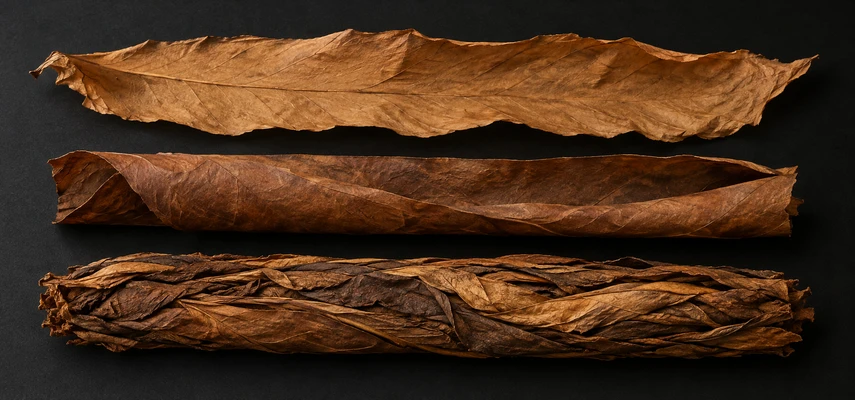

A traditional handmade cigar appears to be one continuous roll of tobacco. Its construction is more organized than that impression suggests. Interior leaves form a bunch, a binder contains it, and an outer wrapper covers the assembly. At the ends, finishing details distinguish the head from the foot.
Understanding the anatomy of a cigar means following those relationships, rather than memorizing three isolated names. Each component is selected and prepared for a particular role, and the layers work together. This structural account explains the object as a manufactured tobacco product; it does not treat careful assembly as protection from smoking-related disease.
The three-layer model and its limits
For a conventional handmade cigar, the useful sequence is filler, binder and wrapper, moving from the center outward. Habanos’ anatomy description uses the Spanish terms tripa, capote and capa. These names identify functions within the construction, not three interchangeable grades of one material.
The model describes a familiar production tradition, not every cigar sold worldwide. Materials and assembly can vary. The FDA’s broad cigar definition includes tobacco-containing coverings as well as tobacco leaf. A technical description therefore needs both a structural role and a material identification.
“Wrapper,” for example, tells us where a covering sits. “Natural-leaf wrapper” supplies additional information about what it is. This distinction prevents a diagram of a handmade cigar from becoming an inaccurate universal specification for the entire product family.
Filler: the organized interior
A bunch, not a solid plug
Filler occupies the center of the cigar. In a long-filler construction, substantial leaf lengths extend along the object. They are folded and arranged rather than machined into one uniform solid. The resulting bunch has an internal organization that a smooth exterior cannot reveal.
This matters when reading a cross-sectional illustration. It should communicate assembled leaf material, not a perfectly homogeneous core. A neat set of colored circles is a useful schematic of layer positions, but not a literal photograph of how the interior leaf surfaces meet.
Material form and blend are separate questions
Filler length describes the physical form of the tobacco. A blend describes which tobaccos have been combined. One term cannot answer both questions. An account may specify long filler while leaving leaf origin and blend composition undocumented.
Habanos’ leaf-preparation account describes selecting filler categories from different positions on the plant. Its Cuban vocabulary illustrates how several leaf characteristics can contribute to an interior blend. That does not mean every manufacturer uses the same categories or proportions.
Binder: the enclosure beneath the surface
The binder surrounds the filler and helps maintain the bunch’s shape before the outer wrapper is applied. It is an enclosing structural layer, not an adhesive coating and not the decorative band. In an intact finished cigar, it is normally concealed.
Its job explains why the visible wrapper is not the whole construction. Removing an outer covering in a teaching model can expose a still-contained bunch. Separating the binder then reveals the interior arrangement. Those are different boundaries, even when their brown tones look similar.
Nor does “one binder layer” necessarily mean exactly one uncut leaf. A layer names a structural position. Several leaf portions can participate in forming it. Distinguishing layer count from leaf-piece count makes diagrams easier to interpret without forcing the real assembly into an oversimplified picture.
Wrapper: a covering with demanding material requirements
The wrapper is the visible tobacco covering of the traditional handmade example. Its surface, overlapping edge and finishing around the head are the features most readily seen from outside. It must conform around the bunch rather than behave like a rigid shell.
This requirement connects anatomy to agriculture. University of Kentucky guidance on Connecticut Broadleaf discusses selecting usable wrapper areas without blemishes and avoiding damage during handling. The material requirement concerns the usable section of a leaf, not a promise that every harvested leaf becomes a wrapper.
A visible vein or color variation is also not a complete diagnosis of manufacturing quality. Exterior appearance supplies evidence about a surface. It cannot independently identify the interior blend, prove a growing location or measure a person’s nicotine exposure. Those questions require different evidence.
Why the leaves are not interchangeable
The three components begin with related plant material, but their intended jobs affect selection. A leaf used as a covering faces different demands from a piece enclosed inside the bunch. Production descriptions should explain that relationship rather than ranking every leaf on one universal quality scale.
Habanos’ cultivation account describes cloth-covered wrapper fields and open-grown filler and binder crops in its system. The example shows how a structural role can influence decisions before harvest. It is not a rule that every wrapper in every country must be grown under cloth.
Preparation also differs by material. The company’s wrapper-processing description distinguishes curing, classification and later storage. These stages help produce workable leaf. They do not turn wrapper, binder and filler into materials whose entire histories can be inferred from a finished photograph.
Head, foot and cap orient the object
Head and foot
The head is the mouth end; the foot is the opposite end, conventionally intended for lighting. These names locate features in a manufacturing description. They do not tell us the object’s length, ring gauge or internal blend.
In a conventional capped example, the head is closed with tobacco finishing material while the foot commonly exposes the assembled interior. End treatments and shaped formats vary, so a diagram should identify the particular example it depicts rather than imply that every cigar has identical ends.
Cap and wrapper seam
The cap finishes the head and helps secure the wrapper there. Habanos’ roller-craft account describes forming the bunch, wrapping it and completing the head with tobacco finishing pieces. Its account also identifies vegetable gum used in that process.
The wrapper seam is an overlapping leaf edge along the exterior. A visible seam is not automatically a tear. To interpret an image, distinguish a normal overlap from a lifted edge or missing material, and avoid attributing hidden defects solely from an illustration’s surface shading.
How the assembly affects airflow
The structural components collectively create a passage through the object. Leaf arrangement and compression matter because the interior is assembled material rather than an empty tube. “Draw” describes resistance to airflow through that assembly.
In its quality-control description, Habanos discusses testing the bunch by suction before the final wrapper is applied. This is a useful anatomical detail: some construction checks can occur while the binder already encloses the filler and the outer layer is still absent.
It also establishes a limit. A draw test evaluates a construction characteristic; it does not determine whether smoke is harmless. A dimensional check, an airflow check and a chemical analysis answer different questions. None should borrow the authority of the others.
Short filler changes the interior model
The three-role framework can remain useful even when the filler is chopped. Habanos documents handmade short-filler construction, in which smaller tobacco pieces are enclosed within full-length binder leaves before hand application of the wrapper. Manual manufacture and long filler are therefore separate attributes.
Other cigar products may also use reconstituted tobacco in binders or wrappers. The National Cancer Institute’s 1998 chapter on cigar chemistry describes those material variations. It is a historical technical reference, not a current inventory of every brand’s construction.
These examples do not erase the usefulness of anatomy. They show why a precise description records both location and substance: what encloses the interior, what covers the outside and what form the central tobacco takes.
Reading an anatomy illustration accurately
An exploded view separates parts to make their relationships visible. The gaps between components are explanatory devices; they do not exist in the finished cigar. Likewise, a leaf shown flat beside a bunch illustrates its role without proving exactly how many leaf portions the actual assembly contains.
Consider a hypothetical museum display with an outer leaf, a binder and a filler bunch laid apart. The display helps explain enclosure. Unless its documentation identifies a specific specimen and method, it cannot establish a factory’s exact recipe, dimensions or growing origins.
This is why illustrations should be identified as illustrations. Their value lies in clarifying structure, not in posing as photographic evidence of an undocumented product. The same caution applies to a perfectly uniform cross section drawn for convenience.
Anatomy is not a health classification
The CDC’s cigar overview identifies addictive nicotine and harmful smoke constituents, including cancer-causing chemicals. Cigar smoking can cause serious disease, and secondhand smoke harms others. Exposure is not eliminated when a person reports not inhaling.
Natural leaf, an intact binder and a carefully finished cap are not exceptions to those findings. They explain how the product is constructed. They cannot establish that it is safe to use.
The anatomy of a cigar is most intelligible as a set of nested relationships: filler within binder, binder beneath wrapper, and finishing at the ends. Understanding those relationships gives a reader a sound basis for interpreting manufacturing accounts and teaching diagrams while keeping their evidentiary and health limits clear.












