










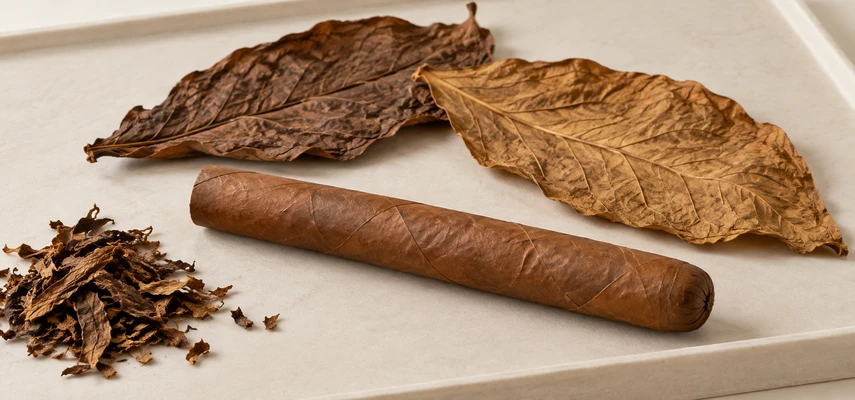
A cigar can be read as an agricultural product, a manufactured object and a historical artifact. Its outer leaf records choices made in the field; its shape reflects work at the factory; its trade connects farming communities with cities and overseas markets. Understanding those connections starts with a straightforward question: what is a cigar?
The answer reaches beyond the familiar image of a large, hand-rolled cylinder. Cigars include several kinds of tobacco products, made with different materials and methods. This introduction explains their basic construction, origins and vocabulary without treating tobacco use as a recommendation. Their cultural history and craftsmanship deserve accurate description, alongside the substantial health risks of smoking.
What is a cigar, exactly?
The U.S. Food and Drug Administration defines a cigar as rolled tobacco enclosed in tobacco leaf or another tobacco-containing substance. That outer covering is the useful starting distinction. A traditional handmade cigar has a natural leaf exterior, but the wider category also includes products with processed tobacco-containing wrappers.
Consequently, size alone cannot identify a cigar. Some resemble cigarettes closely, including products with filters. Conversely, a large cigar need not be handmade. Construction, dimensions and manufacturing method answer different questions, and confusing them creates much of the uncertainty surrounding cigar terminology.
For a museum visitor or reader examining an old advertisement, this distinction matters: a picture may establish a product’s approximate shape, while revealing little about its internal materials. A historical label such as “fine” or “premium” also requires context rather than automatic acceptance as a technical specification.
The basic construction: three tobacco roles
The standard model for a traditional handmade cigar has three components: filler, binder and wrapper. Habanos describes these parts in its account of Cuban cigar construction. Its terminology is useful, although its commercial claims should be read as a producer’s presentation.
Filler: the interior
The filler forms the central bunch of tobacco. In long-filler construction, substantial lengths of leaf run along the cigar. Their arrangement gives the object much of its internal structure. Filler is therefore a construction term, rather than a synonym for waste material.
Binder: the supporting layer
The binder surrounds the filler and holds the bunch together. It lies beneath the finished surface, so it is usually invisible in an intact cigar. Its structural role helps explain why an attractive outer leaf cannot, by itself, establish how carefully the interior was assembled.
Wrapper: the outer covering
The wrapper is the visible exterior. In conventional handmade construction it is a tobacco leaf wound around the bunch. A wrapper’s appearance is one characteristic of the material, not a reliable measure of nicotine exposure or health risk. This three-part model is an introductory framework, not a claim that every product sold as a cigar uses identical materials.
How cigars differ from other tobacco products
The CDC’s cigar overview distinguishes a tobacco-containing cigar covering from a cigarette’s paper or other non-tobacco covering. Pipes, by contrast, hold tobacco in a separate bowl rather than in a consumable rolled wrapper. These are differences in product form; none makes burning tobacco harmless.
The CDC groups U.S. cigars into large cigars, cigarillos and little cigars. Large cigars may be handmade or machine-made. Cigarillos are generally smaller, while little cigars can approximate cigarette dimensions and commonly have filters. Everyday names should not be mistaken for universal specifications across countries or manufacturers.
“Cigar” is therefore the broad family, while “handmade,” “filtered” and “long-filler” describe different attributes within it. A product can belong to several descriptive categories at once. An educational comparison should keep those attributes separate, especially when interpreting photographs, trade documents or packaging that supplies only part of the story.
From a living plant to a usable leaf
Cigar construction begins with agricultural decisions. A producer needs leaves with characteristics suited to their intended roles, rather than one undifferentiated raw material. Habanos’ cultivation account describes shade-covered wrapper fields and open-grown filler and binder fields in its Cuban production system. This is a specific example, not a rule for every cigar-producing region.
Leaf position, cultivation method and selection all help explain why a finished cigar can combine several kinds of tobacco. Agricultural vocabulary and factory vocabulary describe connected stages of work: a wrapper is an outer component, but obtaining suitable wrapper material starts before harvest.
Handling also matters. A leaf destined to remain visible presents different material demands from chopped interior tobacco. The distinction gives a reader a practical way to interpret factory photographs: leaf sorting is part of manufacturing preparation, not merely a decorative display of a crop.
Curing, fermentation and manufacturing
Freshly harvested tobacco is not the same material as a finished cigar leaf. Curing changes the harvested leaf as it dries under managed conditions. University of Kentucky guidance on Connecticut Broadleaf curing emphasizes harvest handling, barn selection and environmental conditions. Its recommendations concern that crop and region; they should not be generalized into one worldwide production schedule.
Fermentation is a subsequent processing stage in many cigar systems. In Habanos’ account of sun-grown tobacco preparation, leaves are assembled into piles whose temperature requires monitoring, cooling and rebuilding. Curing, fermentation and later storage are related operations with different purposes. They should not be collapsed into the vague statement that all tobacco is simply “aged.”
Manufacturing introduces another distinction. Handmade does not necessarily mean long-filler. Habanos also documents a handmade short-filler method using chopped tobaccos inside full-length binder leaves, followed by a hand-applied wrapper. That example separates two questions often conflated: how the cigar was assembled, and what form of tobacco fills it.
For an introductory understanding, the sequence is more valuable than a detailed factory recipe: grow and harvest the crop, prepare and select the leaves, then assemble and inspect the product. Exact procedures depend on the material and production tradition.
A history that begins before European commerce
Tobacco’s history in the Americas precedes European colonization. The National Park Service’s early tobacco history describes Indigenous tobacco use and the plant’s movement into European commerce after transatlantic contact. Europeans encountered existing knowledge and practices; they did not invent tobacco use.
It is also misleading to compress many Indigenous communities and practices into a single origin story for the modern cigar. The later commercial product emerged within changing systems of cultivation, processing, labor and trade. An early description of rolled tobacco is not proof of an unchanged factory process stretching into the present.
By the late nineteenth and early twentieth centuries, cigar manufacturing had become central to communities such as Tampa’s Ybor City. The National Park Service’s Ybor City history lesson connects the industry with immigration, mutual aid organizations and Cuban independence politics. Factory history consequently belongs to social and labor history as much as to the history of a consumer object.
Where cigars and their tobacco come from
Cuba is an important historical reference point, but it is not the whole map. Nicaragua, the Dominican Republic and Honduras are substantial manufacturing centers. For a dated trade example, the Cigar Association of America’s September 2023 import report identifies all three as major suppliers in its U.S. premium-cigar estimates. That report describes a particular market and period, not a current worldwide ranking.
The growing map and the manufacturing map also differ. Connecticut, for example, has a long association with wrapper tobacco; Connecticut Humanities’ account of Windsor tobacco describes growers specializing in wrapper and binder leaves. A place can be important to a cigar’s materials without being where the finished product was rolled.
When interpreting origin claims, ask what the place name describes: a growing location, manufacturing location, seed tradition or brand identity. Those questions are more informative than assuming one country name explains every component.
A few essential terms
Size descriptions commonly combine length with ring gauge. Ring gauge expresses diameter in sixty-fourths of an inch: a gauge of 48 represents 48/64 inch, or three-quarters of an inch. Length is a separate measurement. A larger gauge means a wider cigar, not a safety classification.
Habanos’ guide to shapes and sizes also distinguishes straight-sided forms, called parejos, from shaped forms, called figurados. Vitola is a term used for a cigar format; factory and market names can differ. Familiar names such as robusto or Churchill should therefore be interpreted with the stated measurements rather than treated as perfectly uniform dimensions across brands.
These few terms provide an initial reading vocabulary. They describe what an object is and how it was made; they do not require a reader to become a consumer or accept the status claims attached to it.
Health risks belong in the definition, too
Cigars contain nicotine and can cause dependence. Smoke exposure does not disappear when a person reports not inhaling: the mouth and throat still contact smoke, and nicotine can be absorbed through the lining of the mouth. The National Cancer Institute’s cigar fact sheet identifies cancers of the mouth, larynx, esophagus and lung among the consequences of cigar smoking, with heart and lung disease risks also affected by smoking patterns.
Secondhand cigar smoke exposes other people to harmful substances. Hand rolling, natural leaf, careful fermentation and a high price do not establish safety. Differences in frequency and inhalation can affect exposure, but cannot justify describing cigars as a safe alternative to cigarettes. People seeking help to stop tobacco use can consult a health professional and evidence-based cessation resources.
Understanding the object in its full context
A cigar is a tobacco product whose wrapper, interior materials and manufacturing method can take several forms. Reading it accurately means connecting the leaf to the farm, the finished shape to production, and the commodity to workers and trade. It also means keeping health evidence in view.
That framework supports a more informed encounter with a historical exhibit, agricultural account or industry claim. Craftsmanship explains how the object is made; history explains how it acquired its place in society. Neither removes the risks associated with burning tobacco.










