










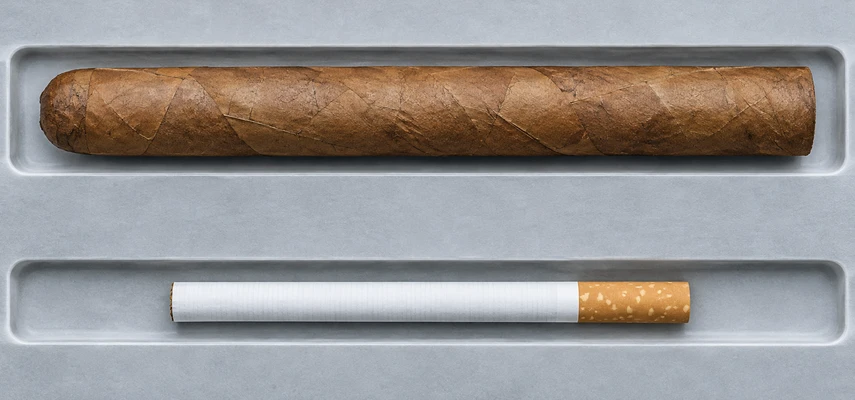

Place a traditional cigar beside a cigarette and the contrast seems obvious: brown leaf beside white paper, a broad cylinder beside a narrow one. Yet appearance leaves several important questions unanswered. Some cigars resemble cigarettes, some contain processed tobacco wrappers, and neither a filter nor a handmade construction establishes safety.
A useful comparison of cigars vs. cigarettes separates the object from the way it is used. Materials, tobacco processing, dimensions and manufacturing describe the product. Frequency, duration and inhalation describe exposure. Keeping those categories separate helps explain real differences without turning them into misleading claims that one combustible tobacco product is harmless.
The outer covering supplies the basic distinction
The FDA’s cigar product overview describes cigars as rolled tobacco enclosed in tobacco leaf or another tobacco-containing substance. A cigarette normally has a paper covering. The important contrast is therefore the covering’s material, rather than brown versus white, large versus small, or expensive versus inexpensive.
That definition accommodates products that look remarkably similar. A small, filtered cigar can approximate a cigarette’s silhouette while remaining part of the cigar category. Conversely, a large cylinder does not establish that its wrapper is an intact natural leaf or that people assembled it entirely by hand.
For readers examining packaging or historical photographs, this supplies a first question: what is the outer layer made from? A picture can suggest an answer, but a specification or contemporary description may be needed to confirm it. Product names alone are imperfect evidence.
A traditional cigar has a different construction model
Filler, binder and wrapper
A conventional handmade cigar combines interior filler tobacco, a supporting binder and an outer wrapper. Habanos’ anatomy description documents those roles in Cuban production. The binder helps contain the interior bunch, while the wrapper forms the visible surface. The roles describe materials and structure rather than separate health protections.
Paper, tobacco rod and filter
A conventional filtered cigarette instead presents a tobacco rod enclosed in paper, with a filter at one end. Designs vary, so “filtered” should be treated as a product feature rather than as the definition of a cigarette. FDA information about cigarette production follows tobacco through growing, manufacture and burning, emphasizing that harmful constituents can enter or arise at different stages.
The comparison is not a contest between an agricultural object and an industrial one. Both begin with cultivated tobacco, and both require processing. Hand assembly changes how an object is constructed; it does not remove nicotine or the consequences of combustion.
Tobacco processing differs, but simple slogans fail
Cigar leaf often undergoes air-curing and fermentation before assembly. Cigarette blends use different tobacco types and processing combinations. The National Cancer Institute’s historical chapter on cigar smoke chemistry describes air-cured, fermented cigar tobaccos and the use of reconstituted materials in some products. Published in 1998, it is background on material chemistry, not a current catalog of every manufacturer’s formula.
Fermentation should not be confused with alcoholic fermentation or with a safety treatment. It belongs to leaf preparation. Likewise, curing is more than a marketing synonym for time in storage: it changes harvested material under managed conditions. A different preparation history can influence the product without making its smoke benign.
Claims such as “pure tobacco” or “no paper” answer only limited questions about ingredients. Tobacco itself supplies nicotine, and burning it creates harmful substances. The absence of a particular wrapper material cannot establish the absence of risk.
Size is a variable, not a definition
The familiar large cigar is only one part of the category. The CDC describes large cigars, cigarillos and little cigars. Large cigars can be hand-rolled or machine-made. Little cigars may resemble cigarettes and usually include filters. These categories prevent the mistaken assumption that every cigar is the large handmade object seen in a film or museum display.
Dimensions and tobacco quantity can affect what a single product contains, but one item is not a standardized exposure unit. Comparing “one cigar” with “one cigarette” without identifying the products hides substantial variation. Comparing a pack with an individual item introduces another mismatch.
Even a carefully stated tobacco-weight comparison has limits. The mass inside a product is not identical to the amount of nicotine absorbed by a person, or to a lifetime disease probability. Those questions require additional evidence about composition and use.
Nicotine content and nicotine exposure are different
Nicotine is an addictive constituent of tobacco. The amount initially present in an object, the amount transferred into smoke and the amount absorbed by a person are different measurements. Confusing them produces exaggerated numerical claims as readily as reassuring ones.
The National Cancer Institute’s cigar fact sheet explains that nicotine from cigar smoke can be absorbed through the mouth, even when smoke is not inhaled into the lungs. That finding matters because the common phrase “not inhaled” is sometimes interpreted as “not exposed.” Those statements are not equivalent.
A large nicotine inventory does not tell us exactly what any particular person absorbs during an occasion. Equally, uncertain absorbed dose does not mean there is no dependence risk. An accurate comparison acknowledges both the product’s properties and the limits of inferring an individual’s exposure from them.
Inhalation patterns change the comparison
Health research must distinguish what participants use from how they use it. A comparison between daily cigarette smoking and occasional cigar smoking can mix differences in product design with differences in frequency. Prior cigarette use and use of more than one tobacco product can further complicate interpretation.
The National Academies’ 2022 premium-cigar research recommendations call for more consistent cigar categories and better monitoring of use patterns. That is a methodological issue with practical consequences: research is harder to interpret when studies group dissimilar products or behaviors together.
Consider a hypothetical historical survey that records only whether someone “uses cigars.” Without separating filtered little cigars from large handmade cigars, it cannot answer a narrow question about one design reliably. Without frequency information, it also cannot establish that all users share the same exposure. This illustrates why a broad label cannot substitute for a complete description.
Smoke remains the central health issue
Both products burn tobacco. The distinction between leaf and paper does not prevent smoke from containing toxic and cancer-causing substances. Processing, appearance and retail price are not clinical measures of safety.
The National Cancer Institute’s overview of tobacco harms identifies cigarette smoking as a cause of numerous cancers and cardiovascular and respiratory disease. Its assessment also treats cigar use as harmful. A comparison that mentions manufacturing differences while leaving out disease consequences would give readers an incomplete account.
This does not require asserting that every pattern of cigar and cigarette use produces an identical numerical risk. Risk varies with accumulated exposure and other factors. The defensible conclusion is that construction differences do not support presenting cigars as a safe alternative, or switching products as a substitute for stopping tobacco use.
Secondhand exposure is part of the comparison
The people near a burning tobacco product are part of its public-health context. Smoke is not limited to what passes through the mouth end, and indoor air is shared. A product comparison based only on what the user chooses to inhale misses this pathway.
CDC guidance on secondhand smoke explains its serious health effects and the absence of a safe exposure level. The practical issue is exposure to tobacco smoke, not whether an object was handmade, filtered or positioned as a luxury good.
An empty-room photograph of a cigar or cigarette cannot show these consequences. Nor can the presence of ventilation in a scene demonstrate safety. Material descriptions and environmental health evidence answer different questions, and both belong in a responsible account.
How to evaluate common comparison claims
“Cigars are natural”
Ask what “natural” is intended to establish. A whole-leaf wrapper is a material description. It does not prove the absence of harmful smoke constituents, addictive nicotine or disease risk. The claim may be accurate about one component while misleading about its implications.
“A filter makes the products equivalent”
A shared feature does not establish that two products contain the same materials or create identical exposure. Nor does a filter label demonstrate safety. Verify the covering, dimensions and construction separately rather than allowing one visible feature to stand in for the complete specification.
“One product equals a fixed number of the other”
First identify the measurement: tobacco weight, nicotine content, measured emissions or absorbed dose. Then ask which products and testing conditions supplied it. An equivalence expressed without those details is too ambiguous to carry a reliable health conclusion.
A comparison that keeps the categories straight
Cigars and cigarettes differ in their coverings, construction and typical product formats. Their processing and patterns of use can differ as well. Those distinctions help explain the objects and the research questions surrounding them; they do not create a safe combustible tobacco category.
The most useful reading habit is to ask what a claim actually measures. Separate ingredients from manufacturing, appearance from classification, and product content from personal exposure. That approach preserves the important differences while keeping nicotine dependence, disease and secondhand smoke in view.











