










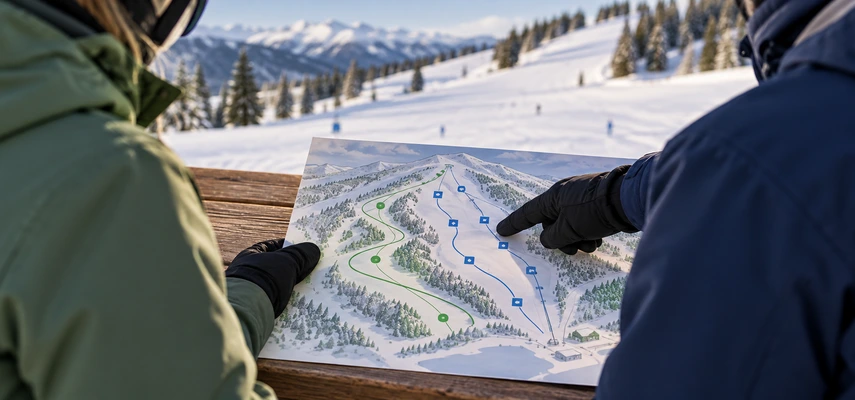

The blue square can acquire an unreasonable amount of personality. After enough green runs, it begins to look like an invitation, a challenge, and a judgment on your skiing—all while remaining a small colored shape on a sign.
Your first blue doesn’t need to settle any of those arguments. It is a change in the task: a particular route with particular demands, attempted when your skills and the conditions make that choice appropriate.
The useful question isn’t how many green runs you’ve completed. It’s whether you can reliably control the movements the new route requires, with enough attention left for the environment. An instructor who has watched you ski can help connect those two sides of the decision.
Know what changes, and what the color cannot tell you
Blue generally indicates a more difficult category than green within the same resort. The change might involve steeper sections, narrower space, longer sustained skiing, variable surface, or several demands together.
It isn’t a universal slope-angle category. A blue at one resort may feel different from a blue elsewhere, and today’s snow can change a familiar route’s difficulty. Learn the local system rather than carrying a previous mountain’s labels unchanged into the next trip.
The NSAA trail-signage guidance emphasizes relative ratings. That makes the first-blue decision specific: which open blue, from which lift, in what condition, with which appropriate route afterward?
A green run that connects briefly to blue terrain is still a route requiring the skills for that blue section. Don’t average the colors together and hope the mountain accepts the calculation.
Ask for an assessment before the harder run
Book instruction or ask your current instructor to observe the skills relevant to progression. Describe what feels dependable and what still becomes awkward. A useful assessment considers both performance and the proposed setting.
You should be able to control speed through turns, change direction both ways, stop deliberately, and choose space around other users on suitable green terrain. Those abilities need to repeat without a series of urgent recoveries.
Aspen Snowmass’s lesson descriptions place developed green skiing before initial exploration of easier blue terrain. They illustrate a progression based on skills, not a universal timetable.
Don’t conceal a weak stopping direction or an accelerating turn because you’re eager to receive permission. The information helps select an appropriate next task. A delayed blue run is less frustrating than discovering the missing skill halfway through one.
Separate ski appearance from useful control
Parallel skis can be a sign of developing coordination, but the appearance alone doesn’t prove readiness. A skier may keep the skis parallel while traveling faster than intended or relying on a very wide empty slope.
Conversely, a learner may use a small wedge effectively on appropriate terrain while developing more refined control. The instructor should judge the functional skills needed for the specific progression, not one photograph of the ski relationship.
The important questions involve outcome. Can you maintain a manageable pace from turn to turn? Can you finish a turn where intended, rather than simply when the skis stop resisting? Can you stop with room to spare?
Vail’s level descriptions distinguish beginner speed control and developing parallel skiing from more established blue-terrain performance. Don’t turn a learning transition into a demand to look finished before you begin.
Prepare the movement on easier terrain
Use suitable greens to make turns more repeatable, manage a chosen corridor, and maintain awareness. Practice the specific task your instructor identifies rather than simply doing another lap and waiting for readiness to appear.
If speed builds through a series of turns, work on the path and ski action while the gradient is manageable. If one direction is unreliable, address it before a new slope makes the difference more consequential.
An instructor may adjust turn shape, steering, balance, or edge release. The appropriate change depends on what they observe. Avoid importing a dramatic movement from a video intended for a different task or skill level.
Give the adjustment time to become recognizable. One successful attempt followed by several uncontrolled ones is information about learning, not a reliable basis for adding terrain difficulty immediately.
Choose the first blue for its actual features
Ask local professionals for a suitable introductory blue in the current conditions. A wide, consistently pitched, appropriately prepared route may offer a different task from a narrow blue with a steeper roll and a crowded junction.
Find out about the whole descent. Where does the harder section occur? Is there enough room for the turns you can make? Does the route finish somewhere familiar and appropriate? Are all necessary connections open?
Don’t assume a route is easy because a friend barely remembers it. Their memory may compress the difficult section into something they no longer notice. Your first encounter needs more specific information.
Choose a time and setting that permit learning without unnecessary traffic or poor visibility. No combination guarantees success, but removing avoidable demands gives the instructor more room to focus on the intended progression.
Keep the first attempt supported
An instructor can choose the entry, explain the route, demonstrate the intended task, and identify appropriate stops. Their presence is especially useful when a familiar movement feels different on a slightly stronger pitch.
Agree on the next manageable section rather than treating the entire run as one continuous test. Stops must be visible and clear of traffic. Don’t gather below a crest just because the group wants to discuss what happened.
Let the instructor set the pace. Following an experienced friend too closely can encourage speed and a line chosen for their skills. A helpful companion should support your plan, not become a moving deadline.
If the task is clearly too demanding, say so early. Staff or patrol can assist when someone cannot manage the route. Continuing because the group has already committed time to the plan doesn’t improve the skiing.
Expect a familiar movement to feel different
A slightly steeper pitch can make the downhill phase of a turn feel more insistent. The natural response may be to hurry the skis around or retreat backward. Either can interfere with the steering and support you’re trying to preserve.
Don’t respond by forcing a larger lean or more abrupt edge set without instruction. Keep the task small enough for feedback, and let the instructor identify the useful adjustment.
The PSIA-AASI Eastern framework treats turn performance as a blend of movements adapted to terrain and task. A new slope isn’t asking you to abandon everything you’ve learned; it may expose which parts need refinement.
Give yourself permission to return to easier terrain afterward. Applying the feedback on a familiar slope can be more productive than repeating a difficult run until fatigue turns every movement into bracing.
Reassess snow, visibility, and traffic
The route that was a sensible first blue yesterday may not be the right choice today. Firm patches, bumps, changing light, fresh snow, and busy intersections can alter the demands without changing the symbol.
Assess your current condition too. Fatigue or cold can reduce the attention and movement freedom you had earlier. The decision should describe this skier on this run now, not an ideal version of both.
Big Sky’s safety advice connects speed, space, and awareness. A first progression should leave margin in all three, rather than using a quiet moment to attempt a task that only works if nothing changes.
Obey signs and closures, and stay on appropriate open resort terrain. Blue-run readiness isn’t a qualification for unmanaged slopes or backcountry travel. Those settings involve different knowledge and preparation.
Know what a useful first blue looks like afterward
You maintained a manageable route, stayed within control, and had enough attention to notice the environment. Perhaps some turns felt awkward, but you can discuss why and practice a specific improvement.
Simply reaching the bottom doesn’t provide the same information. If the run depended on repeated emergency stops or following someone without choosing your own pace, identify that honestly and return to a more suitable task.
The NSAA responsibility code still requires control and avoidance of people ahead. A new trail category doesn’t create a temporary exception while you prove you can survive it.
Ask the instructor whether to repeat the route, practice on green terrain, or choose another progression. The answer can vary with the day’s conditions and the quality of the attempt.
Let the milestone remain a beginning
Your first suitable blue adds an experience; it doesn’t turn every blue on the mountain into an appropriate next destination. Continue choosing specific routes and seek feedback as demands change.
There is no need to retire green runs. They remain useful places to refine movements, practice with less pressure, or enjoy a relaxed descent. Progress expands choices rather than banning the terrain where you learned.
The most satisfying transition is when the new pitch becomes understandable. You recognize the turns, keep the speed intentional, and know where you can pause. The square on the sign hasn’t changed. It has simply become one more piece of information you know how to use.











