










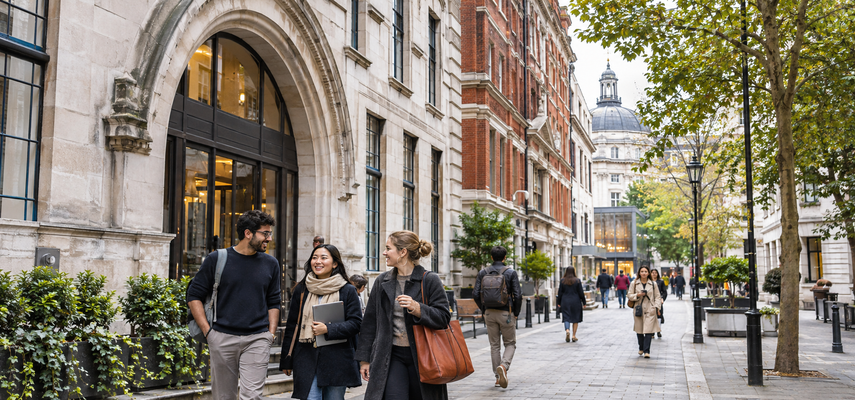
An offer from the London School of Economics and Political Science, known for its focus on social sciences and management, can feel like a decision about a degree alone. Once prospective postgraduates start planning the year, other questions become just as concrete: where will teaching take place, what will the journey to campus look like, and what does a weekly accommodation price actually cover? LSE’s academic identity and its central London setting are best considered together.

What LSE is known for
LSE specialises in the social sciences and management. Economics is part of its identity, but a prospective graduate choosing between programmes will also encounter subjects such as politics, sociology, law, international relations and public policy. That concentration gives applicants a useful starting point: the question is not simply whether a course is in London, but whether its particular approach to studying society, institutions and decision-making suits their interests and next steps.
The School draws students from around the world and holds an extensive programme of public lectures. For a postgraduate, that can make study feel connected to conversations beyond an individual department. It does not remove the need to compare course content carefully. Applicants still need to look at module choices, assessment methods and dissertation requirements, particularly when similarly named degrees at different universities take different approaches. The practical advantage of LSE’s compact campus is that academic events, teaching and everyday student life are concentrated in one part of the city rather than spread across distant sites.
A single campus between Aldwych and Lincoln’s Inn Fields
LSE’s campus sits around Houghton Street and Clare Market, between Aldwych and Lincoln’s Inn Fields. The Strand and the Royal Courts of Justice are close by. Although the surrounding streets carry the pace of central London, much of the campus itself is pedestrianised, and LSE describes it as small enough to cross in about five minutes. That scale matters to a postgraduate whose day might combine a seminar, independent study and an evening lecture.
Holborn also places the School between several distinct parts of London. Covent Garden and the West End lie to the west, while the City is to the east. A student living nearby may be able to walk to teaching and use the neighbourhood throughout the day; a student living farther out can still make use of a campus with a clear centre. Neither arrangement is automatically better. The relevant comparison is how the location works with the student’s course timetable, preferred routine and housing costs.
Where postgraduates actually live
Living near campus is one possibility, not the standard arrangement for every LSE student. LSE’s accommodation guidance says most of its students live in privately rented housing and travel to campus each day. Some postgraduates choose a university hall, where room types, locations and contract lengths vary. Others arrange a room in a shared flat or rent independently. For those seeking a furnished, serviced apartment, Student Luxe curates and books private student accommodation in Holborn and nearby areas such as Covent Garden, with bills, Wi-Fi and weekly housekeeping included.
These routes solve different problems. A hall offers a defined room and contract, but its location may be farther from Houghton Street than its central London address first suggests. A shared private rental can make it possible to divide the cost of an entire flat, while requiring housemates to agree on space, bills and responsibilities. A serviced apartment places a different emphasis on privacy and what is included in the booking. LSE advises that students seeking an ordinary private rental often do so after arriving in London, when they can view a property. That is a meaningful distinction for an international applicant trying to plan accommodation from another country.
The choice also depends on the kind of year ahead. A postgraduate who expects to work regularly on campus may place more value on a short journey. Someone whose course involves placements, fieldwork or long stretches of independent research may use the city differently. Before narrowing the search to a neighbourhood, it helps to map likely teaching locations and consider how often the journey will actually be made.
Comparing what Holborn and the Strand actually cost
There is no useful single weekly figure for “living near LSE”. Around Holborn and the Strand, a price can refer to one person’s room in a hall, a bedroom in a shared rental or an entire private apartment. LSE’s accommodation search lists High Holborn Residence at roughly half a kilometre from campus, with room rates of approximately £218 to £391 per week depending on room type. Those are hall-room prices attached to particular accommodation and contract terms, not a general rent for the neighbourhood.
Private studios are offered from £650 per week per apartment, rather than at a per-person hall-room rate. This is a starting price, not an average for Holborn or the Strand, and it includes bills, Wi-Fi, weekly cleaning and VAT. Comparing that figure directly with a hall-room rate without accounting for what each booking provides would make the difference look simpler than it is. These are distinct products, and neither starting price should be read as a general rent for the area.
The first step towards a fair comparison is to identify who occupies the space and who pays the quoted amount. The second is to calculate the cost across the required stay rather than multiply a weekly figure by an assumed number of weeks. Hall contracts, private tenancies and serviced stays may begin and end on different dates. Applicants can then check which charges sit outside the quoted rent, including utilities and internet, and whether services such as cleaning matter to them. Finally, distance should be measured against the campus entrance or building a student expects to use, not simply against the word “central” in a listing.
Price also has to be weighed against the shape of daily life. A room farther from Aldwych may require more travel but offer a living arrangement that better suits a student’s priorities. A nearby apartment may reduce time spent in transit while costing more over the year. The sensible measure is the full cost of the chosen stay alongside the privacy, space and routine it provides.
Questions worth settling before choosing where to live
Prospective postgraduates can make the housing decision easier by starting with their academic calendar. The dates of teaching are not necessarily the dates for which they will need a room: arrival, examinations, dissertation work and departure all affect the length of stay. A rental that appears to fit the first term may be less suitable if the course requires students to remain in London afterwards. Looking at total contract dates early also makes weekly prices more meaningful.
Room type deserves the same care. An en-suite room offers different privacy from a studio, and a studio differs from a larger apartment or a bedroom in a shared flat. Applicants should read what is included in each arrangement and consider where they will study, prepare meals and spend time away from campus. Those details can matter more over an academic year than a short walk saved on any one morning.
Location is the final test. A map showing Houghton Street, the proposed address and the nearest transport options gives a clearer picture than a neighbourhood name alone. Students planning to view private rentals after arriving will need somewhere to stay while they search; those arranging accommodation in advance should compare the booking dates with their course commitments. LSE offers a distinctive social-science environment in a compact part of London. Choosing how to live around it calls for the same close reading that applicants give the programme itself.











