










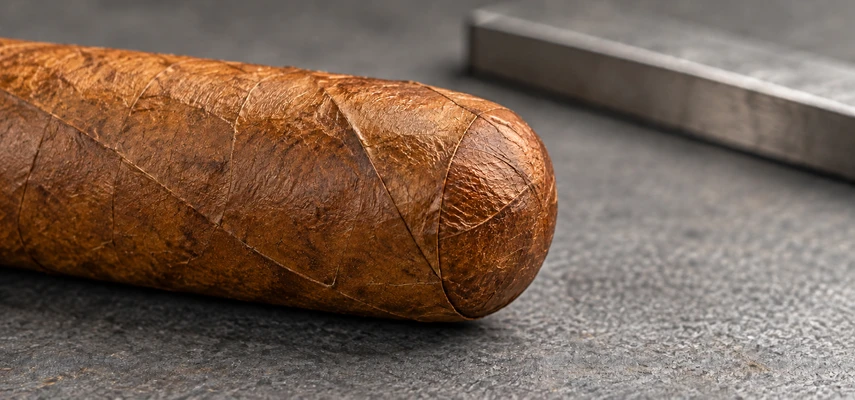

A carefully finished cigar can embody considerable agricultural and manual work. The visible wrapper, however, is only the surface of a larger production story. Leaf selection, preparation, internal arrangement and inspection all matter when explaining craftsmanship. A decorative band or an expensive box reveals much less about those processes.
So what makes a premium cigar? The most useful answer separates a product description from a claim of superiority. “Premium” can identify a commercial segment or a category used by a particular source; it cannot replace evidence about materials and workmanship. This article examines that evidence without treating construction quality as a reason to begin smoking or as protection from tobacco’s health risks.
Define what “premium” is supposed to mean
Before evaluating a claim, identify its context. A manufacturer’s description, a research category and a seller’s adjective need not mean the same thing. Rather than assuming a universal definition, look for the criteria the source actually provides.
The National Academies’ March 2022 recommendations call for consistent cigar categories and definitions for research. That recommendation illustrates why readers should be cautious about treating the word as a complete technical specification. This article uses it in a descriptive editorial sense, not as a current legal classification.
An informative account states whether a cigar has a natural-leaf wrapper, a leaf binder, long filler and manual assembly, then explains what those features contribute. A bare “premium” label leaves those details unanswered. It also leaves health questions unanswered, regardless of the category’s commercial reputation.
Materials begin with a leaf’s intended role
Traditional handmade construction combines filler, binder and wrapper. These components perform different jobs, so selecting suitable tobacco involves more than choosing the most visually attractive leaves. Habanos’ anatomy account identifies the interior filler, the enclosing binder and the outer wrapper in its Cuban system.
The wrapper needs to cover the bunch; the binder needs to help contain it; the interior needs to be assembled according to the intended construction. A favorable feature in one role does not automatically establish suitability for another. Material quality makes more sense in relation to purpose than as one universal ranking of leaves.
This also explains why an exterior photograph cannot demonstrate the entire product’s construction. It can show a surface and perhaps a cap. It cannot independently confirm filler length, component origins or how consistently the interior was arranged.
Wrapper selection involves agricultural constraints
Growing usable wrapper material requires attention before the leaf reaches a rolling bench. University of Kentucky guidance on Connecticut Broadleaf emphasizes careful handling, suitable curing barns and management of environmental conditions. It also discusses the importance of obtaining blemish-free wrapper areas from a leaf.
That account supplies an agricultural explanation for selection work. Damage can affect which portions remain suitable for a visible covering. It does not establish that every discarded wrapper candidate is useless for all other purposes, or that one region’s growing and curing recommendations apply worldwide.
The important distinction is between a material requirement and a promotional story. Explaining why intact usable leaf area matters is informative. Calling every visible vein a defect, or every unusually smooth surface proof of superior agriculture, goes beyond what a photograph can establish.
Leaf preparation is controlled work
Harvested tobacco must be prepared before assembly. In its account of shade-grown wrapper processing, Habanos distinguishes curing, fermentation, classification and subsequent storage. It describes size, color and texture as sorting criteria. These are operations with different purposes, rather than interchangeable synonyms for “aged.”
Preparation is also specific to the material. Habanos’ sun-grown tobacco account describes monitored fermentation piles and different preparation for filler and binder leaves. The process provides a concrete example of management and selection; the producer’s promotional language should not be accepted as independent proof of superiority.
Longer time is not a complete quality argument. A credible aging claim needs to identify what was aged, at which production stage and under what conditions. More importantly, curing, fermentation and storage do not make tobacco smoke safe. Craft and health require separate evidence.
Skilled assembly concerns the interior as well as the surface
Hand assembly requires control over a flexible, variable material. A finished cylinder can look simple while concealing decisions about leaf placement and compression. The quality question concerns consistency with the intended construction, rather than the mere presence of human hands.
Habanos’ description of the roller’s craft discusses arranging filler, forming the bunch, using molds and applying the wrapper and cap. Its account makes clear that shape and finishing are connected stages. These details describe a particular manufacturing tradition rather than a universal recipe for every cigar.
Manual work should therefore be described precisely. “Handmade” alone does not establish a flawless result, and it does not imply that tools or molds were absent. The use of a template or mold can support consistency while leaving substantial skilled manual work in the process.
Long filler is a material description, not a verdict
Long-filler construction is often associated with the premium segment, but the terms should not be treated as interchangeable. Long filler identifies substantial leaf lengths inside the bunch. It does not, by itself, demonstrate even assembly or prove every other component’s specification.
There is an equally important distinction between filler form and manual manufacture. Habanos documents handmade short-filler production, in which smaller tobacco pieces are contained by full-length binder leaves and wrapped by hand. That example prevents an inaccurate equation between handmade and long-filler.
An evidence-based description can acknowledge the materials a manufacturer chose without turning them into a total hierarchy. To explain craftsmanship, it still needs information about selection, execution and inspection. A component label is a starting point for that explanation, not its conclusion.
Inspection makes quality claims more concrete
The strongest manufacturing claims identify checks rather than relying only on adjectives. In its quality-control account, Habanos describes examining weight, dimensions, consistency, construction and appearance. It also describes taking samples apart and testing bunch resistance to airflow before the wrapper is applied.
These are different kinds of evidence. Dimensions can be measured against a specification. Surface inspection can assess wrapper and cap finishing. Examining a sample’s interior can investigate features that are invisible from outside. No one check stands in for all the others.
Inspection methods also have a defined scope. A draw test concerns resistance to airflow through the assembly; it is not a test showing that smoke is safe. A measured diameter establishes a dimension, not an exposure level. Clear explanations should state what a test evaluates and avoid borrowing its authority for unrelated conclusions.
Presentation can demonstrate care without proving everything
Habanos’ color-sorting description explains how workers match finished cigars by wrapper shade. That is evidence of a presentation practice within a documented system. It is not evidence that an evenly matched box contains identical nicotine quantities or identical hidden construction.
Bands, boxes and visual consistency can help communicate identity and intended positioning. They should still be kept separate from the evidence needed to substantiate the object’s components and manufacturing process. A handsome exterior can coexist with incomplete information.
The same applies to price. A price tag is a transaction figure, not a laboratory result. Without supporting information, it cannot establish leaf origin, internal assembly or health risk. A responsible explanation can recognize craftsmanship without using cost as a substitute for documentation.
How to read a craftsmanship claim critically
Identify the feature
Ask whether the claim concerns leaf selection, filler form, manual assembly, dimensions, surface finishing or presentation. An exact feature is easier to investigate than a general adjective such as “exceptional.” If several claims are bundled together, separate them before judging the evidence.
Identify the source
A producer can explain its own stated methods, and those descriptions are valuable primary evidence. Its claim to be better than every competitor requires additional support. Attributing the account preserves useful detail without presenting commercial self-description as independent assessment.
Match the evidence to the conclusion
A hypothetical inspection photograph may support a narrow observation about a cap seam. It cannot confirm the hidden filler or the entire factory’s consistency. A description of one facility should not silently become a claim about all cigars in the same market segment.
This method is useful for a reader of industrial history as well as a reader of modern packaging. It directs attention toward identifiable work and material properties while leaving unsupported claims open to scrutiny.
Craftsmanship does not change the health boundary
The CDC’s cigar information explains that cigar smoke contains toxic and cancer-causing chemicals and that cigars contain addictive nicotine. Exposure occurs even among people who report not inhaling. Other people can also be harmed by secondhand smoke.
Careful selection, manual assembly and inspection are not exceptions to those findings. They concern how a tobacco product is made. They cannot certify it as healthy, safe or suitable as an alternative to stopping tobacco use.
What makes a premium cigar worth studying is the chain of work behind the object: agriculture, preparation, assembly and inspection. Explaining those stages accurately gives craftsmanship a concrete meaning. Keeping that meaning separate from branding and health reassurance makes the account more credible and more useful.












