










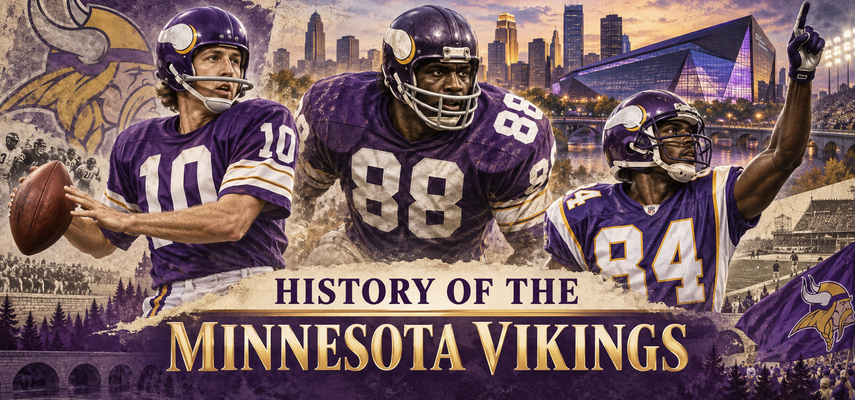

The Minnesota Vikings built an enduring identity through strong defenses, exceptional skill players and repeated championship pursuits that ended short of the Super Bowl title. Bud Grant’s teams established the standard, while Fran Tarkenton’s improvisation and the Purple People Eaters gave the early contenders their defining character. Later generations produced their own dramatic peaks, from Randy Moss’s explosive offense to memorable postseason breakthroughs. The franchise’s 1969 NFL championship remains distinct from its subsequent Super Bowl defeat. This history follows Minnesota through the completed 2025 season, separating those results from later leadership developments and the ongoing competition of the 2026 campaign.
Franchise at a glance
| Field | Details |
|---|---|
| Founded | 1960; NFL expansion franchise awarded January 28 |
| First season | 1961, National Football League |
| Original city and name | Minneapolis–Saint Paul, Minnesota — Minnesota Vikings |
| Current city and name | Minnesota Vikings; home games in Minneapolis, Minnesota |
| Previous cities and names | None; home venues have included Bloomington and Minneapolis |
| League and conference/division | NFL — National Football Conference North |
| Home venue | U.S. Bank Stadium; opened in 2016 |
| League championships | 1 pre-merger NFL championship: 1969; 0 Super Bowl victories |
| Other recognized championships | 3 NFC championships: 1973, 1974, 1976; 1969 NFL title preceded Super Bowl IV |
| Historical coverage | 2025 NFL season, including postseason completed in February 2026; later developments through October 16, 2026 |
Origins and early years
A Minnesota ownership group initially obtained a franchise in the developing American Football League, then relinquished that opportunity and accepted an NFL expansion team in January 1960. The Vikings began play in 1961, giving the Twin Cities a new major professional football institution. The name connected the team to the region’s Scandinavian heritage without making it a continuation of an earlier club.
General manager Bert Rose and head coach Norm Van Brocklin directed the initial organization. The first regular-season game supplied an extraordinary introduction: rookie Fran Tarkenton came off the bench and helped Minnesota defeat Chicago 37–13. The immediate spectacle did not predict an easy expansion period. The team still had to build depth, develop a stable leadership structure and establish itself at Metropolitan Stadium in Bloomington. Jim Finks later became general manager, and Bud Grant arrived as head coach in 1967. Their combination of personnel development and disciplined football transformed a young franchise into a regular contender. The success that followed emerged from that reconstruction rather than from the opening victory alone.
Defining eras
1961–1967: An expansion team finds its direction
The first Vikings teams combined occasional spectacular offense with the limitations of an expansion roster. Tarkenton’s movement and improvisation gave the team a distinctive quarterback, while receivers and running backs worked within a developing system. The early seasons did not produce consistent winning, and the relationship between quarterback and coach became part of the organization’s unsettled direction.
Finks took over personnel leadership during the 1960s, helping assemble players who would support the next competitive period. Minnesota traded Tarkenton to the Giants in 1967, the same year Grant arrived after success in Canadian football. The transition created a different coaching environment and a new quarterback structure. Grant emphasized preparation, dependable execution and a coordinated team whose defense could control games. The roster’s emerging linemen and defensive backs made that approach increasingly plausible. The Vikings had not yet reached the playoffs, but the foundations of their first sustained contender were now present, built through decisions made across several difficult expansion seasons.
1968–1971: The Purple People Eaters reach the top of the NFL
Minnesota won its division in 1968 and developed one of the league’s strongest defensive fronts. Alan Page, Carl Eller, Jim Marshall and Gary Larsen became the Purple People Eaters, supported by strong players elsewhere in the defense. Quarterback Joe Kapp gave the offense a physical, forceful character that matched Grant’s broader approach. The 1969 team finished 12–2 and moved into the postseason as a formidable contender.
The Vikings defeated the Rams and then Cleveland 27–7 to win the NFL championship. Kansas City subsequently won Super Bowl IV, 23–7. Those results belong to separate competitions within the same season: Minnesota was the NFL champion but not the Super Bowl winner. The distinction remains essential to its historical title count. Continued division success followed, and Page earned the AP NFL MVP award for the 1971 season, an exceptional achievement for a defensive player. Minnesota’s strongest identity was established, even as the final championship opportunity remained incomplete.
1972–1984: Tarkenton returns and three more Super Bowls
Minnesota reacquired Tarkenton in 1972, bringing his quarterback skills back into a much stronger organization. Chuck Foreman’s versatility added another dimension to the offense, while the defense retained much of its defining strength. The Vikings won NFC championships after the 1973, 1974 and 1976 seasons, but Miami, Pittsburgh and Oakland won the corresponding Super Bowls. Four appearances had produced no victory in the final game.
Tarkenton earned AP NFL MVP honors for the 1975 season, yet Dallas ended that team’s postseason in the divisional round. The era’s disappointments were therefore not limited to the Super Bowl defeats. Grant continued building competitive teams as players aged and changed, but the organization gradually lost the exceptional defensive concentration of its peak. The move into the Metrodome in 1982 also changed the team’s home environment. Grant first retired after the 1983 season, briefly returned in 1985 after Les Steckel’s difficult year and then left coaching permanently. His record established expectations that would shape every later Vikings contender.
1985–1997: Renewed contention and Green’s foundation
Jerry Burns succeeded Grant and led a team that produced an important postseason run after the 1987 strike season. Minnesota defeated New Orleans and San Francisco before losing narrowly at Washington in the NFC Championship Game. Anthony Carter’s receiving supplied some of the era’s defining performances, while the defense remained a major strength. The run did not become another conference title.
The later trade for Herschel Walker failed to deliver the anticipated championship advance and became a major personnel setback. Dennis Green’s appointment in 1992 opened a more sustained period of regular-season contention. Cris Carter developed into an exceptional receiver, and a series of veteran quarterbacks kept the offense productive through changing personnel. Minnesota repeatedly reached the playoffs but struggled to advance through the final rounds. The team nevertheless built the offensive foundation and organizational stability that would make its next explosive season possible. Its later peak would depend on adding a new kind of receiving threat to a roster already capable of consistent winning.
1998–2015: Explosive offense and painful near misses
Randy Moss’s arrival in 1998 transformed the passing game around Randall Cunningham, Carter and a deep supporting cast. Minnesota finished 15–1, then lost the NFC Championship Game to Atlanta in overtime. The defeat became one of the franchise’s most painful missed opportunities. Another conference-final appearance after the 2000 season ended heavily against the Giants, and later changes closed Green’s tenure.
Adrian Peterson’s arrival in 2007 supplied a different offensive foundation. Brett Favre’s 2009 season brought Minnesota close again, but New Orleans won their overtime conference-final meeting. Peterson later surpassed 2,000 rushing yards and earned AP NFL MVP honors for the 2012 season. His 2014 league suspension following a child-abuse case also belongs to the period’s record and interrupted his availability. Mike Zimmer became head coach in 2014 and rebuilt the defense. The 2015 division champions then lost a close playoff game to Seattle, continuing a history in which credible contenders repeatedly encountered abrupt postseason endings.
2016–2025: A new home and another leadership cycle
U.S. Bank Stadium opened in 2016, giving the franchise a permanent enclosed home after two seasons at the University of Minnesota’s stadium. The 2017 team won its division behind a strong defense and Case Keenum’s quarterback play. The playoff touchdown from Keenum to Stefon Diggs against New Orleans became the Minneapolis Miracle. Philadelphia then won the NFC Championship Game decisively, separating the dramatic breakthrough from a conference title.
Kirk Cousins led the next offensive period, including an overtime playoff victory at New Orleans after the 2019 season. Kevin O’Connell replaced Zimmer in 2022 and immediately won the division, though the Giants ended that postseason. A 14–3 season with Sam Darnold in 2024 also ended in the wild-card round, against the Rams. The following team finished 9–8 without a playoff berth. Minnesota had sustained periods of substantial regular-season success across different quarterbacks, but another Super Bowl appearance and its first victory in that game had not followed.
Recent history
The latest completed season is 2025, when Minnesota finished 9–8 and missed the playoffs. The result followed a 14–3 campaign in 2024 that had ended against the Rams in the wild-card round. Kevin O’Connell remained the head coach, while the organization changed leadership in its personnel department afterward.
The Vikings dismissed general manager Kwesi Adofo-Mensah in January 2026. After an interim period under Rob Brzezinski, Nolan Teasley was named general manager in June. As of October 16, 2026, the new season was underway and its final record and postseason outcome remained undecided. U.S. Bank Stadium remained the home venue. Teasley’s earlier championships as an executive with Seattle did not become Minnesota titles. The Vikings’ completed record still contained the 1969 NFL championship, three later NFC titles and no Super Bowl victory.
Greatest players and influential figures
Fran Tarkenton
Tarkenton supplied the franchise’s first great quarterback identity and later returned to lead three NFC championship teams. His improvisation and passing production helped expand the position’s possibilities. His intervening Giants years form a separate chapter, while Minnesota’s contribution includes both the expansion beginning and the mature contender under Grant.
Alan Page
Page gave the Purple People Eaters exceptional interior disruption and became AP NFL MVP for the 1971 season. His intelligence, speed and consistency helped anchor the Vikings’ strongest defensive era. Later service with Chicago belongs to his wider career, while his 1969 NFL championship was earned with Minnesota.
Carl Eller
Eller supplied sustained edge pressure and exceptional defensive-end play across the Vikings’ first championship period and repeated Super Bowl teams. His partnership with Page and the rest of the front made the defense unusually complete. His long Minnesota contribution remains distinct from his final professional season with Seattle.
Cris Carter
Carter rebuilt his career in Minnesota and became the reliable receiving center of Green’s strongest offenses. His route running, hands and touchdown production helped sustain contention through changing quarterbacks. Earlier and later service elsewhere belongs to a wider career, while his most substantial playing contribution was made with the Vikings.
Randy Moss
Moss immediately transformed Minnesota’s offense through exceptional speed and deep receiving ability. His rookie season helped produce the 15–1 team of 1998 and established a new offensive identity. Later records and championship-game appearances with other teams remain separate from the remarkable but ultimately titleless Vikings period.
Adrian Peterson
Peterson gave Minnesota a foundational running threat and earned AP NFL MVP honors after surpassing 2,000 rushing yards in 2012. His career included major playoff opportunities and significant off-field controversy. The exceptional production belongs to a broader account that also recognizes the interruption and consequences of his 2014 suspension.
Bud Grant
Grant established the franchise’s strongest sustained competitive standard through disciplined preparation and exceptional defense. His teams won the 1969 NFL championship and three later NFC titles, while losing all four Super Bowls. Those distinctions preserve the substantial achievement without assigning him a victory the team did not earn.
Dennis Green
Green restored consistent regular-season contention and developed offenses around outstanding receivers and changing veteran quarterbacks. His 1998 team became one of Minnesota’s most celebrated contenders before an overtime conference-final defeat. The offensive foundation and repeated playoff appearances remain central to his legacy alongside the missed championship opportunities.
Championships and postseason milestones
Minnesota won the 1969 NFL title before losing Super Bowl IV to the AFL champion. Its three later NFC titles led to further Super Bowl defeats. The table keeps those competitions separate. Later NFC Championship Game appearances after the 1987, 1998, 2000, 2009 and 2017 seasons did not add another conference title.
On smaller screens, scroll horizontally to see all columns.
| Season/year | Competition | Opponent | Result | Defining figure(s) |
|---|---|---|---|---|
| 1969 | NFL Championship | Cleveland Browns | Won 27–7 | Joe Kapp; Alan Page; Bud Grant |
| 1969 | Super Bowl IV | Kansas City Chiefs | Lost 7–23 | Joe Kapp; Alan Page; Bud Grant |
| 1973 | NFC Championship | Dallas Cowboys | Won 27–10 | Fran Tarkenton; Chuck Foreman; Bud Grant |
| 1973 | Super Bowl VIII | Miami Dolphins | Lost 7–24 | Fran Tarkenton; Alan Page; Bud Grant |
| 1974 | NFC Championship | Los Angeles Rams | Won 14–10 | Fran Tarkenton; Chuck Foreman; Bud Grant |
| 1974 | Super Bowl IX | Pittsburgh Steelers | Lost 6–16 | Fran Tarkenton; Carl Eller; Bud Grant |
| 1976 | NFC Championship | Los Angeles Rams | Won 24–13 | Fran Tarkenton; Chuck Foreman; Bud Grant |
| 1976 | Super Bowl XI | Oakland Raiders | Lost 14–32 | Fran Tarkenton; Alan Page; Bud Grant |
Rivalries, venues and team identity
Rivalries
Green Bay supplies the defining regional rivalry through repeated division races and significant player connections. Chicago adds another enduring NFC North relationship, including the franchise’s opening victory. New Orleans occupies a different postseason place through the painful 2009 conference final and later Minnesota victories, illustrating how rivalries can develop around particular historical encounters.
Home venues and traditions
Metropolitan Stadium in Bloomington provided the exposed winter setting associated with Grant’s early teams. The Metrodome changed that environment in 1982, followed by temporary outdoor games in 2014 and 2015 before U.S. Bank Stadium opened. Purple and gold, the horn imagery and the Skol tradition connect supporters across those settings. The changing venues also show why the franchise’s Minnesota identity is broader than a single city address or stadium style.
Retired numbers and team honors
Minnesota formally retired numbers including Tarkenton’s 10, Page’s 88, Carter’s 80 and Jim Marshall’s 70. The Ring of Honor recognizes a wider group of players, coaches and contributors, while Pro Football Hall of Fame election is a separate distinction. Those systems should not be treated as interchangeable or used to imply a Super Bowl championship that the franchise had not won.
Legacy
Minnesota’s history demonstrates how a durable contender can leave a substantial mark without winning the Super Bowl. Grant’s defense, Tarkenton’s improvisation and later exceptional offensive players created distinct identities within the same institution. The 1969 NFL championship deserves its actual recognition, while the subsequent defeats remain part of the record rather than erasing the achievement. Repeated near misses give later breakthroughs their emotional weight. The Vikings’ broader significance lies in sustained relevance, memorable innovation and an enduring regional audience, alongside the continuing gap between credible championship opportunities and victory in the final game.
Where to eat in Minneapolis
Planning a visit? Explore our best restaurants in Minneapolis guide.












