










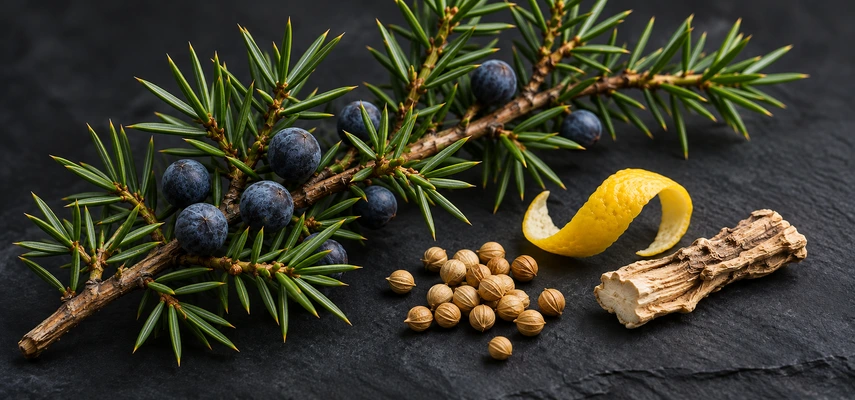

Gin is a useful lesson in recipe design. Juniper must remain central, but it does not work alone. Citrus, seeds, roots, flowers and other botanicals can lift it, deepen it or overwhelm it. The base spirit and the way those materials are processed determine whether the ingredients become a coherent drink or a noisy list.
This lesson follows gin from base selection to botanical treatment and final preparation. The legal terms matter because they constrain some of those choices. They do not replace the sensory task, however. A well-made gin needs an appropriate relationship among juniper, supporting character, alcohol and texture, rather than the greatest possible number of exotic ingredients.
Gin begins with juniper and a suitable base
Juniper supplies the defining aromatic reference, often associated with pine, resin or a fresh woody character. Other botanicals can contribute citrus, floral, herbal or spice notes while leaving that reference predominant under the relevant definition. A spirit with botanical flavor but no appropriate juniper identity does not automatically qualify as gin.
The base spirit is not merely a volume to fill the still. Its strength, composition and residual character influence extraction and the final mixture. A highly rectified base can leave space for the botanical recipe, while a more characterful base introduces another contribution that the maker must balance within the applicable category rules.
Some gin makers produce their own base from fermentation; others obtain suitable agricultural alcohol. Those are different production arrangements, not automatic quality rankings. Assess suitability, consistency and traceability. Owning a fermenter does not independently establish better botanical balance, just as buying alcohol does not remove the need for skilled preparation.
Neutrality makes room but does not design the recipe
A relatively restrained base can help the intended botanicals remain clear. Residual aromas, unsuitable compounds or an inconsistent base can complicate that target. The producer considers the actual spirit, rather than assuming a neutral label proves that every batch is sensorially identical or ideal for every recipe.
The alcohol-water environment also affects extraction. Different strengths can dissolve different balances of compounds from a botanical. A recipe is therefore more than weights of dried material: it includes the medium and conditions in which those materials are treated. Change the starting strength and you may change what the same botanical charge contributes.
This gives a useful control example. If a producer wants consistency, simply repeating the botanical weights may be insufficient when base strength or botanical condition changes. The maker must understand the relevant variables and assess the result. A consistent gin is an achieved relationship among changing materials.
Botanicals play different sensory roles
Juniper provides the main framework, while ingredients such as coriander seed, citrus peel, angelica or orris can contribute different aspects of aroma and structure. These are useful common examples, not a mandatory recipe. One botanical can also contain several aroma-active compounds, so describing it as only citrus or only earthy is a simplification.
Freshness, drying, storage, origin and preparation affect the usable material. Old citrus peel and freshly prepared peel need not offer the same contribution at an identical weight. Crushing a seed changes access to its contents, but can also alter how quickly or extensively material is extracted. Preparation is part of the recipe.
Botanical number is a particularly weak quality shortcut. A short recipe can be detailed and balanced, while a long one can contain ingredients whose contributions are masked. Conversely, a complex formulation can work beautifully when each part serves the whole. Complexity is a sensory achievement, not an ingredient count.
Maceration extracts into liquid
Maceration places botanicals in contact with a liquid medium so compounds move into it. Time, temperature, strength, particle size and loading influence the extraction. Longer contact is not automatically more useful; it can change the balance between desired aromas and less welcome contributions. The target determines the appropriate treatment.
Beefeater describes steeping its botanicals before heating as part of its own London Dry process. That is a clear example of maceration linked with subsequent distillation. The producer’s stated duration is not a universal requirement for gin or evidence that every botanical benefits from the same contact time.
Also distinguish an infusion that will be bottled from one that will be redistilled. A macerate can contain color and less volatile material that will not transfer into a distillate in the same proportions. The extraction supplies a feed for another selection process rather than guaranteeing a direct one-to-one transfer of everything dissolved.
Vapor contact offers another route
In vapour infusion, botanicals are positioned in the vapor path, often in a suitable basket. Passing vapor contacts them and carries aromatic material onward before condensation. This creates a different treatment environment from keeping the whole botanical charge submerged in the boiling liquid.
The result still depends on the botanicals, loading, vapor conditions and apparatus. A basket does not guarantee delicacy or remove all opportunity for imbalance. A producer can use liquid maceration, vapor contact or a combination to achieve particular contributions. Compare the actual contact conditions rather than ranking equipment by how unusual it looks.
This distinction will be developed further in the next lesson on botanical flavoring. For gin, the essential point is that the location of the botanical changes how its compounds enter the process. Identical ingredient names do not imply identical extraction histories, even before the maker decides which distillate to collect.
Redistillation selects the botanical expression
Redistillation concentrates and separates volatile material from an alcoholic botanical preparation or contact system. The distiller manages collection through the run, selecting a balance rather than merely removing visible solids. The resulting composition reflects both the preceding extraction and the subsequent separation.
One producer can distil botanicals together, while another can prepare separate distillates for later combination, subject to the intended legal identity. These arrangements provide different recipe controls. A together-distilled mixture and a set of separately distilled components do not necessarily reproduce one another simply because the total botanical weights match.
In a direct interview, Hendrick’s distiller Lesley Gracie describes combining different distillates and adding rose and cucumber essences afterward. That example shows why post-distillation flavoring can be a deliberate style decision. It also makes the legal distinction between distilled gin and the more restrictive London category practically relevant.
Final preparation changes the finished balance
Water adjustment brings the spirit to bottling strength and changes the solvent environment. Aromatic oils can behave differently as alcohol concentration falls, with possible consequences for clarity and aroma. Filtration may address selected material or haze, but its effect depends on the treatment and the intended product.
Blending and permitted flavor additions can adjust the relationship among components. Sweetening can also change perception under the applicable category conditions. Do not assume that dry as a sensory impression, dry as a regulated term and absence of all sweet-associated aromas mean exactly the same thing.
A citrus-led gin, for example, can smell sweetly aromatic while containing very little added sweetening. A clear appearance does not prove that no flavor preparation was added. Read the production and category evidence for compositional claims; use tasting vocabulary to describe the sensory result without inventing its cause.
USA and EU definitions need careful comparison
The current US gin standard centers on the principal flavor of juniper and recognizes the relevant production routes, with a 40% ABV bottling minimum. The EU framework uses a 37.5% minimum and distinguishes gin, distilled gin and London gin with specific conditions.
In the EU, simply adding essences or flavorings to agricultural alcohol does not qualify a product as distilled gin. Distilled gin requires the specified distillation route, while permitted additional flavoring can still be relevant. Do not assume that the word distilled means absolutely no botanical material can ever be added afterward.
London gin is more restrictive. Its flavor comes exclusively through distillation in the presence of the natural plant materials used; the resulting distillate is at least 70% ABV. It is not colored, and added sweetening cannot exceed 0.1 grams per litre, expressed as invert sugar. The name describes production conditions rather than a universal requirement to manufacture within London.
Styles should be described before they are judged
London Dry often provides a familiar juniper-led reference, while other gins can emphasize different citrus, floral or spice relationships within their applicable identities. Terms such as contemporary or Old Tom can need context beyond a single universal recipe. Read what the particular producer means and distinguish regulated definitions from broader style language.
In tasting, begin with the actual profile. Is juniper clear? How do supporting aromas relate to it? Does alcohol interrupt the detail or support the presentation? Does the finish remain coherent? These observations supply the evidence for a conclusion, rather than a reflexive preference for a fashionable or traditional style.
Quality can involve clarity of expression, balance, complexity, persistence and integration. A very pronounced gin can be coarse; a restrained one can be precise or simply dilute in character. Judge the relationship among features, not just their volume. The same principles apply whether the recipe contains four botanicals or forty.
What to remember
Follow base spirit, botanical selection, extraction, redistillation and final preparation as connected decisions. Keep the USA and EU minimums distinct and learn why distilled gin and London gin are not interchangeable labels. Then explain the finished style through the actual process. Juniper supplies the reference point; good design makes the rest of the recipe worth paying attention to.
Written practice: original TFE exercises
These suggested marks and indicative points are independent teaching guidance, not official WSET marking schemes.
Exercise 1: 5 suggested marks
Explain why using the same botanical weights does not always reproduce the same gin. Mapping: LO2 explain: botanical recipes.
Indicative marking points:
- Botanical condition can vary.
- Preparation can change physical access.
- Base strength changes the solvent environment.
- Extraction and retained composition can therefore differ.
- Assessment and controlled adjustment are needed to maintain the target profile.
Model answer: Botanical condition and preparation can vary, while base strength changes the solvent environment. Those differences alter extraction and the resulting retained composition even at the same weights. Controlled adjustment and sensory assessment are therefore needed to maintain the target profile.
Why it works: It connects recipe inputs and treatment conditions to composition rather than equating weights with taste.
Common mistake: Assuming a fixed ingredient list guarantees identical sensory contribution ignores the materials’ condition.
Exercise 2: 5 suggested marks
Explain why reducing a botanical distillate with water can affect both aroma and clarity. Mapping: LO2 explain: post-distillation operations.
Indicative marking points:
- Water changes the alcohol-water balance.
- The solvent environment therefore changes.
- Some aromatic components can become less soluble.
- Their behavior can affect visible clarity.
- The altered environment also changes aroma release and the finished presentation.
Model answer: Water changes the alcohol-water balance and therefore the solvent environment. Some aromatic components may become less soluble, affecting visible clarity. The changed environment also alters aroma release, so reduction influences the finished presentation as well as its measured strength.
Why it works: It follows one preparation change into linked physical and sensory consequences.
Common mistake: Treating reduction as only arithmetic overlooks solubility and aroma behavior.
Knowledge check: 10 original practice questions
Independent TFE questions, not official WSET examination items. Choose one answer per question; explanations follow separately.
1. Why can a colored macerate produce a clear distillate?
2. Which statement about botanical number is sound?
3. Does London gin require manufacture in London?
4. What provides gin’s defining flavor reference?
5. What is a useful quality question?
6. Why does base strength matter to a botanical recipe?
7. What distinguishes maceration from vapor infusion?
8. What is the US gin bottling minimum cited here?
9. What is the EU gin bottling minimum?
10. Can an essence-only addition route qualify as EU distilled gin?
Answers and explanations
- A — Extraction and volatile separation retain different proportions. Redistillation does not transfer every dissolved component in the same relationship. Mapping: LO2.
- C — It does not independently measure sensory complexity. Perceived detail and balance depend on contribution and interaction, not a count. Mapping: LO2.
- A — No, it specifies production conditions. A producer can physically work in London, but the category name itself is not that geographical restriction. Mapping: LO2.
- A — Juniper. Supporting botanicals do not remove the defining juniper requirement. Mapping: LO2.
- C — Whether juniper, supporting character and alcohol are integrated. Quality concerns the finished relationship and appropriate expression. Mapping: LO2.
- A — It changes the extraction environment. The alcohol-water balance affects which compounds are dissolved and retained. Mapping: LO2.
- A — Liquid contact versus botanical contact in the vapor path. The botanical treatment environment differs even with the same ingredient names. Mapping: LO2.
- B — 40% ABV. The US bottling minimum is separate from EU and distillate-strength requirements. Mapping: LO2.
- C — 37.5% ABV. The EU minimum must not be confused with a required production distillate strength. Mapping: LO2.
- C — No. The specific distilled-gin route cannot be replaced simply by adding essences to alcohol. Mapping: LO2.
Continue exploring this series
5. Distillation Science Explained: Volatility, Congeners, Reflux, and Rectification
6. Pot Still Distillation Explained: Design, Heating, Cuts, and Flavor
10. Spirits Finishing Explained: Blending, Filtration, Sweetening, Coloring, and Packaging
26. Vodka Explained: Neutral Spirits, Raw Materials, and Production Choices
28. How Botanicals Flavor Spirits: Maceration, Percolation, and Redistillation
29. Spirits Quality Explained: How Production Decisions Affect Balance and Complexity
30. How to Explain Spirits Production: Advanced Cause-and-Effect Case Studies
36. Pisco, Grappa, and Brandy de Jerez Explained: Three Grape-Spirit Traditions
50. WSET Level 3 Spirits Exam: Complete Revision Guide and Practice Examinations












