











Bourbon gives you a useful puzzle: a tightly defined category that still produces a remarkable range of whiskey. Corn matters, of course. So do the other grains, the yeast, the way a still separates the fermented mash and the fresh barrel waiting at the end. Reading the recipe is a beginning, not a tasting note.
This lesson follows that chain from raw material to quality. Keep three questions in view: what must happen for the whiskey to qualify, what can the producer choose within those limits, and how might each choice affect the liquid? The distinction prevents a legal number from turning into a supposedly universal flavor rule.
Bourbon rules give the process its boundaries
Under the current federal whisky standard, bourbon is distilled and aged in the United States from a fermented mash containing at least 51% corn. Distillation cannot exceed 80% ABV, and entry into charred new oak barrels cannot exceed 62.5% ABV. Bottling must meet the whisky minimum of 40% ABV. Coloring, flavoring and blending materials are not permitted in bourbon.
Ordinary bourbon has no specified minimum number of years in the barrel; straight bourbon requires at least two. Kentucky is important to its history and production, but Kentucky origin is not a national category requirement. These are boundaries, not instructions to use exactly 51% corn, distill at the maximum or empty every barrel on its second birthday.
Notice the three strengths. Distillation strength concerns separation in the still; entry strength concerns the spirit meeting wood; bottling strength concerns the consumer’s final product. They are separate measurements at separate stages. Confusing them can make an otherwise sensible production explanation collapse before the barrel has even been filled.
The mash bill supplies more than a percentage
The mash bill is the grain recipe. Corn provides much of the starch, while rye or wheat and often malted barley help shape the overall production system. Rye-associated spice and wheat-associated softness are useful tendencies, provided you remember that neither ingredient guarantees a finished sensory profile. Fermentation, separation and wood can amplify or obscure those differences.
Malted barley can contribute conversion enzymes as well as grain character. Its importance is therefore not measured simply by how much barley aroma survives in the glass. A relatively small inclusion can perform a useful technical role. Producers may also use suitable commercial enzymes; do not assume every distillery obtains all its conversion capacity from one ingredient.
For a real example of variation within the category, Four Roses describes two mash bills, containing 60% and 75% corn, alongside five yeast strains. That is one producer’s system, not the definition of bourbon. It demonstrates how several controlled starting combinations can supply different components for later selection and mingling.
Cooking and conversion make starch usable
Grain starch is not ready-made food for ordinary distilling yeast. Milling improves access, and appropriate cooking hydrates and gelatinises the starch so enzymes can work effectively. Temperature management must serve both substrate preparation and enzyme activity. A temperature that helps open up a cereal’s starch can be unsuitable for preserving particular enzymes.
This is why staged preparation matters. Corn may need a relatively demanding cooking treatment before the mash is brought into conditions suitable for enzyme action and other cereal additions. The details depend on the ingredients and equipment. Treat a producer’s sequence as a worked example rather than assigning one universal temperature schedule to every bourbon distillery.
Enzymes then break appropriate links in accessible starch, producing smaller carbohydrates, including fermentable sugars. Successful conversion affects fermentation yield and reliability. Poor conversion cannot be repaired merely by adding a more aromatic yeast: the organism still needs usable substrate. The grain recipe and preparation method therefore have to work together before flavor development can proceed.
Fermentation builds alcohol and a flavor platform
Yeast converts usable sugars into ethanol and carbon dioxide while producing other compounds that influence aroma and texture. Strain selection, temperature, time and the medium all affect the result. A yeast chosen for a desired fruity tendency still operates within its environment; its name alone does not promise an identical result under every set of conditions.
Sour-mash practice uses material remaining from an earlier distillation in preparing a subsequent mash. Its acidity can help establish suitable conditions and support process consistency. The term does not mean the bottled whiskey must taste sour. Nor does it replace yeast: recycled acidic material and the organism fermenting the new sugars have different jobs.
Think about control rather than a contest to ferment longest. An appropriate fermentation develops the intended alcohol and congeners without losing control of the process. More time can create opportunities for additional microbial activity, but whether that is useful depends on the system and target. Longer, warmer and more active are descriptions, not automatic quality awards.
Distillation selects what reaches the barrel
Large bourbon operations commonly use a beer column followed by a doubler or related secondary apparatus. The fermented material meets rising vapor or steam, and separation concentrates alcohol while influencing which congeners travel onward. Equipment design, working contact and operating conditions matter. A column does not automatically make neutral spirit, and a pot-shaped vessel does not automatically make superior whiskey.
The distillation ceiling leaves room for meaningful choices below it. Greater rectification generally changes the balance of congeners retained, but strength alone is an incomplete account of flavor. Two distillates collected at similar strengths can differ because their feed, equipment and operation differ. Describe the actual separation rather than treating one hydrometer reading as a complete recipe.
Copper contact can also influence sulfur-related compounds. That is a useful mechanism, not an instruction to remove every trace of every compound called sulfurous. The aim is a suitable distillate for the intended style and maturation. A new spirit should be assessed as a component entering another process, rather than judged solely as an unfinished version of the final bottle.
Charred new oak is an active ingredient in style
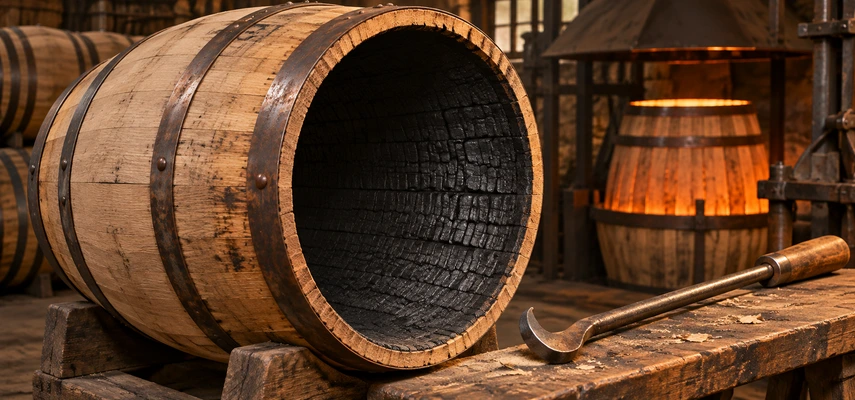
New wood offers a different extractive environment from a repeatedly used cask. Heating changes the inner surface and underlying wood, while charring produces a carbonised layer. Spirit can acquire wood-derived aromas and color, and some compounds can be removed or transformed. Toast-like, vanilla, coconut and spice associations are possibilities rather than a fixed checklist for every barrel.
Do not reduce charring to adding a smoky coating. The charred surface and heat-affected wood beneath it have different roles, and both sit within a larger maturation system. Barrel construction, seasoning, heat treatment, spirit entry conditions and time influence the outcome. Two barrels described by the same char level are not guaranteed to behave identically.
Entry strength changes the ethanol-water environment interacting with that wood. It can alter extraction relationships, so a lower entry strength is a stylistic choice with consequences rather than a universal quality upgrade. The legal maximum supplies a boundary; the producer still needs to select an appropriate working strength and assess the developing whiskey.
The warehouse changes the journey
Temperature patterns affect movement and interaction within the barrel, while evaporation changes the remaining liquid. Warehouse design, position and local conditions can therefore produce differences between casks that began similarly. A high rack and a low rack are locations with potentially different environments, not guaranteed grades of whiskey.
Warm conditions can accelerate some aspects of extraction and development, but extraction and integration are not the same measurement. More intense wood influence can bring welcome structure or excessive dryness. The useful question is whether the particular cask has reached the desired relationship among spirit character, wood influence and maturity, rather than whether it has become dark quickly.
Age records time, not the whole maturation story. As TTB’s age guidance explains, a youngest-component age can describe an unflavored whiskey mixture; it is not the average age. Standard age-statement requirements apply below four years, with the detailed labeling rules governing particular cases. Do not infer a precise age from a missing statement alone.
Selection and bottling finish the argument
A producer may select one barrel or combine compatible stocks to achieve a target profile. Combining casks does not automatically create the separate American blended-whisky category. Legal identity depends on the applicable composition and processing rules. Likewise, a single barrel offers individuality, not an automatic guarantee of balance or greater complexity.
Water adjustment changes strength and can change aroma release and texture. Filtration can help manage clarity, with possible sensory consequences depending on its intensity. These final decisions should be assessed against the intended style. A powerful barrel-strength whiskey and a more approachable lower-strength release can each succeed on their own terms.
Judge bourbon quality through relationships
Look for balance among alcohol, grain-derived character, fermentation-derived fruit or other aromas, and wood influence. Consider persistence, complexity and integration using evidence from the actual sample. A long finish dominated by coarse oak is not automatically better than a shorter, more harmonious one. Price, darkness and high proof cannot substitute for sensory reasoning.
What to remember
For study, practise tracing one choice through its mechanism into a plausible consequence: starch preparation supports sugar availability; yeast and conditions shape fermentation; separation controls the distillate; fresh heated oak and warehouse conditions shape maturation. Keep those connections conditional where several variables interact. Bourbon becomes much easier to explain when the barrel is the next chapter in the process, rather than the entire story.
Written practice: original TFE exercises
These suggested marks and indicative points are independent teaching guidance, not official WSET marking schemes.
Exercise 1: 5 suggested marks
Explain why a producer controls the sequence and temperature of cereal preparation before fermentation. Mapping: LO2 explain: cereal conversion.
Indicative marking points:
- Cereals supply starch.
- Appropriate cooking makes starch more accessible.
- Enzymes require suitable conditions to remain effective.
- Enzyme action produces smaller carbohydrates including usable sugars.
- Those sugars support the subsequent yeast fermentation.
Model answer: Cereals supply starch, which suitable cooking helps make accessible. The producer must also provide conditions in which the conversion enzymes remain effective. A controlled sequence allows preparation and enzyme action to perform their different jobs, releasing usable sugars for yeast fermentation.
Why it works: The answer connects a preparation choice to substrate access, enzyme function and the next biological stage.
Common mistake: Saying yeast simply ferments raw starch omits the conversion problem.
Exercise 2: 5 suggested marks
Explain why two similar new-oak barrels filled with the same spirit may not mature identically in different warehouse positions. Mapping: LO2 explain: maturation conditions.
Indicative marking points:
- Positions can have different temperature patterns.
- Those patterns affect spirit-wood interaction.
- Local conditions can also influence evaporation.
- Composition and wood influence can therefore develop differently.
- Separate assessment is needed before selection for the intended style.
Model answer: Different warehouse positions can experience different temperature patterns, changing spirit-wood interaction. Local conditions can also influence evaporation, so composition and wood influence may diverge even when the starting spirit and barrels are similar. The producer therefore assesses the individual casks before selecting them for the intended style.
Why it works: It follows environmental differences through maturation mechanisms to the practical need for cask assessment.
Common mistake: Assuming a higher rack automatically produces better whiskey replaces sensory evidence with location.
Knowledge check: 10 original practice questions
Independent TFE questions, not official WSET examination items. Choose one answer per question; explanations follow separately.
1. Why can grain cooking and enzyme action need different conditions?
2. Which grain must supply at least 51% of a bourbon mash?
3. Why can similar barrels develop differently?
4. What is a useful technical contribution of malted barley?
5. Which is the strongest statement about a column still?
6. Which conclusion is justified by a dark bourbon alone?
7. Which container is required for ordinary bourbon storage?
8. What extra minimum maturation condition does straight bourbon carry?
9. Which pair correctly separates distillation and barrel-entry maxima?
10. What does sour mash not necessarily imply?
Answers and explanations
- C — Starch preparation and enzyme stability have different requirements. A preparation sequence must make starch accessible while preserving useful enzymatic activity. Mapping: LO2.
- A — Corn. Corn is the defining majority grain; other cereals can contribute within the recipe. Mapping: LO2.
- D — Their warehouse environments and histories can differ. Position, temperature patterns and evaporation can contribute to divergent maturation. Mapping: LO2.
- B — Conversion enzymes. Enzymes can help convert accessible starch into smaller carbohydrates for fermentation. Mapping: LO2.
- B — Its design and operation affect separation and retained congeners. Equipment type alone does not establish composition or sensory quality. Mapping: LO2.
- D — Color needs interpretation alongside other evidence. Color does not independently establish age, quality or an unauthorized addition. Mapping: LO2.
- D — Charred new oak barrels. Fresh charred oak is a category condition, not merely a common producer preference. Mapping: LO2.
- A — At least two years. Straight adds a two-year minimum; ordinary bourbon has no stated minimum number of years. Mapping: LO2.
- D — 80% ABV and 62.5% ABV. The limits concern different stages and cannot be exchanged. Mapping: LO2.
- C — A sour-tasting finished whiskey. The process term concerns production conditions rather than a compulsory finished taste. Mapping: LO2.
Continue exploring this series
3. Alcoholic Fermentation Explained: Yeast, Nutrients, and Flavor Compounds
6. Pot Still Distillation Explained: Design, Heating, Cuts, and Flavor
7. Column and Hybrid Stills Explained: Plates, Reflux, and Continuous Distillation
9. Oak Maturation Explained: Barrels, Oxygen, Evaporation, and Flavor Development
10. Spirits Finishing Explained: Blending, Filtration, Sweetening, Coloring, and Packaging
11. How Grains Become Whisky: Malting, Mashing, Enzymes, and Starch Conversion
15. Rye and Tennessee Whiskey Explained: Production Rules and Flavor Differences
29. Spirits Quality Explained: How Production Decisions Affect Balance and Complexity
13. Grain and Blended Scotch Whisky Explained: Production Choices, Laws, and Style
50. WSET Level 3 Spirits Exam: Complete Revision Guide and Practice Examinations












