










History of Otis Worldwide
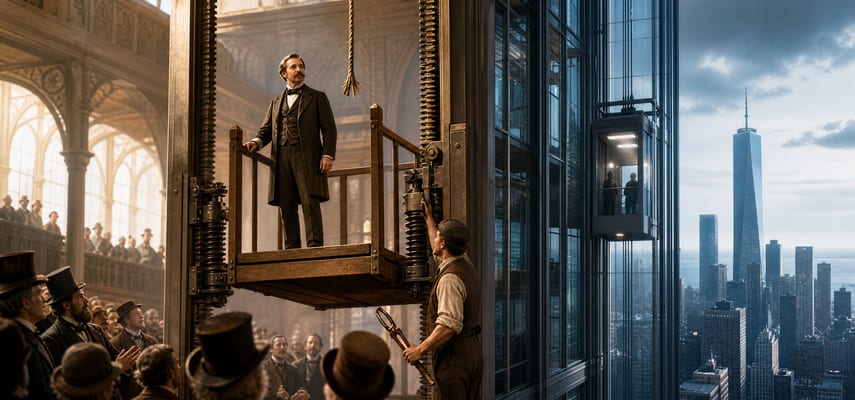
When Elisha Graves Otis stepped onto an elevator platform at New York’s Crystal Palace exhibition in 1854 and ordered the retaining rope cut, he did more than create a dramatic demonstration. He turned an obscure mechanical idea into an indispensable urban technology by showing that a hoisting-rope failure need not send the platform into free fall.
The company that grew from that demonstration—Otis—did not merely sell boxes that go up and down. It helped make the modern city possible, shaped standards for safety and maintenance, and evolved through waves of technology, consolidation and financial reorganization to remain a dominant global presence in vertical-transportation systems.
1853–1880s: Invention, early company building and the promise of vertical life
Otis safety elevator invention
Otis traces its founding to 1853, when Elisha Graves Otis sold his first elevator after inventing the elevator safety brake in 1852. The safety mechanism engaged automatically if the hoisting rope failed, arresting a falling platform.
The invention solved the fundamental problem that kept buildings low: people would not willingly climb dozens of flights of stairs. At the Exhibition of the Industry of All Nations in New York in 1854, Otis stood on an elevated platform and ordered the retaining rope cut. The platform dropped only a short distance before the safety brake stopped it, turning a technical improvement into a persuasive spectacle that showcased safety as the enabling condition for tall buildings.
The company’s early years focused on turning a single invention into a product and a reputation. Otis and his successors marketed safety as a trustable feature, winning contracts for factories, warehouses and eventually, by the late 19th century, for the new generation of multi-story commercial buildings. The practical consequence was immediate: developers could add rentable floors without frightening tenants away.
The company was founded by Elisha Graves Otis in 1853 and was originally intended to make vertical transport safe and to enable taller buildings. This original purpose—safety as a practical and architectural enabler—shaped early marketing, technical choices and the firm’s initial commercial pitch to builders and property owners.
Late 19th century–1910s: Global expansion and the elevator as a civic symbol
By the 1880s and 1890s Otis moved from one-off machines to organized production and international sales. The company supplied elevators for exhibitions and iconic structures, helping shift elevators from novelties to civic fixtures. Elevators in department stores, office blocks and public buildings changed how people experienced cities—an effect that was as much social and economic as it was mechanical.
Two consequences mattered. First, elevator performance and reliability became a business imperative: a stuck elevator in a commercial block cost tenants time and landlords money. That reality pushed Otis to standardize manufacturing and to develop service systems. Second, elevators acquired symbolic weight; a building’s elevators often signaled its modernity and prestige. Otis sales teams used that symbolism in competing for marquee projects, which in turn promoted the company’s reputation and global reach.
1910s–1950s: Electrification, mass production and the service contract model
The 20th century brought new sources of power and new materials. Electric traction systems replaced steam and rope hoists, and hydraulic lifts matured as a solution for low-rise, heavy-load installations. Otis, like other leading manufacturers, adopted these technologies and scaled manufacturing processes to supply rapidly growing urban markets.
Alongside product evolution, Otis refined its commercial model. Maintenance and service contracts—agreements to keep elevators running, safe and code-compliant—grew into a major part of the business. Rather than selling one-off machines, Otis sold long-term uptime: technicians on retainer, scheduled inspections, and spare-part networks.
For building owners the appeal was straightforward—predictable costs and lower operational risk. For Otis, service contracts produced recurring revenue that insulated the company from cyclical swings in new-construction markets and built enduring customer relationships.
1960s–1970s: Global brand, technological competition and corporate consolidation
By mid-century the elevator industry was global and competitive. Otis competed with European and Japanese firms on technology and price. The company’s name, however, had become a global shorthand—“Otis” meant elevators—and that brand value underpinned its expansion into new geographies.
In 1976 Otis became part of United Technologies Corporation (UTC). The acquisition placed Otis inside a larger industrial conglomerate, one that valued steady manufacturing businesses and global sales networks. For Otis, being part of UTC provided capital for product development, broader corporate systems for procurement and global logistics, and access to multinational account relationships.
At the same time, integration into a conglomerate exposed Otis to the strategic priorities of a diversified parent, where elevator operations competed for attention and resources with aerospace and climate-control businesses.
1980s–1990s: Digital controls, modernization and the rise of the retrofit business
The turn toward electronic control systems and microprocessors changed elevator design and performance. Precise control logic improved ride quality, reduced energy use and enabled more complex dispatching systems for high-rise banks of cars. Otis incorporated electronic control systems into new products and retrofitted many older systems with modern controllers to extend their useful lives.
Two business trends were especially important in this era:
- Modernization: As office towers built in the 1920s–1960s aged, owners faced choices between full replacement and selective modernization. Upgrading controls, doors, and motors offered a cost-effective way to improve performance, safety and energy efficiency. Otis increasingly positioned itself not just as a new-equipment supplier but as the vendor-of-choice for modernization projects.
- Energy and space efficiency: New drive technologies and gearless motors reduced machine-room sizes and improved efficiency. That enabled different building layouts and helped Otis compete on technical grounds in premium buildings.
These shifts increased the company’s engineering demands and reinforced the service-oriented parts of the business, since modernized elevators required fewer emergency repairs but more sophisticated diagnostics and parts supply.
2000s–2010s: Global scale, safety standards and digital service platforms
Entering the 21st century, Otis faced a familiar dual challenge: continuing to innovate in product design while expanding its global maintenance footprint. Rapid urban growth in Asia, the Middle East and parts of Latin America created a large addressable market for both new equipment and service contracts. Otis invested in factories, distribution and local service teams to meet that demand.
During these decades, elevator safety, code compliance and industry standards tightened. Regulatory bodies in many countries required more rigorous inspections, redundant safety mechanisms and accessible designs. For Otis, adherence to evolving standards was both a compliance obligation and a commercial advantage: landlords and architects preferred suppliers with demonstrable safety protocols.
Digital transformation and predictive maintenance
At the same time, Otis and its competitors began adding digital capabilities—remote monitoring, predictive maintenance algorithms and fleet-management dashboards. These systems collected data from sensors embedded in cars, doors and drives; analytics aimed to predict failures before they happened, optimize dispatching and reduce downtime.
The promise was lower operating costs for customers and lower call volumes for service organizations, which allowed companies to schedule technicians more efficiently. Over time these developments shifted parts of the business toward software-enabled service offerings.
2016–2020: Corporate restructuring and a return to independence
The late 2010s were a period of strategic refocusing for United Technologies. Management choices at UTC led to a plan to separate several businesses into standalone companies. The rationale was financial and strategic: independent public companies could pursue distinct capital structures, acquisitions and research priorities without being bound to a conglomerate’s portfolio decisions.
Otis spin-off in 2020
Otis’s separation from UTC was completed on April 3, 2020, through a pro rata distribution of Otis shares to UTC shareholders. Otis common stock began regular-way trading on the New York Stock Exchange that day under the ticker symbol OTIS. The spin-off was the culmination of a long arc: from a family-founded manufacturer to a division in a diversified industrial conglomerate and finally to an independently traded company focused solely on vertical transportation.
The return to independence placed a premium on operational clarity—Otis now faced market expectations for growth, margins and dividend policy that would be judged on its own merits.
2020s: Independence, digital transformation and market pressures
Today, as an independent company listed under the ticker symbol OTIS, the firm entered a period defined by three overlapping pressures:
- Operational continuity in a turbulent economic environment. Global construction cycles, supply-chain disruptions and pandemic-era constraints forced Otis to manage installations and service activity under difficult conditions. The maintenance business proved resilient, but new-equipment orders were exposed to macro swings.
- Acceleration of digital services. The company continued to roll out remote monitoring, cloud-based diagnostics and predictive-maintenance offerings. The scale of its maintenance portfolio gives Otis broad opportunities to deploy connected monitoring and predictive-maintenance tools.
- Capital allocation as an independent firm. Otis had to decide how to balance investment in factories and R&D with shareholder returns. As a stand-alone public company, executive teams faced quarterly investor scrutiny in ways they had not as a division of a conglomerate.
These forces have practical implications. Increased digitization changes labor skill requirements—field technicians need more diagnostic training—and shifts product development priorities toward systems integration rather than purely mechanical improvements. The installed-base model of recurring service revenue remains the company’s financial ballast, but it also requires consistent execution in inventory, technician scheduling and parts logistics.
Products and technology over time
Otis’s technical portfolio expanded in step with urban demands. Core product categories include:
- Passenger elevators (low, mid and high rise), with variations in traction and hydraulic drives.
- Freight elevators and platforms, engineered for industrial and logistics uses.
- Escalators and moving walks, which handle horizontal and inclined circulation in transit hubs, shopping centers and airports.
- Modernization kits—control systems, doors, motors and finish upgrades—designed to extend car lifespans and improve energy efficiency.
Technological progress followed predictable paths: improved drive systems and materials, refined control algorithms for dispatching groups of cars, and increasingly sophisticated sensor networks for condition monitoring. The broader industry moved from single-point mechanical solutions to systems-engineering approaches that combined hardware, electronics and software. Otis’s strategy emphasized integration: selling not only the physical car but the software and service layer that keeps it moving reliably.
Why Otis mattered—and still matters
Three intertwined reasons explain Otis’s historical significance.
- It enabled vertical urbanism. The safety elevator removed a physical and psychological barrier to tall buildings. That simple fact reshaped city skylines and the economic logic of land use, enabling denser development in central districts.
- It institutionalized a service model. By making maintenance a product—contracts, technician networks, spare parts logistics—Otis helped create a recurring-revenue business that prioritized uptime and safety as core metrics. That model changed how building owners budgeted and operated properties.
- It has been a technical integrator. The company’s long history required not only mechanical ingenuity but the ability to blend new drives, controls and digital services into operational systems. That engineering continuity is why architects and developers have often preferred established brands for complex, safety-critical installations.
Challenges and continuing debates
Otis has not been immune to the industry’s structural challenges. The business is capital intensive and exposed to construction cycles. Its labor model—field technicians and local service networks—creates operational complexity that global supply chains can exacerbate. And digitalization raises strategic questions about data ownership, cybersecurity and the comparative advantage of incumbent suppliers over new entrants offering software-first services.
Regulatory frameworks remain important. Safety standards, accessibility rules and building codes vary by jurisdiction, requiring the company to maintain diverse engineering, certification and inspection capabilities worldwide. Failures or high-profile incidents can have outsized reputational effects because elevators are visible and experienced by millions daily.
Looking ahead
Otis enters the mid-2020s with a clear cluster of priorities: modernize legacy fleets profitably, leverage data from a vast installed base to offer predictive and subscription services, and compete on both price and technological differentiation in emerging markets. The company’s longevity is not a guarantee of future dominance; success will depend on execution in digital services, supply-chain resilience and an ability to adapt the technician workforce to new diagnostic and repair requirements.
Conclusion
From a dramatic mid-19th-century demonstration to a 21st-century public company, Otis’s history is a story of technology shaping the built environment. The safety elevator did more than preserve lives—it reconfigured cities. Over 170 years later, Otis faces familiar imperatives—safety, reliability, and adaptation to new technologies—while navigating modern pressures of digitization and market cycles. The company’s future will depend on how well it turns its vast operational footprint and engineering heritage into a platform for the next era of vertical transportation.












