










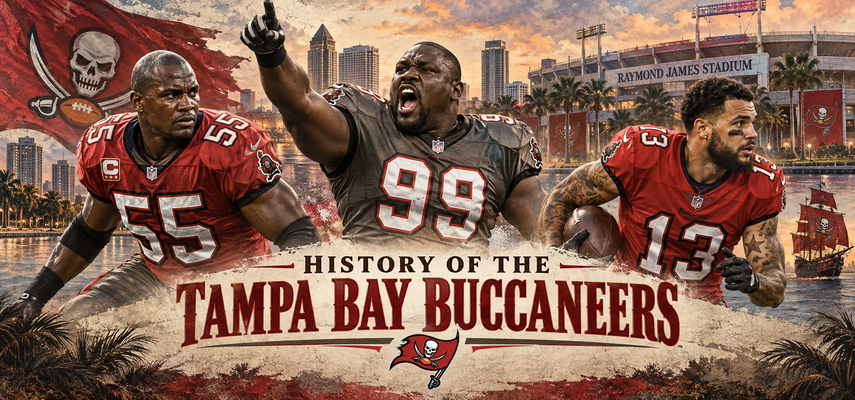

The Tampa Bay Buccaneers began with a long losing streak and eventually built two championship teams with strikingly different identities. Lee Roy Selmon gave the early franchise credibility, a later defense featuring Derrick Brooks and Warren Sapp delivered its first title, and Tom Brady helped complete a second championship run. Between those peaks came rebuilding, coaching changes and repeated efforts to establish continuity. Tampa Bay’s story is therefore broader than either its difficult beginning or its famous quarterbacks. This account follows the franchise through the completed 2025 season, with later developments distinguished from results still unfolding during the 2026 campaign.
Franchise at a glance
| Field | Details |
|---|---|
| Founded | April 24, 1974; NFL expansion franchise awarded |
| First season | 1976, National Football League |
| Original city and name | Tampa, Florida — Tampa Bay Buccaneers |
| Current city and name | Tampa Bay Buccaneers; Tampa, Florida |
| Previous cities and names | None |
| League and conference/division | NFL — National Football Conference South; AFC West in inaugural 1976 season |
| Home venue | Raymond James Stadium; opened in 1998 |
| League championships | 2 Super Bowl victories: 2002, 2020 |
| Other recognized championships | 2 NFC championships: 2002, 2020 |
| Historical coverage | 2025 NFL season, including postseason completed in February 2026; later developments through October 16, 2026 |
Origins and early years
The NFL awarded the Tampa Bay expansion franchise in 1974, with play scheduled to begin in 1976. Hugh Culverhouse became the owner, and John McKay left a successful college coaching career to direct the new team. The Buccaneers name connected the organization to a regional pirate identity, while its original orange uniforms gave it an immediately recognizable appearance at Tampa Stadium.
The first season was unusually difficult. Tampa Bay went 0–14 and continued losing into 1977, reaching twenty-six consecutive defeats before its first regular-season victory. Lee Roy Selmon, the franchise’s first draft selection, supplied an important defensive foundation amid those results. The club’s inaugural AFC West placement also requires care: Tampa Bay moved to the NFC the following year, so its first-season conference alignment does not describe its later identity. The beginning created a reputation for futility, but McKay and his developing roster would soon demonstrate that the expansion record was not a permanent definition of what the organization could achieve.
Defining eras
1976–1982: From twenty-six defeats to a conference final
The Buccaneers’ first victory came at New Orleans in December 1977, ending the losing streak that had defined their opening seasons. McKay continued building around a defense led by Selmon, while quarterback Doug Williams and running back Ricky Bell helped the offense become more competitive. The improvement culminated in a remarkable fourth season. Tampa Bay won its division in 1979 and defeated Philadelphia 24–17 in the playoffs.
The Rams then won the NFC Championship Game 9–0, stopping the Buccaneers one game short of a Super Bowl. The rapid transformation from expansion defeats to a conference final established the franchise’s first positive historical benchmark. Further playoff appearances followed in 1981 and the strike-shortened 1982 season. Selmon’s exceptional defense gave those teams a lasting individual symbol, but the organization could not preserve the momentum. The next period would show how fragile the initial recovery had been and how much sustained success depended on continuity beyond one strong roster.
1983–1995: A long rebuilding period
Williams’ departure and subsequent changes weakened the offense, while the first successful core gradually broke apart. McKay retired after the 1984 season, and a sequence of coaching appointments failed to establish a lasting contender. Individual players occasionally supplied encouraging performances, but Tampa Bay spent years outside the playoffs. The franchise again became associated with rebuilding rather than with the conference-final team it had fielded so early in its existence.
The organization’s direction began changing during the 1990s. The Glazer family’s purchase brought new ownership, while the roster acquired young defensive talent capable of anchoring a different identity. Warren Sapp and Derrick Brooks arrived in the same 1995 draft, joining a group that would eventually make Tampa Bay a consistent contender. Their immediate importance lay in potential rather than an instant turnaround. The team still needed a coaching system and organizational patience capable of turning those talented individual selections into a defense that could determine the outcome of an entire season.
1996–2002: A great defense produces the first championship
Tony Dungy became head coach in 1996 and helped establish the defensive structure associated with the Buccaneers’ revival. Brooks, Sapp and John Lynch became leading figures, with Monte Kiffin’s coordination central to the system. Tampa Bay returned to the playoffs and reached the NFC Championship Game following the 1999 season. Raymond James Stadium, opened in 1998, gave the improving franchise a new home alongside its redesigned red-and-pewter appearance.
Jon Gruden replaced Dungy for 2002 and helped complete the championship pursuit with quarterback Brad Johnson and the established defense. Tampa Bay won at Philadelphia for the NFC title, then defeated Oakland 48–21 in Super Bowl XXXVII. Dexter Jackson earned the game’s MVP award, while the defense produced decisive interceptions. The championship was the product of the final coaching transition and the roster developed over the preceding years. It permanently changed a franchise once identified principally with expansion losses into an organization with a completed league title.
2003–2018: The championship fades and another search begins
The first championship did not become a dynasty. The Buccaneers returned to the playoffs in later Gruden seasons without recreating the title team’s final success. As the defensive core aged and departed, the organization again needed to renew its roster and offensive leadership. Gruden’s tenure ended after the 2008 season, and subsequent coaches attempted different approaches to the same underlying challenge of establishing dependable performance.
Quarterback changes and repeated rebuilding left Tampa Bay outside the postseason for an extended period. Mike Evans’ arrival in 2014 supplied an exceptional receiver, and Jameis Winston became the first overall draft choice the following year. Their production did not immediately translate into playoff football. The organization had talented offensive pieces but still lacked the combination of consistency and overall balance needed to compete deep into January. By the end of 2018, another coaching change was coming, setting up a dramatically different route toward the franchise’s second championship opportunity.
2019–2022: Arians, Brady and another Super Bowl
Bruce Arians became head coach in 2019, with Todd Bowles directing the defense. Tom Brady’s arrival in 2020 gave the offense a proven quarterback to join Evans, Chris Godwin and other established contributors. Rob Gronkowski and further additions strengthened the group. The roster developed into a complete contender, with a defense capable of complementing the passing attack rather than depending entirely on it.
Tampa Bay reached Super Bowl LV after three road playoff victories and defeated Kansas City 31–9 at Raymond James Stadium. Brady earned MVP honors, and the Buccaneers became the first team to play and win a Super Bowl in its own home stadium. The game completed the 2020 season despite being played in February 2021. Arians later moved out of the head-coaching role, and Bowles took over for 2022. Brady’s final season ended with another division title but a wild-card defeat, closing a short and highly consequential period in the franchise’s history.
2023–2025: Mayfield sustains contention before a setback
Baker Mayfield became the starting quarterback in 2023 and helped the Buccaneers remain competitive after Brady’s retirement. Tampa Bay won the division and defeated Philadelphia 32–9 in the wild-card round before losing at Detroit. The result demonstrated that the organization could build a credible offense beyond its famous veteran quarterback, with Evans and other established players continuing to supply a dependable foundation.
Another division championship followed in 2024, although Washington ended that postseason immediately. The 2025 team began with promise but declined to an 8–9 finish and missed the playoffs. That outcome ended a run of four consecutive division titles from 2021 through 2024. It also showed that maintaining the post-Brady transition required further renewal rather than simply preserving the same roster. The completed season left Bowles’ team with recent evidence of competitiveness and a clear need to recover the consistency that had sustained its earlier position atop the NFC South.
Recent history
Tampa Bay completed the 2025 regular season 8–9 and did not qualify for the playoffs. Its four consecutive NFC South titles belonged to the 2021–2024 seasons, not to the 2020 championship campaign, when it entered the postseason as a wild card. The completed franchise record remained two NFC championships and two Super Bowl victories, earned in the 2002 and 2020 seasons.
Bowles continued as head coach for 2026, with Mayfield remaining central to the offense. Evans signed with San Francisco during the 2026 offseason after twelve seasons in Tampa Bay, closing the Buccaneers chapter of an exceptional receiving career. His departure left a receiving group that still included Chris Godwin alongside younger players, changing one of the offense’s longest-established partnerships. As of October 16, 2026, the new campaign remained in progress and its final outcome was not assigned. Raymond James Stadium continued as the home venue for the organization’s next competitive chapter.
Greatest players and influential figures
Lee Roy Selmon
Selmon gave the expansion Buccaneers an exceptional defensive player around whom to build. His pass rushing and strength helped carry the team from its losing start to the 1979 NFC Championship Game. He became the franchise’s first Hall of Fame player, and Tampa Bay formally retired his No. 63.
Derrick Brooks
Brooks’ range, recognition and leadership made him central to the defense that won Super Bowl XXXVII. His ability to cover space while contributing against the run helped define Tampa Bay’s defensive system. He earned AP Defensive Player of the Year honors for the championship season and later entered the Hall of Fame.
Warren Sapp
Sapp’s interior pressure disrupted offenses before plays could fully develop. His partnership with Brooks gave Tampa Bay complementary defensive strengths during the franchise’s revival. He helped win the first Super Bowl title and received Hall of Fame recognition, with his retired No. 99 preserving his place in the team’s history.
John Lynch
Lynch supplied physical presence and communication in the secondary, helping connect Tampa Bay’s defensive front with its coverage. He contributed to the first championship after years of development under Dungy and Kiffin. His later Denver playing career and executive service elsewhere belong to a wider professional record.
Mike Evans
Evans became Tampa Bay’s defining receiver across several quarterback eras. His size, consistency and ability to make difficult catches helped support the second Super Bowl team and the transition to Mayfield. His move to San Francisco in 2026 began a separate playing chapter after twelve seasons with the Buccaneers.
Tom Brady
Brady’s three Tampa Bay seasons included a Super Bowl victory and two division titles. His arrival gave an already talented roster a veteran quarterback capable of completing another championship run. His earlier New England titles remain Patriots achievements, while only the 2020 Super Bowl victory counts toward Tampa Bay’s total.
Tony Dungy
Dungy established the disciplined defensive identity that restored Tampa Bay to regular contention. His teams did not finish the championship pursuit, but their development of the core made the later title possible. His subsequent Super Bowl victory as Indianapolis’ head coach belongs to the Colts rather than the Buccaneers.
Bruce Arians
Arians directed the franchise’s second championship team and built a coaching arrangement that paired a productive offense with Bowles’ defense. His work with Brady helped turn an experienced roster into a complete contender. The Super Bowl LV victory established his central place in Tampa Bay’s later successful era.
Championships and postseason milestones
The Buccaneers have two Super Bowl victories and two NFC titles. Each conference championship led to the corresponding Super Bowl win within the same season. The table includes the first conference-final appearance as an earlier milestone, clearly identifying its defeat rather than counting it as another title. Season years govern all entries.
On smaller screens, scroll horizontally to see all columns.
| Season/year | Competition | Opponent | Result | Defining figure(s) |
|---|---|---|---|---|
| 1979 | NFC Championship Game | Los Angeles Rams | Lost 0–9 | Lee Roy Selmon; Doug Williams; John McKay |
| 2002 | Super Bowl XXXVII | Oakland Raiders | Won 48–21 | Derrick Brooks; Dexter Jackson; Jon Gruden |
| 2020 | Super Bowl LV | Kansas City Chiefs | Won 31–9 | Tom Brady; Bruce Arians; Todd Bowles |
Rivalries, venues and team identity
Rivalries
Carolina, Atlanta and New Orleans provide Tampa Bay’s modern NFC South rivalries. The Saints matchup became especially prominent during the Brady period, including a playoff victory on the way to the second championship. Earlier postseason meetings with Philadelphia remain important to the first title team’s history and its eventual breakthrough.
Home venues and traditions
Tampa Stadium hosted the expansion years and the first conference-final team. Raymond James Stadium opened in 1998, adding its pirate ship to the franchise’s home imagery. The original orange appearance and later red-and-pewter design identify different periods, while the Buccaneers name connects both to the same regional identity.
Retired numbers and team honors
Selmon’s No. 63, Brooks’ No. 55 and Sapp’s No. 99 are formally retired. The Ring of Honor recognizes additional contributors and is a separate distinction from Canton induction. Team tributes should therefore be described specifically rather than assuming that every honored player also has a retired jersey number.
Legacy
Tampa Bay’s history is a reminder that a difficult beginning need not define a franchise permanently. The first championship grew from an exceptional defense assembled over years, while the second combined a veteran quarterback with an already talented roster. Those contrasting routes produced the same final achievement without eliminating the rebuilding periods around them. Selmon, Brooks, Evans and other leading figures connect the story across changing uniforms and coaches. The Buccaneers’ continuing challenge is to make competitiveness more durable while preserving the distinct identities of the teams that reached the summit.
Where to eat in Tampa
Planning a visit? Explore our best restaurants in Tampa guide.











