










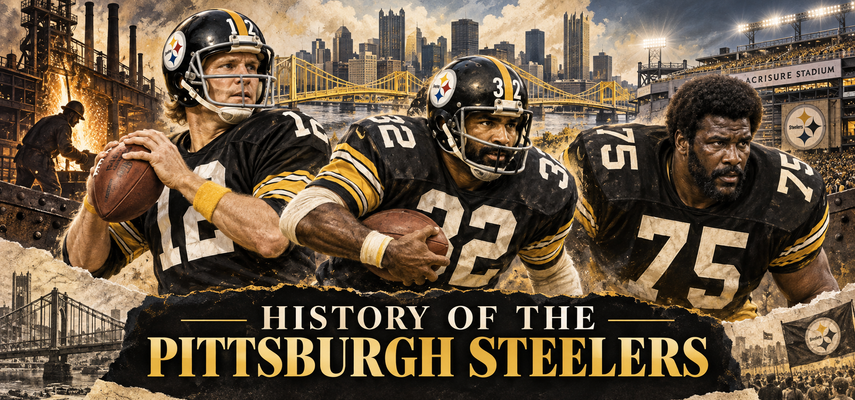

The Pittsburgh Steelers became a championship institution only after decades of frustration. Art Rooney’s early teams struggled to establish themselves before Chuck Noll’s drafting and development produced the defining dynasty of the 1970s. Later champions under Bill Cowher and Mike Tomlin extended the record through different players and approaches. Six Super Bowl victories connect those eras, while the Steel Curtain, enduring family ownership and distinctive supporter traditions explain the franchise’s wider identity. This history follows Pittsburgh from its 1933 beginning through the completed 2025 season, separating those results from the leadership transition and ongoing competition of the 2026 campaign.
Franchise at a glance
| Field | Details |
|---|---|
| Founded | 1933; Art Rooney received an NFL franchise |
| First season | 1933, National Football League |
| Original city and name | Pittsburgh, Pennsylvania — Pittsburgh Pirates |
| Current city and name | Pittsburgh Steelers; Pittsburgh, Pennsylvania |
| Previous cities and names | Pittsburgh Pirates, 1933–1939; temporary wartime combined teams in 1943 and 1944 |
| League and conference/division | NFL — American Football Conference North |
| Home venue | Acrisure Stadium; opened in 2001 as Heinz Field |
| League championships | 6 Super Bowl titles: 1974, 1975, 1978, 1979, 2005, 2008 |
| Other recognized championships | 8 AFC championships; no pre-Super Bowl NFL title |
| Historical coverage | 2025 NFL season, including postseason completed in February 2026; later developments through October 16, 2026 |
Origins and early years
Art Rooney founded Pittsburgh’s NFL team in 1933 and initially used the Pirates name shared with the city’s baseball club. The football operation was separate from the baseball franchise and created its own record. Early teams played at Forbes Field and struggled both competitively and financially. Rooney sometimes took games to other cities while working to establish a dependable local audience.
The club adopted the Steelers name in 1940, connecting its identity more directly to Pittsburgh’s industrial base. Wartime personnel shortages led to temporary combined teams with Philadelphia in 1943 and the Chicago Cardinals in 1944. Those arrangements did not permanently merge the franchises. Pittsburgh’s first winning season came in 1942, but sustained contention remained distant. Its 1947 playoff appearance ended in a shutout loss to Philadelphia. The early history matters because the later reputation for stability and championships was not present from the beginning. It emerged from a long effort to convert ownership persistence and local attachment into a stronger football organization.
Defining eras
1933–1968: Surviving before the breakthrough
Rooney’s early teams rarely found the combination of coaching, personnel and resources necessary to compete with the league’s established powers. Individual attractions such as Byron White and later Bill Dudley supplied highlights without transforming the club’s overall position. The wartime combined teams were practical responses to shortages, followed by a return to Pittsburgh’s separate operation. A single playoff appearance did not create a lasting contender.
Buddy Parker’s teams in the late 1950s and early 1960s became more competitive. Quarterback Bobby Layne, defensive lineman Ernie Stautner and running back John Henry Johnson supplied experienced leadership. Yet Pittsburgh still could not turn respectable seasons into a championship. The team’s later struggles in the 1960s demonstrated that a more thorough reconstruction was necessary. By the time Noll arrived in 1969, the franchise had accumulated decades of history but no league title. Its strongest institutional asset was continued ownership commitment, while the football foundation still had to be rebuilt.
1969–1973: Noll builds through the draft
Noll’s first team won only once, but the organization began assembling an exceptional core. Joe Greene arrived in 1969, Terry Bradshaw in 1970 and Franco Harris in 1972. Successive drafts supplied defenders and offensive players whose development would change the franchise’s standing. Moving into Three Rivers Stadium in 1970 also placed the team in a new home as it shifted into the AFC at the merger.
The 1972 season brought Pittsburgh’s first division championship and the playoff victory over Oakland remembered for Harris’s Immaculate Reception. Miami ended that run in the AFC Championship Game, but the breakthrough changed expectations. The Steelers were now a credible contender with a young core. Another postseason appearance followed in 1973 before the famous 1974 draft added further exceptional talent, including future Hall of Famers on both sides of the ball. Noll’s reconstruction depended on developing a complete roster, with defensive strength and a dependable running game supporting Bradshaw’s growth at quarterback.
1974–1979: Four championships define a dynasty
Pittsburgh won its first Super Bowl after the 1974 season, defeating Minnesota 16–6. Harris earned MVP honors as the defense controlled the game. The following team beat Dallas 21–17 in Super Bowl X, with Lynn Swann’s receiving earning the award. Greene, Jack Lambert, Jack Ham, Mel Blount and a deep defensive front gave the Steel Curtain its enduring identity.
The dynasty also evolved offensively. Bradshaw’s passing became increasingly decisive, with Swann and John Stallworth supplying exceptional receiving. Pittsburgh beat Dallas again, 35–31, for the 1978 championship and defeated the Los Angeles Rams 31–19 for the 1979 title. Bradshaw earned the MVP award in both games. Four Super Bowls in six seasons established the strongest period in franchise history. The achievement belonged to a coherent roster and organizational process rather than one unit alone: the defense gave the team its public image, while the offense’s development allowed it to win through changing game conditions.
1980–1991: The dynasty ages
The championship roster gradually broke apart through retirement and declining availability. Bradshaw, Harris and other foundational players left the team, while Noll worked to build another contender. Pittsburgh remained capable of important seasons but could not reproduce the same density of exceptional talent. The 1984 team reached the AFC Championship Game, where Miami ended its opportunity to return to the Super Bowl.
Later teams relied on different players and a more limited offensive approach. The 1989 Steelers recovered from a difficult start to win a playoff game in overtime at Houston before losing narrowly at Denver. That run demonstrated Noll’s continuing ability to develop a competitive team, though another championship did not follow. His retirement after the 1991 season closed an unusually long coaching period. The organization now faced a central question: whether the structures developed during the dynasty could support another successful era without the coach and players who had created the franchise’s championship reputation.
1992–2006: Cowher completes a new pursuit
Bill Cowher restored immediate energy and regular-season success after becoming head coach in 1992. His teams emphasized physical defense and the running game, with players such as Rod Woodson, Greg Lloyd and later Jerome Bettis giving the era a distinctive character. Pittsburgh reached Super Bowl XXX after the 1995 season but lost to Dallas. Other promising campaigns ended in conference-final defeats, creating another long championship pursuit.
Ben Roethlisberger’s arrival in 2004 supplied a new quarterback around whom the offense could develop. The 2005 team entered the playoffs as a wild card and won three road games to reach Super Bowl XL. Pittsburgh defeated Seattle 21–10, with Hines Ward earning MVP honors. The fifth championship joined Cowher’s generation to the earlier dynasty while recognizing a different roster and route. Cowher stepped down after the 2006 season. His tenure had shown that the organization could sustain its identity and win again beyond the players and leadership of the 1970s.
2007–2025: Tomlin’s longevity and another title
Mike Tomlin succeeded Cowher in 2007 and won Super Bowl XLIII in his second season. Pittsburgh defeated Arizona 27–23 after a late Roethlisberger touchdown pass to Santonio Holmes, whose performance earned MVP honors. Troy Polamalu and James Harrison helped anchor a formidable defense. Another AFC title followed after the 2010 season, but Green Bay won Super Bowl XLV.
The subsequent years produced repeated regular-season success and several difficult playoff exits. Roethlisberger’s later offenses featured major receiving talent, while defensive rebuilding eventually centered on players such as T.J. Watt. Pittsburgh reached the AFC Championship Game after the 2016 season but did not return to the Super Bowl. Roethlisberger retired after 2021, beginning another quarterback transition. Tomlin’s 2025 team won the AFC North at 10–7 before Houston ended its postseason. His departure afterward closed nineteen seasons without a losing regular-season record, but also an extended period without another playoff victory.
Recent history
The latest completed season is 2025, when Pittsburgh finished 10–7 and won the AFC North. Houston defeated the Steelers 30–6 in the wild-card round, extending the gap since their most recent postseason victory after the 2016 season. Mike Tomlin then stepped down after nineteen years as head coach.
Mike McCarthy was appointed in January 2026, becoming only the fourth head coach hired by Pittsburgh since 1969. As of October 16, 2026, his first Steelers season was underway and its final outcome remained undecided. His earlier Super Bowl victory with Green Bay belongs to the Packers’ record and did not add to Pittsburgh’s titles. Acrisure Stadium remained the home venue. The completed franchise record stood at six Super Bowl championships and eight AFC titles, with the latest title still the one earned by Tomlin’s 2008 team.
Greatest players and influential figures
Joe Greene
Greene became the foundational player of Noll’s reconstruction and the defensive front’s most recognizable force. His interior play helped establish the Steel Curtain’s standard across all four 1970s championships. His entire NFL playing career belonged to Pittsburgh, which later formally retired his No. 75 in recognition of that contribution.
Terry Bradshaw
Bradshaw developed from an inconsistent young quarterback into the passing leader of four Super Bowl champions. His MVP performances in Super Bowls XIII and XIV marked the offense’s growing importance within the dynasty. His Pittsburgh career connects early development, exceptional supporting talent and the ability to deliver in major games.
Franco Harris
Harris supplied the running foundation behind the first championship teams and the franchise’s most famous early playoff moment. His Immaculate Reception helped launch the breakthrough, and he earned Super Bowl IX MVP honors. Later service with Seattle was a separate career chapter from his four-title Pittsburgh contribution.
Jack Lambert
Lambert brought range, intensity and a distinctive physical presence to the middle of the Steel Curtain defense. Arriving in the 1974 draft, he immediately joined a team ready to win. His entire NFL career belonged to Pittsburgh, including all four championships that defined the franchise’s greatest era.
Troy Polamalu
Polamalu gave the later Steelers an exceptional combination of anticipation, disguise and disruptive play from safety. His work helped support two Super Bowl victories and another conference championship. His AP Defensive Player of the Year award recognized an individual peak within a career spent entirely with Pittsburgh.
Ben Roethlisberger
Roethlisberger supplied long-term quarterback continuity after arriving in 2004. He helped Pittsburgh win two Super Bowls and directed the late touchdown drive that decided Super Bowl XLIII. His long career also included difficult postseason endings, making the full contribution broader than either the championship moments or later disappointments alone.
Chuck Noll
Noll transformed Pittsburgh through drafting, teaching and the construction of a complete roster. His four Super Bowl victories established the franchise’s championship identity after decades without a title. The later rebuilding years also belong to his tenure, which created a durable organizational standard rather than only one exceptional team.
Bill Cowher
Cowher sustained Pittsburgh’s competitive expectations through a new generation and eventually won Super Bowl XL. His teams combined physical defense, strong running and repeated postseason opportunities. The championship completed a long pursuit after earlier near misses and demonstrated that the organization could succeed beyond the Noll dynasty.
Championships and postseason milestones
Pittsburgh’s six Super Bowl victories were earned across three head coaches. Its eight AFC titles also include the 1995 and 2010 seasons, which ended in Super Bowl defeats. Division championships and conference-final appearances are separate achievements. The franchise did not win a pre-Super Bowl NFL championship, and temporary wartime combinations did not create additional titles.
On smaller screens, scroll horizontally to see all columns.
| Season/year | Competition | Opponent | Result | Defining figure(s) |
|---|---|---|---|---|
| 1974 | Super Bowl IX | Minnesota Vikings | Won 16–6 | Franco Harris; Joe Greene; Chuck Noll |
| 1975 | Super Bowl X | Dallas Cowboys | Won 21–17 | Lynn Swann; Terry Bradshaw; Chuck Noll |
| 1978 | Super Bowl XIII | Dallas Cowboys | Won 35–31 | Terry Bradshaw; John Stallworth; Chuck Noll |
| 1979 | Super Bowl XIV | Los Angeles Rams | Won 31–19 | Terry Bradshaw; John Stallworth; Chuck Noll |
| 2005 | Super Bowl XL | Seattle Seahawks | Won 21–10 | Hines Ward; Jerome Bettis; Bill Cowher |
| 2008 | Super Bowl XLIII | Arizona Cardinals | Won 27–23 | Santonio Holmes; Ben Roethlisberger; Mike Tomlin |
Rivalries, venues and team identity
Rivalries
Baltimore became the defining modern divisional rival through repeated physical games and postseason meetings. Cleveland supplies the older regional relationship, while Oakland’s Raiders occupied an especially consequential place during the 1970s championship pursuit. Those opponents matter in different periods, connecting competitive history to the changing structure of Pittsburgh’s conference.
Home venues and traditions
Forbes Field and Pitt Stadium preceded Three Rivers Stadium, which housed the dynasty and later Cowher teams. The current venue opened as Heinz Field in 2001 and became Acrisure Stadium in 2022. Black and gold, industrial imagery and the Terrible Towel connect supporters across those settings. The towel’s association with broadcaster Myron Cope makes a public tradition part of the franchise’s wider institutional memory.
Retired numbers and team honors
Pittsburgh formally retired Ernie Stautner’s 70, Joe Greene’s 75 and Franco Harris’s 32. The Hall of Honor recognizes a much broader group of significant players, coaches and contributors. Some famous numbers have been kept out of regular use without receiving the same formal retirement. Those distinctions matter when describing team honors separately from Pro Football Hall of Fame election.
Legacy
Pittsburgh’s strongest historical thread is the transformation of patient ownership commitment into a durable football institution. The early decades supplied persistence, Noll’s dynasty established the championship standard, and later coaches proved that another generation could meet it. Six Super Bowls anchor the account without making every competitive period equally successful. The rebuilding seasons, quarterback transitions and recent postseason disappointments remain part of that same history. The Steelers’ significance therefore includes both exceptional teams and the organizational expectations those teams created for successors who worked under very different conditions.
Where to eat in Pittsburgh
Planning a visit? Explore our best restaurants in Pittsburgh guide.











