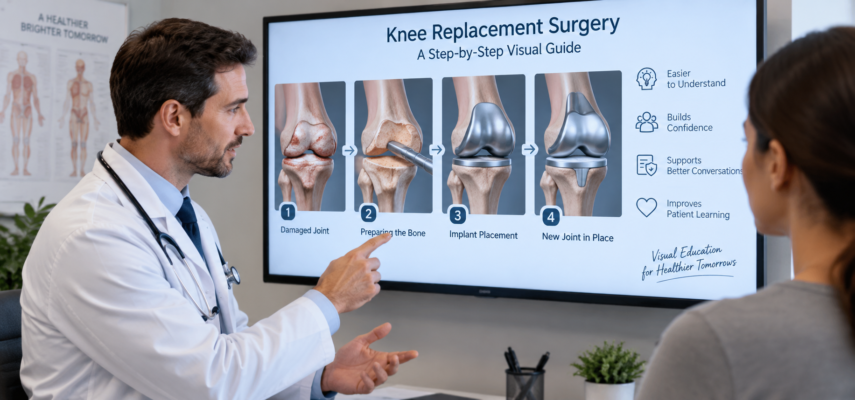
Medical information may prove hard to understand by patients and consumers, particularly where there is the need to learn about anatomy, which may not be well known and procedures that may prove complicated and cannot be seen. By giving visual sequences, it becomes easy to understand the information because they are presented in an understandable sequence. Instead of just relying on information that is technical, it becomes easier to understand the relationships between different body parts and the process involved.
Improving Understanding
Having a visual sequence makes it easy for the audience to follow the information provided step by step. Where there are many stages to a medical concept, organizing them in a sequence may make it easier to understand the process. In a video that shows a surgical process, the start of the process, the process, and the end of the process can be easily demonstrated. In this case, having an organized visual sequence makes it easier to understand the whole process.
The other use of visual sequences in education is illustrating change that occurs within the body. Many times, medical processes cannot be seen by the naked eye and may require some form of technology in order to visualize them. With the use of 3D medical animations, a learner is able to see the changes taking place within the body. This makes it easier for the process to be understood by following through the visual sequence.
Supporting Patient Learning
The amount of information that patients get while getting ready for a test or treatment is usually very high. The use of visual sequences can help reduce the amount of information since they break complex processes into smaller parts that are easier to digest. It may be easier for the viewers to remember vital information from a certain process as well as how particular steps relate to the entire process.
The use of visual sequences can be especially helpful when there are complex medical terms in the information provided. It is much easier to see what a term means in a sequence than trying to understand it through a definition only. The same effect can be achieved using 3D medical animations in which medical terms are related to anatomy, so the viewers will know where the terms apply.
Reducing Confusion
The order of the information provided visually can also play an important role in making the process of understanding it easier. In case of inconsistency in visuals between various steps, one cannot be sure whether the viewer can understand which event happened first and why it is needed. Sequence brings continuity which helps every next visual to flow from the previous ones.
Consistency is also essential for the visual education process. The anatomical structures, labels, movement and many other aspects need to be consistent during the whole sequence. Any changes in the perspective can lead to difficulty for viewers to catch the information. Keeping the consistency of the visual process will help the audience to focus on the medical aspect.
Encouraging Better Communication
Visual sequences might help in improving patient-doctor communications as well. Patients who possess knowledge on a particular procedure or disease may feel better prepared for discussion of their issues and questions. Of course, visual education does not substitute for any professional medical advice, however, it can become a good source of necessary information to discuss beforehand.
Healthcare educators can apply visual sequences to highlight information that must be known by patients. Important steps will get their deserved visualization, while excessive information will be excluded from them. In such a way, the educational information will become clearer, more practical, while still containing enough information to create context. Medical education, which will be well-organized, will allow patients to discuss complicated matters with a higher level of confidence.
Well organized visual sequence is important because it helps in turning complicated medical information into a well-organized learning process. By showing a process in a well-ordered manner, it is possible to simplify the anatomy of a procedure, eliminate confusion, and facilitate better communication with patients. Well-structured visuals can make it easier for people to learn medicine despite difficulties in comprehending the information verbally.