










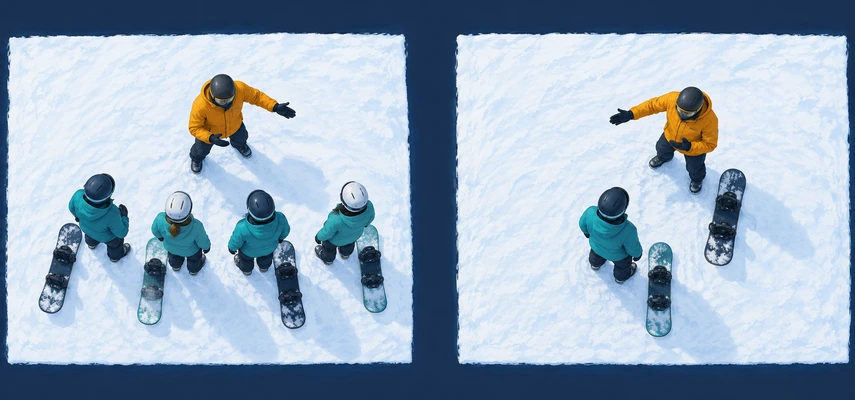

The booking page offers two versions of your future: learn alongside other people or have an instructor’s attention focused on you. One costs more, one involves a group, and neither promises that your first turn will be elegant.
Choosing a snowboard lesson is really choosing how teaching time is organized. A group shares that time among learners with broadly similar needs. A private lesson can focus more closely on an individual or a privately booked party. The best fit depends on what you need from the session, not which format sounds more prestigious.
Before comparing them, establish the actual starting point. A complete first-timer, a rider returning after years away and someone struggling with one particular turn need different things. Calling all three beginner can hide the question the lesson is supposed to answer.
What a lesson is doing besides demonstrating turns
A good instructor chooses terrain, breaks a task into manageable pieces, watches your attempts and changes the explanation or exercise when needed. The demonstration is only one part. Deciding what to ask you to try next can matter just as much.
Imagine being told to relax when you don’t understand what the board is about to do. Repeating the word louder probably won’t help. An instructor might reduce the slope, simplify the movement or choose a task that lets you experience one useful sensation at a time.
The PSIA-AASI learning resources describe the value of real-time professional feedback. That feedback separates a lesson from watching someone skilled ride past. You aren’t just buying a demonstration of what is possible; you’re buying help connecting it to what you can currently do.
Both group and private formats can provide that help. Neither format guarantees a particular instructor, teaching relationship or outcome unless the school explicitly makes a specific commitment. Ask about the actual product rather than relying on the category name.
How a group lesson usually works
Group lessons bring together learners within the school’s age and ability categories. The instructor works toward shared goals, while observing individual attempts and offering feedback. The group may move through exercises together, with adjustments according to the terrain and what participants can manage.
For a first-timer, shared starting points can be reassuring. Everyone is discovering boots, bindings and the unusual business of moving sideways. Seeing someone else ask the question you were about to ask can make the unfamiliar feel less isolating.
You may also learn by observing other attempts. A demonstration of a common error can become more recognizable when you see its effect, provided the instructor explains it constructively. Other learners aren’t obstacles to your education; they can be part of its context.
The tradeoff is shared attention. You won’t necessarily receive feedback after every attempt, and the class may spend time on a task you understand while another learner needs more practice. That doesn’t automatically make the lesson ineffective. It does mean the pace has to account for several people.
Group size, duration, age bands and ability divisions vary. Mammoth Mountain’s adult lesson information is one example of a school describing its products. Read the current details for your own venue; an advertised maximum isn’t a universal industry class size.
What private instruction can change
A private lesson can concentrate assessment and feedback more closely on your needs. If you repeatedly lose control during one transition, the instructor can spend time investigating it without also managing unrelated goals from a larger class.
The useful advantage is flexibility, not simply a larger number of sentences directed at you. The instructor may change the practice area, timing, explanation or exercise. You can ask questions that follow your particular problem, and the next task can be chosen around what the instructor observes.
That can appeal to someone with a specific technical issue, pronounced anxiety, a language preference or requirements that need discussion in advance. A school may also offer adaptive instruction through a specialist program. Ask which service can actually meet the need rather than assuming an ordinary private booking covers every situation.
Private lessons aren’t always one-to-one. Some are sold to a party that may include several people, subject to age, ability and capacity rules. If you invite friends, check whether the school can teach the group together effectively. One invoice doesn’t make different ability levels disappear.
More focused instruction also doesn’t guarantee an immediate breakthrough. Learning still involves practice, fatigue, conditions and a working relationship between teacher and learner. A private instructor can adapt the task; they can’t sell you an exemption from being new.
Compare value using the actual package
The headline lesson price isn’t the complete comparison. Check whether lift access, equipment rental, a helmet, lunch or other services are included. Confirm the duration and whether it includes arrival, equipment handling or other scheduled components. Policies differ between venues and products.
A group lesson is often the less expensive option per participant, but calculate the actual offering rather than assuming. A private booking shared among eligible companions may change the per-person arithmetic. The practical question is what useful instruction each person receives within that arrangement.
Avoid dividing price by lesson length and treating the result as a teaching-quality score. A longer session that leaves you exhausted may be less useful than a manageable one followed by appropriate practice. Travel, fitting and waiting also affect how much attention you bring to the lesson.
Breckenridge’s lesson information illustrates why product details and school placement matter. Prices and availability can change, so use the booking page for your dates and confirm uncertain inclusions directly. An evergreen guide shouldn’t pretend today’s quoted rate will follow you into a future season.
Match the format to the learning problem
If you’re a complete beginner comfortable learning with others, a properly matched group can provide a useful introduction. The early tasks often overlap substantially: equipment handling, simple movement and controlled stopping. You may prefer the shared atmosphere as much as the lower individual cost.
If you have one persistent problem, private instruction may make focused assessment easier. Be specific when booking: for example, you can stop on both edges but struggle to connect turns. That description tells the school more than saying you want to get better.
If confidence is the main issue, ask how the school handles nervous learners. Either format may work with a suitable instructor and terrain. Paying for privacy isn’t the same as having your concerns understood, and being in a group doesn’t mean you must keep quiet about them.
If you want to learn with a partner, discuss ability and expectations honestly. One person may need first-day exercises while the other wants intermediate turns. Separate suitable lessons followed by lunch together can be a better shared day than one lesson trying to serve incompatible goals.
Be accurate about ability
Schools usually define levels through specific skills, not the number of holidays you’ve taken. Read the descriptions and say what you can control consistently. A rider who has completed a steep run through repeated falls may still need foundational work.
Accurate placement helps the instructor choose useful tasks and terrain. The NSAA Responsibility Code requires control and appropriate lift knowledge regardless of the lesson category. Choosing a higher group to stay with friends doesn’t remove those responsibilities.
If the initial placement seems wrong, speak to the instructor or school early. Explain the mismatch rather than silently struggling or riding ahead. Changes depend on staffing and availability, but the school can’t respond to information it doesn’t receive.
Questions worth asking before you pay
Ask how the school matches ability, what the maximum group size is and which ages can learn together. For a private party, ask whether mixed abilities can be accommodated and what happens if the group needs to separate. These answers reveal the actual teaching arrangement.
Confirm the meeting location, required arrival time and access to rentals. Ask about cancellation, weather and late-arrival policies. A lesson can be excellent and still become unusable if you’ve misunderstood which base area to reach or whether your ticket provides the needed lift access.
If requesting a particular instructor, language or access arrangement, get confirmation rather than treating a request box as a guarantee. Tell staff what matters and ask what they can commit to. Specific communication is more effective than assuming every preference travels automatically with the booking.
Make the lesson useful after it ends
Tell the instructor your goal in plain language at the beginning. During practice, describe what you feel and ask what to notice on the next attempt. Trying to follow six new cues simultaneously can turn a simple movement into an internal debate.
At the end, ask for one or two appropriate practice tasks, suitable terrain and a clear description of the next skill. A lesson’s value includes what it helps you practice afterward. That doesn’t mean independently trying terrain the instructor hasn’t said you can manage.
Group and private lessons are ways of organizing help. Choose the arrangement that can address your current needs, then arrive ready to ask questions and work on modest tasks. The best purchase is a clearer understanding of what to do next, not a more impressive label on the reservation.












