










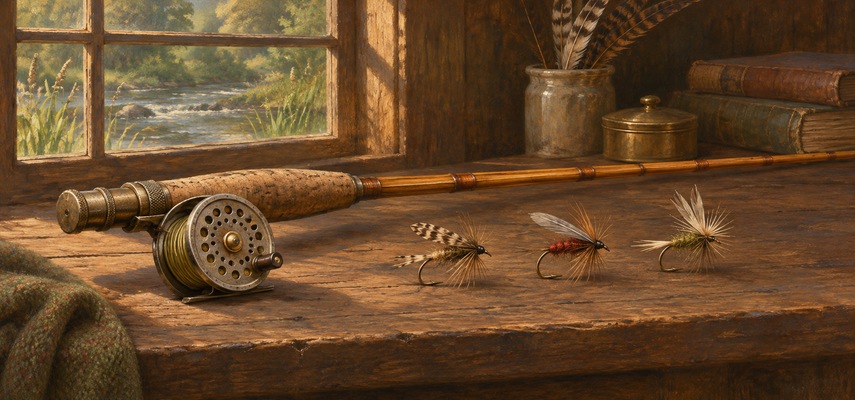

Red wool and two feathers. That’s the recipe at the heart of one of the oldest surviving descriptions of fly fishing. The writer Aelian says Macedonian anglers dressed a hook with those materials because they couldn’t readily use the insect the fish were eating. Those anglers faced a problem anyone standing beside a river can recognize. How do you offer a fish something it will take when the real thing is hard to put on a hook?
The history of fly fishing is full of practical answers to questions like that. A bundle of fibers became a lure. The lure became a recipe someone else could tie. A reel made spare line easier to manage. And a disagreement about what trout were eating turned into a disagreement about how an angler ought to fish. Seen through those choices, the history reads less like a parade of inventions and more like a long conversation about what happens on the other end of the line.
An ancient fly made of wool and feathers
In Book 15 of On the Nature of Animals, Aelian describes a river in Macedonia where speckled fish fed on a local insect. The natural insect, he says, spoiled when handled. Anglers wrapped red wool around a hook and fixed two feathers from a rooster to it. He also describes a rod and line of equal length. Those details make this an unusually vivid early account of fishing with an artificial fly.
Imagine the imitation on your palm. The wool gives the hook a little bulk, and the feathers put something soft and irregular around a piece of hard metal. Aelian gives us the materials and his explanation for why anglers used them. The text leaves open which feature mattered most to the fish, precisely how the fly moved, and how often it succeeded. There’s no surviving rod or fly in the account for a museum to measure.
Aelian was recording a practice already in use. The date of an account tells us when a technique was documented, while the date of its invention could lie much earlier. It also takes a leap to draw a straight line between those Macedonian anglers and the writers who appear much later in the English record. A fish feeding on small moving prey gives people in very different places a reason to try making an imitation.
How print carried fly recipes beyond the river
In England, the fishing treatise usually called the Treatyse of Fysshynge wyth an Angle appeared in a 1496 edition of the Book of St. Albans. The work is traditionally attributed to Juliana Berners. The preserved treatise on tackle and fishing includes a dozen artificial flies associated with times of year, turning the knowledge of what to tie into something a reader could carry to another stream.
The calendar makes intuitive sense. If a certain kind of insect appears regularly around the same time, an imitation is worth having ready. But a printed date can’t tell you what is on the water this afternoon. A seasonal recipe gives you somewhere to start, and the river gets the last word. This tension between written advice and local observation has stayed with fly fishing ever since.
Izaak Walton’s The Compleat Angler first appeared in 1653. It mixes fishing instruction with conversations, meals, songs and the company of fellow anglers. Charles Cotton’s contribution, added in 1676, pays particular attention to fly fishing. In the combined text, the instruction takes the form of a conversation. Reading over the speakers’ shoulders, you can learn a little about what to do and quite a lot about what it meant to spend a day fishing in their company.
Walton gives his reader twelve patterns, from a dun-fly in March to a dark drake-fly in August. He jokes that this jury of flies could condemn every trout in the river. There’s a familiar pleasure in that concession. Anyone who has organized a fly box knows the comfort of having a plan, even when it’s the first thing the river will make you reconsider.
What a bamboo rod and a better reel changed
In the 19th century, gear makers had room to improve almost every part of the outfit. The American Museum of Fly Fishing’s account of an 1881 Leonard rod shows how many decisions could go into a single rod. A maker could shape strips of bamboo and glue them into a tapered blank, the body of the rod. The taper changes how the rod bends along its length, so the work of shaving and fitting those strips affects what the angler feels in hand.
The metal sleeve that joins two rod sections is called a ferrule. It lets the rod come apart for transport, at the cost of introducing a hard joint into a rod that needs to flex. The Leonard rod’s maker faced another problem at that joint. If moisture collected where bamboo met metal, it could damage the cane. The museum’s example shows a design aimed at that particular weakness. A detail you could overlook at first glance mattered every time the rod came home wet.
The reel evolved alongside the rod. An Orvis reel built to an 1874 patent in the same museum has a narrow spool and holes in its side plates, features a modern angler would recognize. The spool holds line that the angler can pay out or recover. The line itself has enough mass to carry a light fly through the air, which is why a fly rod, line and reel form a system even though each part solves a different problem.
Commercial distribution mattered, too. A study in the museum’s journal traces Orvis’s sale of tackle through mail-order catalogs by the 1880s. A fly that had once needed to be described in terms of its materials could now be bought by name. A shop or catalog gave that name a life beyond one stretch of river, giving anglers farther apart a shared reference, even if two people still tied the same pattern a little differently.
The argument over where trout eat
On the clear chalk streams of southern England, anglers could often watch individual fish feeding. That made a question unusually visible. Was a trout taking insects on the surface, or intercepting them just below it? A rise could look like an answer while still leaving the important detail unresolved. The disturbance tells you the fish came close to the surface, and the difference between a fly in the surface film and one just under it can be hard to see from the bank.
Frederic Halford set out an influential account of the upstream floating-fly method in his 1889 book Dry-Fly Fishing in Theory and Practice. The appeal is easy to picture. You see a rising fish, send a floating imitation above it, and watch the current carry it into view. If the fly is traveling at a very different speed from the insects around it, the line may be pulling it off course. Visibility lets the angler notice a mistake that might otherwise be invisible.
G. E. M. Skues made the case for fishing an imitation under the surface in Minor Tactics of the Chalk Stream. He acknowledged the strengths of the dry fly and argued that a submerged fly also deserved a place on chalk streams. Both approaches could ask the angler to present a small imitation carefully to a feeding fish. They differed in where that imitation needed to travel.
The debate also captured a tension that still makes the sport interesting. A self-imposed restriction can sharpen your attention, just as a willingness to change methods can teach you something the restriction would hide. Halford’s floating fly made the drift easier to watch. Skues’s submerged fly made it harder to ignore the possibility that a trout was feeding somewhere you couldn’t see clearly.
The sport reaches beyond the trout stream
American records complicate the familiar picture of fly fishing spreading from English trout rivers to American trout rivers. The American Museum of Fly Fishing examined a 1764 letter from Florida that mentions fishing with flies. The letter leaves the fish and the patterns unidentified. What it offers is early documentary evidence from a place far removed from the cold streams usually pictured in histories of the sport.
The museum’s saltwater exhibit follows American anglers from the surf to shallow coastal flats. Both places involve moving water and an artificial fly, but they set different problems. A trout can hold in current while its food comes past. On a shallow flat, the angler may see a fish moving and have to place a fly where the fish will be by the time it arrives. The core idea has traveled a long way from Aelian’s river, and it still depends on observing where the fish expects to find food.
The exhibit also records early experiments with fiberglass that helped open up new options for tackle makers. Saltwater puts a premium on gear that can handle bigger fish, wind and conditions that can be rough on equipment. Manufacturers and anglers kept adapting rods, reels and lines for those demands. The result was room for more kinds of fly fishing, alongside the trout traditions that had filled so many of the earlier books.
A sport comes to depend on the water it fishes
Organized conservation added another kind of question to the sport. Once you know how to reach a fish, what will keep fish and their habitat there for the next generation? Trout Unlimited traces its founding to Michigan’s Au Sable River in 1959, where anglers questioned the state’s reliance on stocking and formed an organization to advocate for wild trout. Fly Fishers International’s conservation policy likewise traces its conservation advocacy to the organization’s founding in 1965. Their histories show anglers working together on problems that a better cast or a more convincing fly couldn’t solve.
The next time you see a fly in a shop, look at what the tier chose to put on the hook. You might see a few turns of thread and a feather, or more material arranged to suggest a larger meal. The recipe may have traveled from one river to another through a book, a catalog, or a person showing someone else how to tie it. The choice to use that fly still comes down to looking at the water in front of you. Aelian’s anglers would probably recognize that part right away.
Related reading The Ultimate Guide to Fishing Knots, Hooks, Baits, and Lures












