










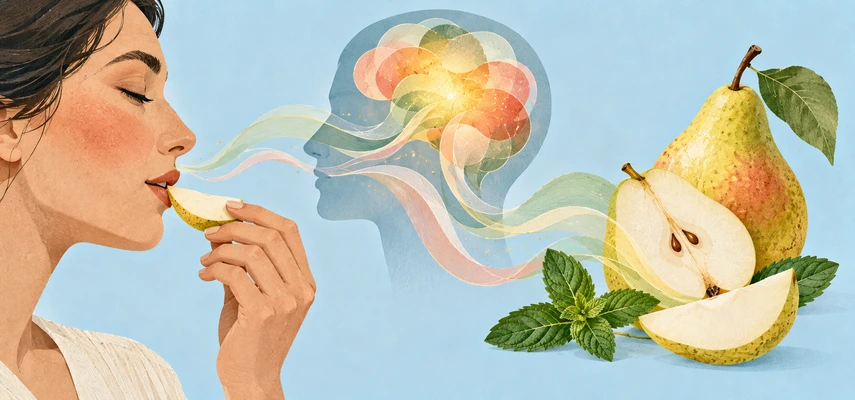

Bite into a pear and try to identify the exact moment it becomes a pear. There’s sweetness, certainly, but sugar water is sweet too. There’s juice, a yielding texture, perhaps a slight graininess. Above all, there’s that unmistakable pear aroma. The science of taste begins with a small surprise: much of what we casually call taste is a team effort.
Your tongue supplies part of the information. Your nose, mouth, eyes, ears, and brain help make it into an experience. Understanding that collaboration explains why the same food can seem different when you’re congested, distracted, or expecting something else. It also gives cooks a better question than simply asking whether a dish needs more seasoning.
Taste is one part of the flavor system
In everyday conversation, taste can mean almost anything we experience while eating. In sensory science, it has a narrower meaning: the sensations produced when substances stimulate taste receptor cells. Sweet, sour, salty, bitter, and umami are the familiar basic qualities. Umami means the savory quality associated with substances such as glutamate.
According to the NIDCD explanation of taste these signals travel through nerves to the brain. Taste cells aren’t arranged in the neat tongue map sometimes printed in schoolbooks. Different types occur across the tongue rather than occupying exclusive sweet, bitter, or salty territories.
Flavor is the combined experience. Aroma, temperature, texture, and chemical sensations such as chili’s burn contribute alongside taste. These are related signals, but they aren’t interchangeable. A hotter chili hasn’t become more sour, and a crisp apple hasn’t acquired an extra basic taste.
That distinction is useful at the stove. When someone says a soup tastes dull, they might mean weak aroma, little contrast, an unappealing consistency, or insufficient seasoning. The complaint describes a whole experience. The remedy depends on which part of it is missing.
The nose has two ways into a meal
Smelling coffee before drinking it is orthonasal smell: airborne molecules enter through the nostrils. Eating provides another route. Aromatic molecules released in the mouth can travel toward the nose from behind. This is retronasal smell, and it helps a food’s identity seem to belong inside your mouth.
The NIDCD account of smell describes specialized olfactory sensory neurons high in the nose. They detect odor molecules and send information onward to the brain. A blocked nasal passage can interfere with the aromas that ordinarily enrich a bite, even when sweetness or saltiness remains detectable.
A primary study of retronasal airflow investigated how airway structure influences the movement of food volatiles, the molecules that can enter the air. Its model helps explain how breathing out can carry aromatic information from the mouth toward the nasal cavity. It doesn’t establish one universal percentage of flavor attributable to smell.
That percentage is a tempting shortcut, but the contribution varies with the food and the question being asked. Distinguishing a pear from an apple isn’t the same task as comparing two salt solutions. A single number can’t sensibly describe both.
Your brain makes a coherent bite
Sensory information arrives through different routes, but dinner doesn’t usually feel like a stack of separate laboratory readings. The smell, sweetness, and texture of a pear seem to belong to one object. Multisensory integration is the name for combining information from different senses into a coherent perception.
Imagine a restaurant serving a smooth green soup. Before tasting, its appearance suggests a range of possibilities. Its aroma narrows them. The first spoonful supplies taste, temperature, and texture. Recognition emerges from that combination rather than from a green detector on the tongue.
This is why an ingredient list doesn’t fully describe an eating experience. The diner also encounters the food’s form, serving conditions, and context. Two bowls can contain the same ingredients yet arrive as noticeably different meals.
However, integration doesn’t make the food imaginary. Molecules and physical structures still matter. The point is that perception involves interpreting those inputs. The brain is doing its ordinary job, usually quite effectively, with the information available.
What you see can steer what you smell
In the 2001 study The Color of Odors researchers examined how wine color affected odor descriptions. A panel of 54 tasters described a white wine colored red with odorless dye using language associated with red wine. Appearance had influenced how they identified and described its smell.
This result is often retold as proof that nobody can taste wine. It supports a more specific conclusion: visual information can shape odor interpretation in the conditions tested. It doesn’t erase differences between wines, make training pointless, or show that all tasters respond identically.
For a home comparison, the lesson is simple. If the question concerns the food itself, revealing the brand or announcing the supposedly superior sample adds information. That information may affect the judgment. Covering labels is a useful way to remove one possible influence.
At the same time, everyday eating doesn’t require blindness. Attractive presentation is part of a meal. The right setup depends on whether the goal is to isolate a difference or enjoy the whole occasion.
Even the crunch carries information
A potato chip makes a sound as its structure breaks. That sound becomes part of the encounter with its texture. In a controlled chip experiment Massimiliano Zampini and Charles Spence altered the auditory feedback participants heard while biting. Louder sound, or amplified high frequencies, made the chips seem crisper and fresher.
The experiment manipulated what people heard rather than changing the chip recipe. That makes it a particularly clear example of one sensory channel influencing a judgment associated with another. It doesn’t mean that louder food is necessarily better food, or that sound reveals microbiological safety.
By contrast, a normal kitchen comparison changes several things together. A freshly toasted slice differs from a soft slice in sound, resistance, moisture, and aroma. Hearing a crackle is part of that difference, but it can’t explain every part by itself.
The useful insight is attention. When evaluating a crisp crust or a crunchy vegetable, listen as well as chew. A description becomes more precise when it separates the audible crack from the resistance felt between the teeth.
Temperature and mixtures change the signal
Temperature contributes a sensation of its own, but it also interacts with taste. In the 2000 study Thermal stimulation of taste warming or cooling small tongue regions could evoke taste sensations in some people. The finding demonstrates a connection between temperature and taste pathways; it isn’t a rule that warming every dish makes it sweeter.
For comparison purposes, serving conditions therefore deserve attention. If two drinks are at different temperatures, the comparison has changed more than the recipe. Keeping them similar is a practical way to make the question clearer without pretending to reproduce a laboratory.
Ingredients also interact in mixtures. Breslin and Beauchamp’s 1997 paper Salt enhances flavour by suppressing bitterness identifies a reason salt can do more than add a salty sensation. Suppressing one quality can alter the balance of the whole mixture.
This doesn’t give a universal formula for improving food. A heavily salted dish may still be heavily salted. It does explain why a cook should taste after each adjustment instead of imagining that every sensation changes independently. The mixture is what reaches the diner.
People bring different sensory equipment and histories
Two diners can honestly disagree about the same mouthful. Research linking TAS2R38 receptor variants with bitter perception demonstrated a molecular basis for differences in responses to the compounds PTC and PROP. These laboratory substances help researchers study bitter sensitivity. They don’t provide a complete genetic explanation for anyone’s entire diet.
The distinction matters because detecting a sensation and enjoying it are different questions. Someone can recognize a pronounced bitterness and like it. Another person can experience a milder sensation and still dislike the food. Preference isn’t a competition for the most sensitive tongue.
Experience matters too. A study introducing daikon to young children found that liking and intake increased with repeated exposure across the tested schedules, including the limited exposure received by the control group. No single schedule emerged as the best choice, and the result didn’t establish that every vegetable would become more appealing.
Similarly, a root-vegetable exposure study found increased intake among young children after repeated encounters, without an added advantage from pairing the vegetable with a familiar flavor. These findings show that responses can change through experience. They don’t justify pressuring a particular diner or dismissing a sensory difficulty as stubbornness.
Make your next tasting a better question
Choose a familiar food and describe the experience before judging it. With a pear, separate sweetness from aroma, firmness from graininess, and the first impression from what lingers. Plain words are enough. The aim is to notice distinctions that a single word such as delicious hides.
Then choose one comparison. Serve similar portions of the same food under two conditions, keeping the rest as consistent as practical. If exploring appearance, hide the labels. If comparing serving temperatures, leave the recipe unchanged. Taste each sample more than once, allowing for the possibility that the order influenced the impression.
Write down both the observation and its limit. One sample may seem more aromatic today; that doesn’t prove it contains more of every aroma molecule. A small household comparison reveals something about this encounter, not a law for every eater.
The reward is a better vocabulary for pleasure and problem solving. Instead of saying that something simply tastes different, there’s a chance to identify what changed. A bite becomes recognizable because several senses arrive at an agreement. The interesting part is learning to hear their individual contributions.










