










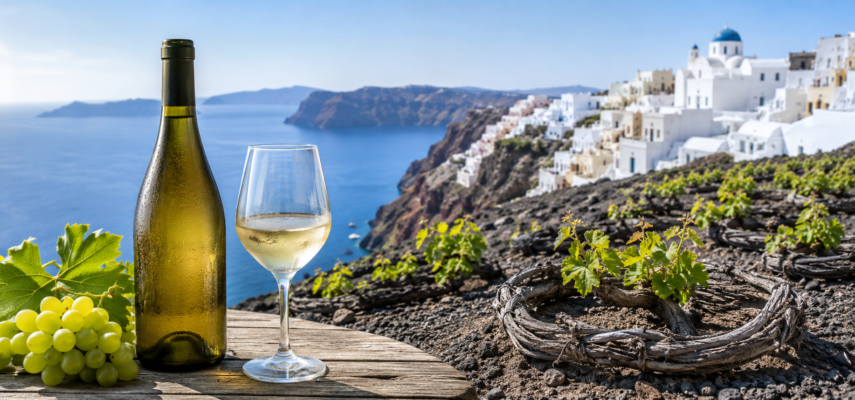
Greek wine is one of the oldest wine traditions in the world, but for many modern drinkers, it still feels like a discovery. France, Italy, Spain, and California dominate most wine conversations. Greece often arrives later, almost like a secret passed from one curious wine drinker to another.
But Greek wine deserves far more attention.
It is ancient, distinctive, food-friendly, and increasingly respected by sommeliers around the world. And if there is one grape that has become the modern ambassador for Greek wine, it is Assyrtiko.
Assyrtiko is a white grape most famously associated with the island of Santorini, where it produces some of the most distinctive white wines on earth. These wines are sharp, mineral, salty, citrus-driven, and powerful without being heavy. They taste like they could only come from one place.
That place is a windswept volcanic island in the Aegean Sea.
Greek Wine Is Older Than Most People Realize
Wine has been part of Greek culture for thousands of years. Long before modern wine labels, critic scores, and restaurant pairing menus, wine was woven into Greek mythology, trade, medicine, religion, and daily life.
The ancient Greeks helped spread viticulture across the Mediterranean. Wine was not simply an alcoholic beverage. It was a cultural object, a symbol of civilization, and a major part of social life.
That long history can actually make Greek wine feel intimidating today. Many Greek grape names are unfamiliar to English-speaking drinkers. Assyrtiko, Xinomavro, Agiorgitiko, Moschofilero, Aidani, and Athiri do not roll off the tongue the way Chardonnay, Merlot, or Pinot Noir do.
But the unfamiliar names are also the point. Greek wine is not trying to be a copy of French or Italian wine. Its greatest strength is that it offers something different.
What Is Assyrtiko?
Assyrtiko is a white wine grape indigenous to Santorini. It is now grown in other parts of Greece and even in some international regions, but Santorini remains its spiritual home.
The grape is prized because it can ripen in hot, sunny conditions while still keeping high acidity. That is unusual. Many white grapes lose freshness as they get riper. Assyrtiko can produce wines with ripe fruit, substantial body, and electric acidity at the same time.
That combination is what makes it so compelling.
A classic Santorini Assyrtiko often shows flavors and aromas of lemon, lime, grapefruit, green apple, sea salt, crushed stone, smoke, herbs, and sometimes a slightly waxy or savory note. It is not usually a soft, fruity white wine. It is more angular, more intense, and more mineral.
For beginners, the easiest comparison is this: Assyrtiko can have the acidity of Sauvignon Blanc, the mineral edge of Chablis, and the body of a richer Mediterranean white. But even that does not fully capture it.
Good Assyrtiko tastes like Assyrtiko.
Why Santorini Matters
Santorini is not just a pretty island with blue domes, white buildings, and sunset views. It is one of the most unusual wine regions in the world.
The island was shaped by volcanic activity, including a major Bronze Age eruption that helped form the caldera landscape Santorini is famous for today. Its vineyards grow in volcanic soils made of ash, pumice, basalt, and other mineral-rich materials. The climate is dry, windy, sunny, and harsh.
In many wine regions, vines are carefully lined up on trellises. In Santorini, many vines are trained in a traditional low basket shape called kouloura. The vine is woven close to the ground, creating a kind of natural basket that protects the grapes from fierce winds and intense sun.
This is not romantic decoration. It is survival farming.
Santorini is dry, windy, and exposed. The basket shape helps shield grapes, conserve moisture, and allow vines to live in a place where conventional vineyard systems would struggle.
The Power of Volcanic Soil
Wine people often use the word “minerality,” and Santorini Assyrtiko is one of the wines most commonly associated with it.
Minerality does not mean the wine literally tastes like drinking rocks. It usually describes a sensation: salty, stony, chalky, smoky, flinty, or almost metallic. In Assyrtiko, that mineral impression is often combined with citrus and saline freshness.
Santorini’s volcanic soils are central to the identity of the wine. They are poor in organic matter, free-draining, and difficult to farm. Those conditions naturally limit yields. Lower yields can mean fewer grapes per vine, which often leads to more concentrated wines.
This is one reason Santorini Assyrtiko can be more expensive than many people expect from Greek wine. The island is small. Farming is difficult. Yields are limited. Demand has grown. The wines are not mass-market commodities.
They are products of scarcity.
Old Vines and Phylloxera
One of Santorini’s most remarkable vineyard facts is that many vines are ungrafted and extremely old. Much of Europe’s vineyard land was devastated in the 19th century by phylloxera, a vine pest that attacks roots. As a result, most European vines today are grafted onto resistant American rootstock.
Santorini is widely described as having avoided the same level of phylloxera destruction, partly because its volcanic sandy soils are inhospitable to the pest. Many vines remain own-rooted and some are very old.
Old vines do not automatically make better wine, but they can contribute to concentration, resilience, and complexity. In Santorini, they also add to the island’s mystique. When you drink serious Assyrtiko from Santorini, you may be tasting fruit from vines older than many buildings in modern cities.
What Does Santorini Assyrtiko Taste Like?
Santorini Assyrtiko is usually dry, crisp, and intense.
Common tasting notes include:
Lemon peel, lime, grapefruit, green apple, pear skin, sea spray, crushed rock, smoke, herbs, white flowers, and sometimes beeswax or lanolin with age.
The key structural feature is acidity. Assyrtiko has the kind of acidity that makes your mouth water immediately. But unlike some light white wines, it can also have real texture and weight.
That is what makes the wine so versatile. It can be refreshing like a crisp white, but serious enough to pair with richer foods.
A young, unoaked Assyrtiko is often bright, salty, and citrusy. A more ambitious version aged on lees or in barrel can be broader, creamier, and more complex. With bottle age, some Assyrtiko can develop notes of honey, nuts, wax, dried citrus, and smoke.
Santorini PDO: What the Label Means
Santorini has a protected wine designation. For dry white wines under the PDO Santorini designation, the wine must be made from at least 85% Assyrtiko, with Athiri and Aidani allowed as supporting grapes.
That is useful to know when reading labels. A bottle labeled Santorini PDO will usually be Assyrtiko-dominant, even if it is not always 100% Assyrtiko.
You may also see related styles such as Nykteri, a traditionally richer Santorini white, and Vinsanto, the island’s famous sweet wine made from sun-dried grapes. Santorini’s Vinsanto is not the same thing as Italian Vin Santo, although the names look similar.
Why Assyrtiko Is a Great Food Wine
Assyrtiko is one of the best white wines for food because it has three things chefs and sommeliers love: acidity, salinity, and structure.
It is especially good with seafood. Grilled fish, oysters, shrimp, scallops, lobster, crab, octopus, and sardines all work beautifully. The wine’s acidity cuts through richness, while its saline edge echoes the flavor of the sea.
It also pairs well with Mediterranean foods: Greek salad, feta, olives, lemon potatoes, grilled vegetables, tzatziki, chicken souvlaki, and herb-heavy dishes.
One of the best pairings is Assyrtiko with fried seafood or salty appetizers. The wine acts like a squeeze of lemon and a dash of sea salt at the same time.
It can also handle foods that are tricky for softer white wines. Tomatoes, vinegar, capers, citrus, garlic, and briny ingredients can overwhelm low-acid wines. Assyrtiko stands up to them.
Assyrtiko Compared With Better-Known Wines
If you are trying to understand Assyrtiko through more familiar wines, here are a few helpful reference points.
If you like Sauvignon Blanc, Assyrtiko may appeal because of its acidity and citrus profile. But Assyrtiko is usually less grassy and more mineral.
If you like Chablis, especially lean, unoaked Chardonnay from northern Burgundy, Assyrtiko may appeal because of its stony, salty, high-acid character.
If you like Albariño, Assyrtiko may appeal because both wines often pair beautifully with seafood and show a coastal freshness.
If you like dry Riesling, Assyrtiko may appeal because both grapes can combine acidity, intensity, and age-worthiness.
But Assyrtiko is not simply Greece’s version of one of those wines. It belongs in that conversation because it has the same seriousness, not because it is an imitation.
Why Greek Wine Is Having a Moment
For many years, Greek wine struggled internationally because of unfamiliar grape names, inconsistent export presence, and outdated assumptions. Some consumers associated Greek wine only with inexpensive taverna wine or retsina.
That has changed.
Modern Greek producers have invested in quality, cleaner winemaking, better vineyard management, and stronger export markets. At the same time, wine drinkers have become more adventurous. Sommeliers are constantly looking for wines with identity, acidity, food compatibility, and a strong sense of place.
Greek wine checks all of those boxes.
Assyrtiko has benefited from this shift more than any other Greek grape. It is distinctive enough to interest wine professionals, but approachable enough for curious beginners. It is exotic without being weird. It is serious without being pretentious.
The Challenge Facing Santorini
Santorini’s wine success has also created challenges.
The island is small, land is expensive, tourism is intense, and vineyard work is difficult. Climate pressure is becoming more serious as heat and drought affect grape yields. Recent reporting has highlighted how Santorini producers are exploring adaptation strategies as prolonged drought and extreme heat threaten production.
This matters because Santorini wine is not easily scalable. You cannot simply make more authentic Santorini Assyrtiko somewhere else. The identity of the wine comes from the island: its soils, winds, old vines, farming traditions, and climate.
That scarcity is part of the wine’s appeal, but also part of its vulnerability.
How to Buy Assyrtiko
For beginners, start with a dry white wine labeled Santorini or Assyrtiko.
If the bottle says Santorini PDO, expect a more classic island expression: high acid, mineral, salty, citrus-driven, and often more expensive.
If the bottle simply says Assyrtiko from mainland Greece, it may still be excellent, but the style may be fruitier, softer, or less intensely mineral than Santorini.
For a first bottle, look for producers such as Estate Argyros, Domaine Sigalas, Gaia, Santo Wines, Hatzidakis, Vassaltis, Karamolegos, or Gavalas. Availability will depend on your market, but these are commonly respected names associated with Santorini or Greek wine.
Serve Assyrtiko chilled, but not ice cold. Too much chill can hide its texture and complexity. A good target is cold enough to refresh, but warm enough to smell the citrus, salt, and stone.
The Big Lesson
Santorini Assyrtiko is one of the clearest examples of why wine is more than just grape juice with alcohol.
It is geography in a glass.
The grape matters. The island matters. The soil matters. The wind matters. The farming tradition matters. The history matters.
A glass of Assyrtiko can taste sharp, salty, smoky, and sunlit all at once. It can feel ancient and modern at the same time. It is easy to enjoy with seafood on a summer night, but complex enough to study seriously.
For beginners, it is a reminder that wine does not have to be limited to the familiar names. Chardonnay, Sauvignon Blanc, and Pinot Grigio have their place. But sometimes the most exciting bottle is the one with the grape name you do not yet know how to pronounce.
Assyrtiko is one of those bottles.
And once you understand it, Greek wine starts to look a lot less like a niche category and a lot more like one of the wine world’s great unfinished conversations.












