










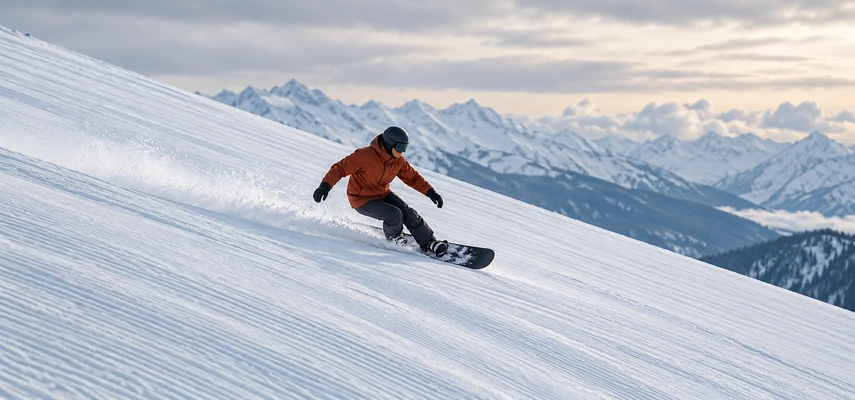

The board hasn’t changed. Your boots are the same. Yet a few extra degrees of slope can make familiar movements feel as though someone has rearranged the controls.
Steeper terrain changes how quickly speed can build, how much room you have to complete a turn and how readily a small hesitation becomes a larger correction. It also changes your perception: a manageable movement may suddenly feel like an unreasonable request.
The answer isn’t to switch off that concern and point downhill. Progress with a qualified instructor on suitable open resort terrain, after your linked turns and stops are dependable on easier slopes. A written guide can explain the task; it can’t establish that a particular pitch is appropriate for you.
Understand what the pitch changes
Gravity acts downward. On a slope, part of that pull acts along the snow surface, tending to accelerate you downhill. As the pitch increases, that downhill component increases.
That doesn’t mean the board must run away. Your route and interaction with the snow still affect speed. It does mean that a delayed turn or a very direct downhill path can produce a more noticeable result than it did on the gentle practice run.
The time available for a comfortable decision may feel shorter. Movements that worked because you had generous space to reorganize now need to become more purposeful. That is a reason to reduce the task with instruction, not to make every movement larger.
The snow matters too. A steeper supportive groomer and a similarly pitched sheet of hard scraped snow are different problems. Terrain assessment must include the surface, width, visibility, traffic and stopping opportunities as well as the apparent angle.
Choose a progression, not a test
Ask an instructor to identify a modest increase in pitch with a manageable approach and runout. The whole route should suit the task. An easy beginning doesn’t compensate for a narrow difficult exit you can’t yet control.
Don’t use trail color as the sole measure. The NSAA trail-signage guidance explains that ratings are relative to each resort. Conditions can also change the practical difficulty of a familiar trail.
Begin when you’re attentive and physically comfortable, with suitable visibility. A final run on tired legs is a poor time to introduce a demanding pitch simply because the lift happens to serve it.
Tell the instructor what you can do consistently and what still requires a recovery. An accurate starting point makes a sensible progression possible. Calling every successful arrival at the bottom a controlled descent hides information you need.
Keep access to the front of the board
Moving toward the tail can feel like withdrawing from the downhill direction. Unfortunately, it may also make it harder to guide the front of the board into the turn you need.
Maintain a functional relationship to the board with help from the instructor. This isn’t a command to lean your chest downhill or force constant pressure onto the front foot. Pressure distribution changes through the turn, and the right movement depends on what you’re trying to accomplish.
The AASI performance guide treats control of pressure along the board as one of several interacting fundamentals. On a steeper pitch, losing access to that adjustment can become especially noticeable.
If you finish each turn braced against the rear binding, tell the instructor when the shift begins. The useful correction may need to happen before the moment when you feel stuck at the tail.
Organize the turn before speed demands it
A familiar problem is waiting on one edge until the route feels too far across the hill, then rushing the board toward the next turn. On steeper terrain, that rushed movement can lead into a faster downhill section before you’ve organized the next edge.
Work on a purposeful release and a controlled redirection appropriate to the actual path. Avoid thinking of the transition as a moment when all control must disappear. The instructor can choose tasks that help you manage the change without throwing the shoulders or stamping a new edge into the snow.
Controlled slipping is useful. You don’t need to carve to ride a steeper resort run competently. A brushed, rounded turn can provide speed adjustment and route control that a forced clean arc would not.
Nor do you need to adopt an advanced jump-turn pattern simply because the slope looks more serious. Unfamiliar airborne movements introduce another task. Learn the appropriate progression in person rather than borrowing the most dramatic technique from a video.
Use turn shape to keep the pace manageable
Think about the route over several turns. If each new turn starts faster than the last, something in the pattern isn’t controlling speed for that pitch and surface.
A more rounded route may spend more time traveling across the slope, while controlled skidding can dissipate energy through sideways interaction with the snow. The amount of each must fit the available space and your skills.
The PSIA-NW snowboard guide connects speed management with turn shape. That doesn’t prescribe huge traverses or one fixed turn size. It means judging whether the path actually gives you a manageable descent.
If you need a large emergency stop after every few turns, simplify with the instructor. Don’t treat the recovery as proof that the earlier pattern was working. The goal is to retain time and options throughout the section.
Stay mobile as pressure changes
A steeper pitch can encourage a rigid defensive posture. But the board still needs movements from ankles, knees and hips, and the snow still presents small variations.
Keep a useful range of flexion rather than locking the legs or staying in your deepest crouch. Let the instructor assess whether you’re supporting the edge, folding at the waist or making a sudden movement that interrupts contact with the snow.
There’s no universal body angle that matches every slope. Equipment, turn style and conditions alter the relationship between the rider and the board. Copying an expert’s dramatic lean without the speed, support and timing behind it doesn’t recreate the turn.
One helpful observation is whether your hands become increasingly busy as the run continues. Large arm movements may be a response to a balance problem elsewhere. Describe when they start rather than trying only to pin the arms in place.
Look beyond the next patch of snow
When a pitch feels intimidating, it’s easy to stare at the surface immediately in front of the board. That narrows your planning time just when you need more of it.
Look through the usable route, noticing the next turn space, changes in snow and suitable places to stop. Keep awareness of people around you. A route that looked clear from above may need to change as traffic moves.
The NSAA Responsibility Code requires control and avoidance of people ahead or downhill. It also requires uphill checks before starting and stopping where visible without restricting traffic. On a steeper trail, the consequences of choosing a blind stopping place can be especially serious.
If you need to pause, choose the place deliberately with the instructor. The middle of the next rollover isn’t a useful meeting point simply because it’s where the group happened to stop.
Don’t confuse exposure with steepness
An open resort pitch with a clear runout differs from terrain above rocks, trees or other consequences. A narrow corridor can leave fewer options even when its angle is similar to a wider trail you’ve ridden.
This guide doesn’t cover closed terrain, uncontrolled backcountry or exposed technical descents. Being able to ride a steeper groomer doesn’t establish readiness for those settings. Terrain immediately outside a resort boundary may lack the hazard management you’re relying on inside it.
Likewise, moguls, deep snow and hard ice add demands beyond pitch. Progress to each with suitable instruction and current conditions in mind. Avoid turning one successful steep run into a general permission slip.
Respond early when control isn’t there
If you’re having difficulty organizing the next turn, communicate before the task becomes a repeated emergency. Stop where appropriate if you can do so in control and discuss a smaller movement task or a different route.
If you’re already on terrain you can’t manage, seek assistance from resort staff or ski patrol. The next safe action depends on the location. Don’t unstrap and improvise a walk down a steep shared trail without guidance.
PSIA-AASI’s lesson guidance emphasizes personalized feedback and help reading the mountain. Those aren’t optional extras on a progression like this. They help distinguish a useful challenge from a situation that simply exceeds your present options.
Let confidence follow control
After the attempt, assess more than whether you fell. Could you choose the route, regulate speed and stop deliberately? Could you notice traffic while maintaining the turn pattern? What changed when the snow or pitch changed?
Repeating an appropriate section may consolidate the skill. Returning to easier terrain may provide a better place to correct a movement. Both can be productive choices.
A steeper slope doesn’t require a different personality. It requires suitable skills, a thoughtful route and the willingness to adjust when the task changes. Confidence becomes more dependable when it grows from that control, rather than being asked to substitute for it.












