










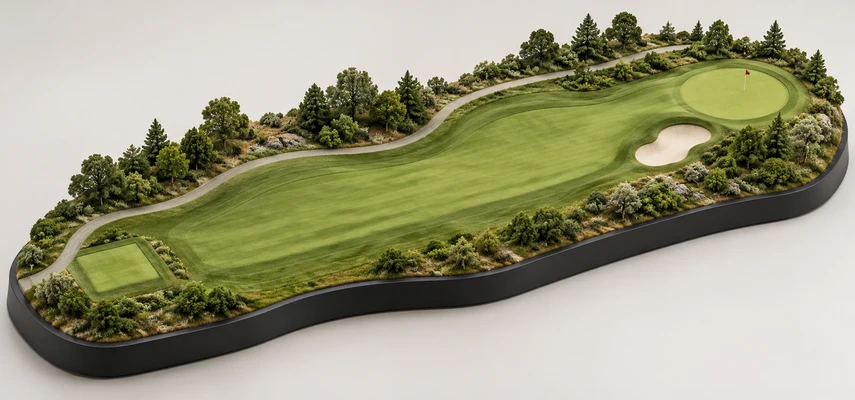

Your first golf ball has finally landed on the fairway. Excellent. Now comes a question the driving range never asked: what happens next?
You don’t carry it to a nicer patch of grass, and you don’t tee it up again. Usually, you walk to the ball and play from where it stopped. That simple connection between one shot and the next explains much of golf. You inherit the consequences of your previous decision, then get another chance to make a better one.
The rules give that journey a common structure. You don’t need to memorize the entire book before playing, but a few essential distinctions will help you understand what you’re doing, keep an honest score and recognize when to ask for help.
Decide what kind of game you’re playing
A round consists of 18 or fewer holes played in the required order. Each hole begins at a teeing area and normally finishes when your ball goes into the cup. Rule 1 introduces those foundations, along with the expectation that golfers act honestly and consider other people.
Before starting, establish the format. In regular stroke play, your score is the total of your strokes and any penalty strokes. Lowest total wins. In match play, you compete against an opponent hole by hole: taking fewer strokes wins that hole, and the match depends on holes won rather than the total number of strokes across the round.
That distinction changes more than strategy. Rule 3 explains how competitions work, including the requirement to hole out in regular stroke play. An opponent can concede your next stroke in match play. A friendly companion saying “that’s good” doesn’t turn an unfinished stroke-play hole into a properly completed one.
Start inside the teeing area
The teeing area is a rectangle defined by two tee-markers. Its front edge runs between their forwardmost points, and it extends two club-lengths backward. A club-length is measured using the longest club you carry for the round, excluding your putter. You may stand outside that rectangle provided the ball is in it.
For the opening stroke, you can put your ball on a conforming tee or play it from the ground. Using a driver isn’t compulsory. The useful choice is whichever club gives you a manageable shot from the designated starting place.
Don’t confuse the large, mown teeing platform with the smaller area the markers define. Rule 6 covers starting and playing a hole. If you aren’t sure which markers your group is using, settle that before hitting. It’s easier than explaining afterward why you have started from a different postcode.
Find your ball and assess where it lies
After everyone has safely played, move toward the balls. Pay attention to landmarks where yours finished: a particular tree, bunker edge or change in grass color. An identifying mark on your ball helps distinguish it from another golfer’s otherwise identical white sphere.
The course has five defined areas. Most fairway and rough belong to the general area. The other four are the teeing area of the hole you’re playing, its putting green, bunkers and penalty areas. Rule 2 explains why those locations matter: the same action can be permitted in one area and restricted in another.
First identify the ball, then its area, then your options. That sequence prevents a common beginner mistake: applying a rule heard somewhere else to a situation that merely looks similar. Sand in a bunker and sand on a path, for example, don’t automatically have the same rules status.
Usually, play the ball where it stopped
The default is to play the ball as it lies. A clump of grass behind it doesn’t create permission to move it onto a convenient tuft. Golf includes imperfect lies because negotiating them is part of the challenge.
There are important exceptions. An immovable obstruction such as a cart path can qualify you for free relief when it interferes with your lie, stance or intended swing, subject to the rule’s conditions. A tree blocking your view doesn’t generally do so. Rule 16 sets out relief from abnormal course conditions.
“Free” describes the absence of a penalty stroke, not freedom to choose the nicest nearby grass. The correct reference point and relief area still matter. Sometimes the nearest point of complete relief is inconvenient. When unsure, leave the ball where it is while you consult the rule or ask an appropriate official.
Recognize the difference between two kinds of trouble
A ball in a marked penalty area and a ball out of bounds can both spoil a promising shot. Their procedures are different.
Penalty areas
Penalty areas are marked red or yellow and often include water. You may play the ball as it lies without a penalty if you can safely and legally do so. Alternatively, Rule 17 provides penalty-relief options, usually involving one added stroke.
Both colors permit stroke-and-distance and back-on-the-line relief. Red areas offer an additional lateral option, using where the ball last crossed the edge as the reference point. Don’t simply drop beside wherever you think the ball splashed down. The crossing point, relief method and defined area govern the procedure.
Lost or out of bounds
Outside a penalty area, a lost ball or one out of bounds normally requires stroke-and-distance relief: add one penalty stroke and play again from where the previous stroke was made. After an opening tee shot goes out of bounds, the replay from the tee is your third stroke.
The search limit is three minutes from when you or your caddie begins searching. A provisional ball can save a return journey when the original might be lost outside a penalty area or out of bounds; you must announce that it’s provisional before playing it. Rule 18 explains those conditions.
Some courses adopt an alternative Local Rule for certain lost or out-of-bounds situations. Don’t assume it applies, and don’t substitute an informal one-stroke fairway drop for the normal rule.
Drop correctly when a rule requires it
A drop is a procedure, not a vague gesture toward some grass. The player drops from knee height, with the ball falling straight down without touching the player or equipment before hitting the ground. It must be dropped in the right way and come to rest in the specified relief area.
Different relief options produce different areas; there isn’t one universal “two club-lengths anywhere” rule. Rule 14 explains dropping, placing and replacing. If a properly dropped ball rolls out of its relief area, that rule tells you what to do next.
For now, remember the useful question: “Which rule gives me relief, and where exactly does it allow the ball to go?” Asking it before lifting the ball can prevent a surprisingly elaborate rescue operation.
Finish on the putting green
The putting green offers permissions you don’t have everywhere else. You may mark your ball’s spot, lift it and clean it, then replace it on its original spot. Put a ball-marker immediately behind or right next to the ball before lifting; replacing doesn’t mean dropping it from knee height.
You can leave the flagstick in the hole or have it removed before your putt. There’s no penalty simply because a ball played from the green hits a flagstick left in the hole. Rule 13 covers those putting-green provisions, including repair of permitted damage.
In regular stroke play, finish by holing out. Count the short putt as carefully as the long drive. A two-inch stroke and a two-hundred-yard stroke each add one to the score; the ball offers no bulk discount for distance.
Keep the round moving without guessing at rules
You can prepare for your next shot while others are playing, provided you’re safely out of their way and aren’t distracting them. Choose a club, estimate distance and consider your target before it’s your turn.
In stroke play, safe, responsible ready golf is encouraged: a player who is ready may play rather than wait mechanically for the farthest player. Match play has different order-of-play consequences, so don’t assume the same arrangement without understanding it. Rule 5 covers pace and the conduct of a round.
On a casual learning outing, your group may agree on a maximum number of attempts or decide to pick up when a hole becomes unmanageable. That’s a way to structure practice, not permission to write down a made-up completed score in regular stroke play. Handicap score posting has additional procedures; ask before assuming a practice score qualifies.
Record what happened, then move on
Once clear of the green, record the hole’s score, including penalties. Counting in small stages helps: tee shot, approach, recovery, two putts, plus any penalty. Keep the arithmetic tied to actual events rather than how good the hole felt.
Before the next tee, check that you have your clubs and that the group ahead is safely beyond your possible reach. Read Local Rules and any instructions from the starter, especially temporary restrictions or no-play zones.
You won’t encounter every situation on your first round. You don’t need to solve each one from memory, either. Know the default, recognize when an exception might apply, and consult the right source before changing the ball’s position. With that framework, the course becomes a sequence of understandable decisions instead of eighteen small legal emergencies.












