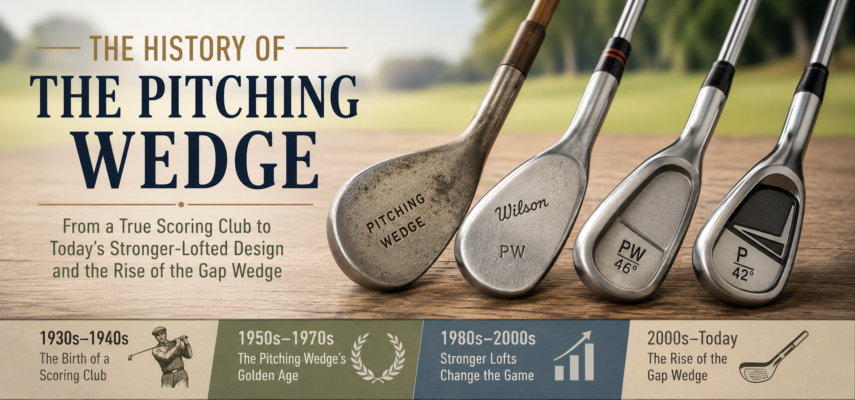
The pitching wedge occupies an unusual place in the golf bag.
It is classified as a wedge, shaped increasingly like an iron and frequently sold as the final club in a modern iron set. Golfers use it for full approaches, abbreviated swings, low-running chips and occasional recovery shots. For generations, it was also the primary club for producing the controlled, lofted pitch shot from which it took its name.
Yet the modern pitching wedge is not quite the same club it once was.
As manufacturers strengthened iron lofts in pursuit of greater distance, the pitching wedge gradually changed from a specialized short-game instrument into something closer to a numbered scoring iron. Traditional pitching wedges commonly carried approximately 50 to 52 degrees of loft. Some modern versions have less than 42 degrees.
The letters stamped on the sole have remained the same. The club behind those letters has changed dramatically.
Before the Pitching Wedge
Early golfers did not organize their clubs around standardized numbers and lofts. Instead, they carried individually named clubs designed for particular situations.
Among the traditional iron clubs was the niblick, a short, heavy, highly lofted club used for difficult lies, bunker shots and approaches around the green. The niblick is often described as an ancestor of the modern wedge, although it did not correspond perfectly to any single club used today.
Golfers also employed clubs such as the mashie, mashie-niblick and jigger. Their exact shapes and lofts varied from one clubmaker to another. A golfer’s set was less a mathematically organized progression than a collection of tools assembled according to personal preference.
That began to change during the early decades of the 20th century.
Steel shafts were legalized by the USGA in 1924 and by the R&A in 1929. Steel made clubs more durable and consistent than traditional hickory-shafted designs and helped manufacturers produce matched sets on a larger scale. By the 1930s, companies including Wilson and Spalding were mass-producing steel-shafted clubs, accelerating golf’s transition toward standardized equipment.
As matched iron sets became more common, the old descriptive club names gradually gave way to the numbered system. The mashie became roughly equivalent to a mid-iron. The mashie-niblick evolved into something resembling a short iron. The niblick’s responsibilities were divided among the 9-iron and the emerging family of wedges.
The pitching wedge arose from this period of reorganization.
The Birth of a Distinct Scoring Club
Unlike the sand wedge, the pitching wedge does not have a single universally recognized inventor.
It evolved more gradually as manufacturers attempted to create a logical club below the 9-iron. The new club needed enough loft to launch the ball high and stop it quickly, but it also needed a narrower sole and more iron-like construction than the specialized sand clubs emerging during the 1930s.
By the middle of the 20th century, the pitching wedge had become an established part of the matched iron set. It typically sat directly below the 9-iron and carried approximately 50 to 52 degrees of loft.
The name described its intended purpose. It was built to play the pitch shot: a controlled approach that flew relatively high, landed softly and traveled a predictable distance.
Players such as Ben Hogan, Byron Nelson and Sam Snead learned to produce an extraordinary range of trajectories with relatively simple blade-style pitching wedges. They could hit high shots, low checking approaches, partial swings and running pitches by changing ball position, face angle and swing length. The club was not merely the shortest iron in the bag. It was a creative scoring tool.
Traditional pitching wedges were generally one-piece forged blades. Their compact heads offered little forgiveness by modern standards, but they provided skilled players with precise feedback and considerable control over trajectory.
The Sand Wedge Changes the Family
The development of the pitching wedge cannot be separated from the rise of the sand wedge.
In the early 1930s, Gene Sarazen developed a specialized bunker club with a widened, weighted sole. Inspired partly by the way an aircraft’s tail interacted with the air, Sarazen designed the sole so that it would resist digging and move through sand more effectively.
He famously used the club during his victory at the 1932 Open Championship. Sarazen’s design helped establish the defining characteristic of the modern sand wedge: bounce, the angle between the leading edge and the lowest point of the sole.
For several decades, the relationship between the principal wedges was straightforward. The pitching wedge generally measured around 48 to 52 degrees, while the sand wedge commonly carried approximately 54 to 56 degrees. The loft gap was manageable, and many golfers could cover most short-game situations with those two clubs.
The pitching wedge handled fuller approaches and ordinary pitch shots. The sand wedge handled bunkers, heavy rough and higher shots around the green.
There was no perceived need for a gap wedge because there was not yet a significant gap to fill.
The Pitching Wedge’s Golden Age
From the postwar period through much of the 1970s, the pitching wedge retained a relatively stable identity.
A typical club had about 50 degrees of loft, a compact head and a short steel shaft. It was often visually similar to the other irons in the set but offered enough loft for finesse shots around the green.
Because golf balls launched lower and spun differently than modern multilayer balls, trajectory control was especially important. Players learned to vary distance by feel rather than relying on a large collection of specialized wedges.
The pitching wedge became one of the most versatile clubs in the bag. It could be used for:
- Full approach shots
- Three-quarter and half swings
- Low chips that released toward the hole
- Higher pitch shots
- Recovery shots from rough
- Controlled approaches in windy conditions
For many recreational golfers, the pitching wedge was the club chosen automatically whenever the ball was near the green. The sand wedge was regarded as a more specialized instrument, while lob wedges had not yet become common.
The pitching wedge was both an approach club and a short-game club.
That dual identity began to weaken during the distance-driven equipment revolution of the late 20th century.
The Era of Stronger Lofts
Beginning in the 1980s and accelerating through the 1990s and 2000s, manufacturers increasingly strengthened the lofts of numbered irons.
A traditional 7-iron might once have carried 35 or 36 degrees of loft. Many modern game-improvement 7-irons are closer to 28 or 30 degrees. Stronger lofts help produce greater distance, while low centers of gravity, perimeter weighting and flexible faces help the ball launch high enough to remain playable.
Because iron sets must maintain reasonably consistent distance spacing, strengthening the numbered irons also required strengthening the pitching wedge.
A pitching wedge that had once measured 50 or 52 degrees became 48 degrees, then 46, then 44. In some contemporary distance-oriented sets, the pitching wedge can carry approximately 40 or 41 degrees of loft—similar to an 8-iron or 9-iron from an earlier era. A 2026 comparison of iron specifications found that pitching wedges around 2000 often had 47 or 48 degrees of loft, while some current models have fallen as low as 40 degrees.
This change produced an obvious equipment problem.
The traditional sand wedge remained near 54 to 56 degrees. As pitching-wedge lofts grew stronger, the distance difference between the two clubs became too large. A golfer might hit a strengthened pitching wedge considerably farther than a sand wedge, leaving no comfortable club for the yardages between them.
The solution was the gap wedge, sometimes labeled an approach wedge, utility wedge or attack wedge.
The gap wedge did not appear because golfers suddenly needed an entirely new type of shot. It appeared largely because the pitching wedge had moved away from its historical loft. Teaching sources explicitly connect the rise of the gap wedge to pitching wedges falling from around 50 degrees to 46 degrees or lower.
In effect, the gap wedge inherited much of the traditional pitching wedge’s specification.
From Wedge to 10-Iron
The modern pitching wedge now exists in two broad forms.
The first is the set pitching wedge. This club matches the design of the numbered irons around it. A game-improvement pitching wedge may feature a cavity back, perimeter weighting, a thin face and a relatively strong loft. It is engineered primarily to continue the distance progression below the 9-iron.
The second is the specialty pitching wedge. This is purchased separately and resembles a conventional sand or gap wedge. It may offer a forged or cast wedge head, multiple bounce options, specialized grooves and different sole grinds. Specialty pitching wedges are more common among accomplished players using traditionally lofted irons.
The set pitching wedge has increasingly become what some equipment commentators call a “10-iron.” It fills the next yardage slot after the 9-iron but may no longer perform the same short-game role as its historical predecessor.
That does not necessarily make it inferior. Modern pitching wedges are generally easier to launch, more forgiving on off-center strikes and capable of producing consistent distance on full swings. For the average golfer, those benefits can be valuable.
But the change does make the letter P less informative.
Two clubs labeled pitching wedge might differ by eight or even ten degrees of loft. They may produce entirely different distances, trajectories and levels of spin. Golfers can no longer assume that every pitching wedge occupies the same place in the bag.
Grooves, Spin and Regulation
As wedges became more specialized, manufacturers also invested heavily in groove design, face texture and manufacturing precision.
Modern milling techniques allowed grooves to be produced with highly consistent dimensions. Designers sought to increase friction between the clubface and ball, particularly from grass and imperfect lies.
Golf’s governing bodies eventually became concerned that aggressive groove designs allowed elite players to generate too much spin from the rough. New groove regulations introduced around 2010 restricted groove volume and edge sharpness, particularly for higher-lofted clubs. The USGA and R&A now maintain equipment rules and databases covering conforming irons and wedges.
The regulations applied broadly to scoring clubs, although their practical effect is most noticeable on shots from rough with higher-lofted wedges. For the pitching wedge, technological development has increasingly focused on consistent spin, predictable launch and distance control rather than maximum spin alone.
What Defines a Pitching Wedge Today?
Historically, loft provided a reasonably reliable definition. A pitching wedge was a club of approximately 48 to 52 degrees designed for controlled approaches and pitch shots.
Today, the term is more dependent on its position within a set.
A modern pitching wedge may have:
- Approximately 40 to 48 degrees of loft
- A shaft slightly shorter than the 9-iron
- A cavity-back or blade construction
- Less bounce than a typical sand wedge
- A sole designed primarily for full swings and ordinary turf conditions
Traditional players’ irons tend to retain weaker pitching-wedge lofts, often around 46 to 48 degrees. Distance-oriented game-improvement sets may use lofts in the low 40s.
That variation makes loft gapping more important than the club’s name. A golfer with a 42-degree pitching wedge may need wedges around 47, 52 and 56 degrees. A golfer with a 48-degree pitching wedge might need only 54- and 60-degree clubs below it.
The correct setup depends not on traditional labels but on measurable distance intervals.
The Pitching Wedge’s Enduring Importance
Despite its changing specifications, the pitching wedge remains one of golf’s essential scoring clubs.
It represents the transition between the iron game and the short game—the point at which golfers begin to prioritize precision over maximum distance. It can still be used for full approaches, controlled knockdowns, chips and partial shots. For many players, it remains one of the most frequently used clubs outside the putter.
Its history also reveals one of the most important changes in modern equipment.
Golf clubs do not evolve only through dramatic inventions. Sometimes they change quietly as specifications shift beneath familiar names. The pitching wedge still carries the same designation it did generations ago, but its loft, construction and primary purpose have all moved.
The original pitching wedge was a true wedge: a high-lofted, versatile scoring instrument positioned only a few degrees below the sand wedge.
The modern pitching wedge is often the final iron in a distance-engineered set.
It has become longer, stronger and easier to hit. In the process, it created space for the gap wedge and helped transform the golf bag into the carefully calibrated collection of scoring clubs used today.
The pitching wedge did not disappear.
It simply surrendered part of its old identity—and made an entirely new category of wedge necessary.