










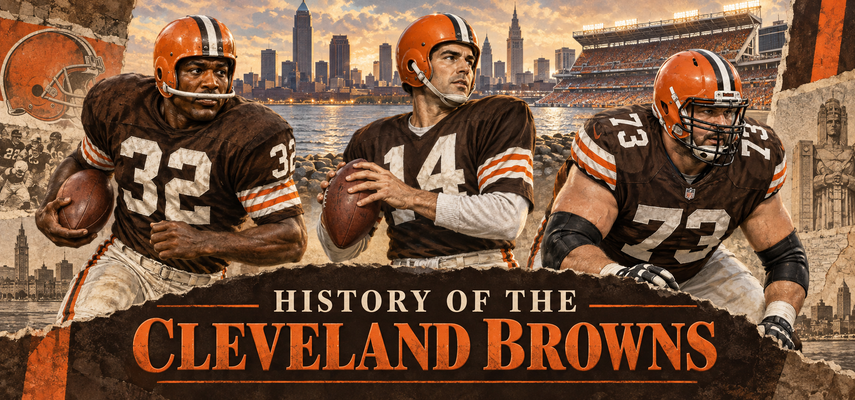

The Cleveland Browns carry a history of early dominance, enduring local attachment and an unusually complicated interruption. Paul Brown and Otto Graham established a championship standard almost immediately, while Jim Brown became one of professional football’s defining players. Later teams produced memorable contenders and painful near misses before the organization’s departure suspended play in Cleveland. The name and earlier records remained with the city, linking the returning team to its original history. This account follows that continuing Browns record through the completed 2025 season, with subsequent leadership and stadium developments separated from the unfinished competition of the 2026 campaign.
Franchise at a glance
| Field | Details |
|---|---|
| Founded | 1944; charter franchise in the All-America Football Conference |
| First season | 1946, All-America Football Conference; NFL from 1950 |
| Original city and name | Cleveland, Ohio — Cleveland Browns |
| Current city and name | Cleveland Browns; Cleveland, Ohio |
| Previous cities and names | None; franchise inactive during the 1996–1998 seasons |
| League and conference/division | NFL — American Football Conference North |
| Home venue | Huntington Bank Field, Cleveland lakefront; opened in 1999 |
| League championships | 4 pre-Super Bowl NFL titles: 1950, 1954, 1955, 1964; no Super Bowl title |
| Other recognized championships | 4 AAFC titles: 1946–1949; no AFC championship |
| Historical coverage | 2025 NFL season, including postseason completed in February 2026; later developments through October 16, 2026 |
Origins and early years
Businessman Arthur McBride obtained a Cleveland franchise in the new AAFC in 1944 and recruited Paul Brown to lead its football operation. The club began playing in 1946 after the Rams had left Cleveland for Los Angeles. Its name honored the coach whose reputation and preparation became central to its identity. The Browns were a new organization, separate from the Rams, and built their own record at Cleveland Stadium.
Brown assembled a team that combined tactical preparation with exceptional personnel. Otto Graham directed the offense, Marion Motley supplied powerful running and Lou Groza contributed as both an offensive lineman and kicker. Motley and Bill Willis also helped reintegrate professional football in the immediate postwar period. Cleveland won each of the AAFC’s four championships, then entered the NFL in 1950 when the rival league ended. The different competitions remain identifiable in the club’s history. Its NFL titles did not replace the AAFC achievements, and neither set should be described as Super Bowl victories.
Defining eras
1946–1955: Graham and Brown establish a dynasty
Cleveland immediately became the AAFC’s strongest team. Graham’s passing worked alongside a sophisticated running game and receivers such as Dante Lavelli and Mac Speedie. The 1948 Browns completed an unbeaten season, including the championship game, and the organization won the league’s final title the following year. Its dominance created an immediate question when it entered the NFL: could the same approach succeed against the established league’s best teams?
The answer came quickly. Cleveland defeated defending champion Philadelphia in its first NFL game and beat the Los Angeles Rams 30–28 for the 1950 championship. The Browns reached the NFL title game in each of their first six seasons in the league. Defeats against Detroit became part of that rivalry before Cleveland won again in 1954 and 1955. Graham retired after the latter victory, ending a remarkable ten-season sequence in which the team reached its league’s championship game every year. That record spans two competitions and depends on preserving their different identities.
1956–1965: Jim Brown and another championship
Jim Brown arrived in the 1957 draft and became the offense’s central force. His combination of speed, power and productivity changed how opponents approached Cleveland. The Browns remained regular contenders, although another title did not arrive immediately after Graham’s retirement. Art Modell purchased the team in 1961, beginning a different ownership relationship with the coach whose name the franchise carried.
Paul Brown’s tenure ended after the 1962 season, and assistant Blanton Collier succeeded him. The transition preserved substantial football continuity while changing leadership. In 1964, Cleveland defeated the heavily favored Baltimore Colts 27–0 for its fourth NFL championship. Frank Ryan’s passing, Gary Collins’s touchdown catches and a strong defense complemented Brown’s running. The team returned to the championship game the following season but lost to Green Bay. Jim Brown then retired before the 1966 campaign. His nine-season career remained entirely associated with Cleveland, while the organization faced the task of replacing its most imposing offensive player.
1966–1984: Contention and the Kardiac Kids
Leroy Kelly helped sustain the running game after Brown’s departure, and Cleveland continued reaching important postseason games. Conference-final defeats at the end of the 1968 and 1969 seasons stopped the Browns short of another NFL title or a Super Bowl appearance. The move into the AFC at the 1970 merger changed the competition around an established franchise. Division success did not automatically produce the same championship opportunities as in the earlier league structure.
The most memorable later contender developed around quarterback Brian Sipe and coach Sam Rutigliano. The 1980 Kardiac Kids won the division through a succession of close games, and Sipe earned AP NFL MVP honors. Their playoff loss to Oakland ended with the interception associated with the Red Right 88 play. The moment became a lasting part of Cleveland’s history because it interrupted a credible championship opportunity. Ozzie Newsome’s receiving and the contributions of a deeper supporting cast gave that team an identity beyond the final play, even as the defeat shaped its public memory.
1985–1995: Kosar’s near misses and the departure
Bernie Kosar’s arrival gave Cleveland another long-term quarterback and helped produce a sustained run of division contention. Marty Schottenheimer’s teams reached consecutive AFC Championship Games after the 1986 and 1987 seasons. Denver won both: the first after John Elway’s long tying drive, the second after Earnest Byner’s late fumble near the goal line. A third conference-final defeat against Denver followed after the 1989 season under Bud Carson.
The following reconstruction eventually brought Bill Belichick to Cleveland. His 1994 team reached the playoffs and defeated New England before losing to Pittsburgh. That progress was overtaken by Modell’s 1995 announcement that he would move the operation to Baltimore. Supporters and city officials contested the departure. The resulting settlement left the Browns’ identity, colors and history in Cleveland while the transferred organization became the Ravens. Cleveland’s team stopped playing for three seasons. The distinction is essential: the Ravens’ subsequent championships do not belong to the Browns, whose earlier record remained in Ohio.
1999–2017: The return proves difficult
The Browns resumed play in 1999 under new ownership and in a new lakefront stadium. The returning roster had to be assembled through an expansion process, even though the club retained its earlier history. That unusual combination created strong expectations around an institution that had lost its former personnel infrastructure. Repeated coaching and quarterback changes made sustained improvement difficult.
Butch Davis’s 2002 team reached the playoffs before losing a close game at Pittsburgh. A 10–6 record in 2007 did not earn another postseason berth, and later rebuilding projects repeatedly stalled. Offensive tackle Joe Thomas supplied exceptional individual consistency across the instability, but his career did not include a playoff appearance. The results reached a low point with a one-win 2016 season followed by an 0–16 campaign in 2017. The public attachment survived, yet the competitive gap showed how far the returning organization remained from its historical championship standard. Another personnel and coaching reconstruction followed.
2018–2025: Breakthroughs without lasting stability
Baker Mayfield’s arrival helped restore offensive credibility, and Nick Chubb became a major running-game strength. Kevin Stefanski took over in 2020 and guided Cleveland to its first playoff victory since returning. The Browns defeated Pittsburgh 48–37 before Kansas City ended the run in the divisional round. The achievement mattered independently of any promise that sustained championship contention would follow.
The subsequent acquisition of Deshaun Watson became a major organizational turning point. His 2022 NFL suspension following sexual-misconduct allegations, later injuries and uneven availability complicated the team’s quarterback direction. A strong defense and Joe Flacco’s late-season play helped produce another playoff appearance in 2023, but Houston won the wild-card game. Cleveland then fell back into losing seasons. The 2025 team finished 5–12, and Stefanski’s tenure ended afterward. The period contained meaningful postseason progress, but repeated resets and unresolved offensive continuity prevented that progress from becoming a durable competitive cycle.
Recent history
The latest completed season is 2025, when the Browns finished 5–12 and missed the playoffs. The organization relieved Kevin Stefanski of his duties after six seasons that included two playoff appearances and the returning franchise’s first postseason victory. Todd Monken was named head coach in January 2026, opening another leadership period.
The offseason also brought Myles Garrett’s trade to the Rams for Jared Verse and draft choices. As of October 16, 2026, Monken’s first season remained underway, with its final outcome undecided. The Browns continued playing at the lakefront Huntington Bank Field in Cleveland. Construction had begun on a different enclosed stadium in Brook Park, also carrying the Huntington Bank Field name and targeted for 2029. The future project had not yet replaced the current venue. The completed title record remained four AAFC championships and four pre-Super Bowl NFL championships, with no Super Bowl appearance or AFC title.
Greatest players and influential figures
Otto Graham
Graham directed the Browns to championship games in all ten of his seasons, spanning the AAFC and NFL. His passing and command made Brown’s system unusually effective against different competitions. Seven league titles across those seasons establish his team-specific contribution without treating AAFC championships as NFL or Super Bowl victories.
Marion Motley
Motley supplied powerful running, blocking and defensive versatility during the Browns’ early championship period. Alongside Bill Willis, he also helped reintegrate professional football after World War II. His importance combines exceptional play with a broader historical contribution, while later service elsewhere remains separate from his foundational Cleveland years.
Lou Groza
Groza contributed as an offensive lineman and an exceptional placekicker across different Cleveland championship teams. His decisive field goal completed the 1950 NFL title victory. The length and versatility of his service connected the original AAFC organization to later Browns contenders and made his retired No. 76 especially significant.
Jim Brown
Brown transformed Cleveland’s offense through extraordinary rushing production and an imposing combination of speed and power. His nine seasons included the 1964 NFL championship before he retired at the height of his playing ability. His entire professional football career belonged to the Browns, giving the franchise its most celebrated individual figure.
Ozzie Newsome
Newsome gave the late-1970s and 1980s Browns an exceptional receiving threat at tight end. His durability and productivity connected the Sipe and Kosar eras. His subsequent executive achievements with Baltimore are a separate contribution; Cleveland’s history recognizes the playing career completed entirely in a Browns uniform.
Joe Thomas
Thomas supplied elite offensive-line play during one of the franchise’s least stable competitive periods. His exceptional consecutive-snap streak and repeated Pro Bowl selections established a personal standard despite the team’s losing records. His Cleveland career demonstrates why an important individual legacy does not require a postseason appearance or championship.
Paul Brown
Brown created the football methods and institutional identity behind Cleveland’s earliest dominance. His teams won four AAFC and three NFL championships, with preparation, personnel evaluation and coordinated offense central to their success. His later Cincinnati work belongs to a different franchise, while the Browns retain the record built under his Cleveland leadership.
Blanton Collier
Collier succeeded Paul Brown and guided Cleveland to the 1964 NFL championship. His leadership preserved a strong football foundation while adapting the team around Jim Brown and Frank Ryan. That title remains the franchise’s most recent league championship through the completed 2025 season and the defining achievement of his tenure.
Championships and postseason milestones
Cleveland’s eight league titles comprise four AAFC championships and four NFL championships before the Super Bowl era. They remain separate competitions. The Browns have never reached the Super Bowl through the completed 2025 season. Their AFC Championship Game defeats after the 1986, 1987 and 1989 seasons are later near misses, not additional conference titles.
On smaller screens, scroll horizontally to see all columns.
| Season/year | Competition | Opponent | Result | Defining figure(s) |
|---|---|---|---|---|
| 1946 | AAFC Championship | New York Yankees | Won 14–9 | Otto Graham; Marion Motley; Paul Brown |
| 1947 | AAFC Championship | New York Yankees | Won 14–3 | Otto Graham; Lou Groza; Paul Brown |
| 1948 | AAFC Championship | Buffalo Bills | Won 49–7 | Otto Graham; Marion Motley; Paul Brown |
| 1949 | AAFC Championship | San Francisco 49ers | Won 21–7 | Otto Graham; Dante Lavelli; Paul Brown |
| 1950 | NFL Championship | Los Angeles Rams | Won 30–28 | Otto Graham; Lou Groza; Paul Brown |
| 1954 | NFL Championship | Detroit Lions | Won 56–10 | Otto Graham; Dante Lavelli; Paul Brown |
| 1955 | NFL Championship | Los Angeles Rams | Won 38–14 | Otto Graham; Lou Groza; Paul Brown |
| 1964 | NFL Championship | Baltimore Colts | Won 27–0 | Jim Brown; Frank Ryan; Blanton Collier |
Rivalries, venues and team identity
Rivalries
Pittsburgh supplies the most enduring regional rivalry, with division competition and postseason meetings connecting different Browns eras. Cincinnati adds an Ohio relationship shaped by Paul Brown’s role in founding both organizations. Baltimore carries the unusual emotional and institutional consequences of the 1995 departure, even though the recognized franchise records are separate.
Home venues and traditions
Cleveland Stadium housed the original teams through 1995. The current lakefront stadium opened for the 1999 return and later became Huntington Bank Field. The Dawg Pound, orange helmets and brown-and-orange colors provide continuity across the interruption. The Brook Park project remained a future venue at the cutoff, so the city’s existing lakefront football setting still belonged to the present rather than only to memory.
Retired numbers and team honors
The Browns formally retired numbers including Graham’s 14, Jim Brown’s 32 and Groza’s 76. Their Ring of Honor recognizes a wider group of significant contributors, while the Pro Football Hall of Fame supplies a separate form of recognition. Those systems should remain distinct from the club’s championship record and from honors a former player later earned as an executive or coach elsewhere.
Legacy
Cleveland’s significance rests on both championship innovation and the persistence of a community’s attachment through institutional disruption. The early Browns established an extraordinary competitive standard, while later contenders and the returning team created a more uneven record. Preserving the earlier history in Cleveland made that continuity explicit without pretending the interruption had no consequences. The franchise’s greatest players connect those different conditions. Its full account includes separate AAFC and NFL titles, painful near misses and repeated rebuilding efforts, all belonging to a Browns identity that remained rooted in Cleveland.
Where to eat in Cleveland
Planning a visit? Explore our best restaurants in Cleveland guide.












