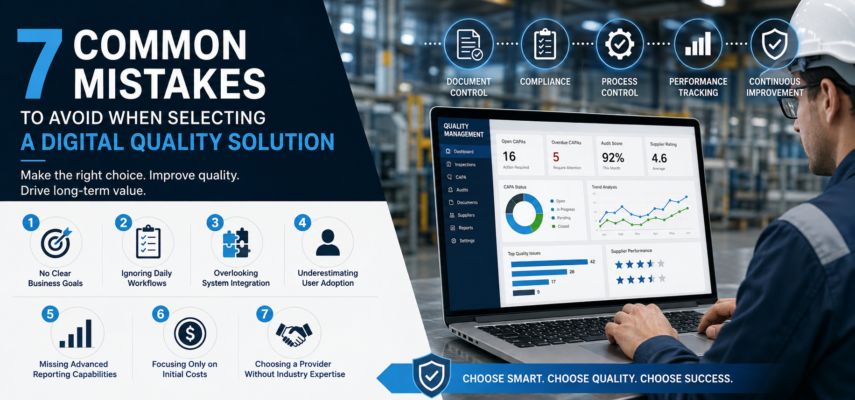
Quality teams rely on accurate records, controlled processes, and timely information to maintain product standards. A digital quality solution that lacks essential capabilities can create extra work, delay corrective actions, and make compliance more difficult. Careful planning before software selection helps manufacturers avoid expensive changes later.
Businesses evaluating Quality management software should look beyond product demonstrations and focus on daily operational needs. This article explains seven common mistakes that can affect long-term success and highlights practical ways to avoid them.
1. Selecting a Solution Without Clear Business Goals
Software selection should begin with clearly defined business objectives. Purchasing a system before identifying quality challenges can lead to unnecessary features or missing capabilities. A clear roadmap helps decision-makers compare solutions against real operational priorities.
How to avoid this mistake
- Define quality objectives before product evaluations.
- Identify existing process gaps.
- List compliance and reporting requirements.
- Include quality and operations teams in discussions.
- Prioritise business needs before software features.
Why this matters
- Creates a focused evaluation process.
- Helps match software capabilities to business goals.
- Prevents unnecessary software investments.
2. Ignoring Daily Quality Workflows
Quality teams complete inspections, audits, document reviews, corrective actions, and supplier evaluations every day. Software should simplify these activities instead of introducing additional steps. Practical workflow support has a direct impact on productivity.
How to evaluate workflows
- Review inspection processes.
- Test document approval workflows.
- Examine CAPA management.
- Assess supplier quality functions.
- Verify workflow flexibility.
Why workflow support matters
- Reduces manual effort.
- Improves process consistency.
- Supports faster quality responses.
3. Overlooking System Integration
Quality information rarely exists in one application. Production, purchasing, supplier management, and inventory systems all contribute valuable data. A connected solution creates smoother information flow across departments.
How to assess integration
- Confirm ERP compatibility.
- Review available APIs.
- Examine automated data exchange.
- Test information synchronisation.
- Evaluate integration support.
Why integration is important
- Eliminates duplicate data entry.
- Improves data accuracy.
- Creates better collaboration between departments.
4. Underestimating User Adoption
A feature-rich platform provides little value if employees struggle to use it. Simple navigation, organised dashboards, and logical workflows encourage consistent use across the organisation.
How to improve adoption
- Request hands-on demonstrations.
- Include future users during evaluations.
- Compare dashboard layouts.
- Review mobile accessibility.
- Assess available training resources.
Why user adoption affects success
- Encourages consistent system use.
- Reduces training time.
- Improves operational efficiency.
5. Missing Advanced Reporting Capabilities
Quality improvement depends on meaningful data rather than assumptions. Reports and dashboards should help managers identify trends, monitor corrective actions, and evaluate supplier performance with minimal effort.
How to review reporting tools
- Examine dashboard flexibility.
- Review KPI tracking options.
- Compare report customisation.
- Test real-time reporting.
- Evaluate export capabilities.
Why reporting deserves attention
- Supports informed decision-making.
- Identifies recurring quality issues.
- Measures operational performance clearly.
6. Focusing Only on Initial Software Costs
The lowest purchase price does not always produce the greatest value. Implementation support, updates, scalability, and long-term maintenance have a greater influence on overall return.
Businesses comparing quality management solutions should evaluate total ownership costs instead of software licensing alone.
How to compare long-term value
- Calculate implementation expenses.
- Review upgrade policies.
- Compare technical support options.
- Assess future scalability.
- Evaluate training availability.
Why long-term value matters
- Protects technology investments.
- Supports future business growth.
- Reduces unexpected operational costs.
7. Choosing a Provider Without Industry Expertise
Technology works best when supported by industry knowledge. Providers with manufacturing and quality management experience understand regulatory requirements, implementation challenges, and operational best practices. Companies such as Quality-One combine digital quality solutions with consulting, training, and implementation support, providing an example of how software expertise and quality knowledge can work together.
How to evaluate provider expertise
- Review industry experience.
- Request implementation examples.
- Compare customer support services.
- Examine available training programmes.
- Assess long-term partnership capabilities.
Why provider expertise matters
- Simplifies implementation.
- Improves software adoption.
- Supports continuous quality improvement.
Selecting a digital quality solution requires more than comparing software features. Clear business goals, practical workflows, system integration, and reliable reporting all contribute to successful quality management. The right Quality management software can also support compliance and improve process control. A thoughtful evaluation helps manufacturers choose a solution that delivers sustainable value over time.